
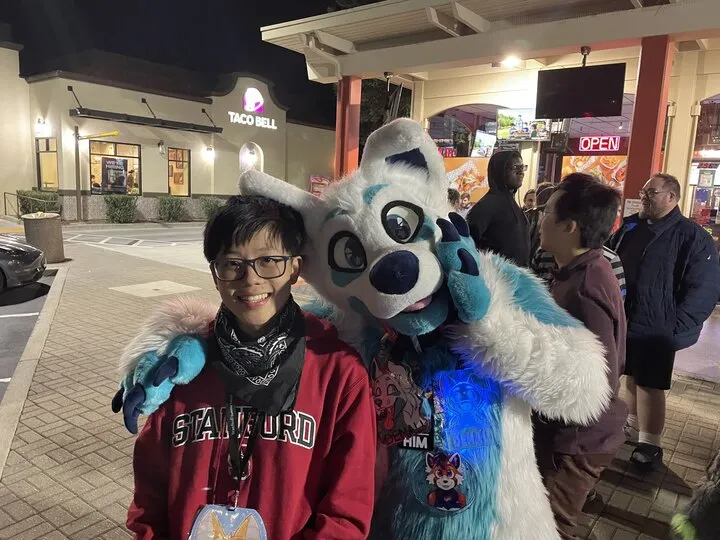
Lucas Wang ’27 has always liked drawing animals, especially ones that he calls character “personas.” In middle school, he created Oliver, a bubbly and carefree otter, Adrian, a nerdy engineer bird and Skylar, a mechanical bat. Now, Wang feels like he’s “morphed” most into Skylar, he told The Daily.
For members of the Furries at Stanford club and the larger furry community, Wang is only known as Skylar. “People eventually started calling me Skylar, and then it just kind of became me,” Wang said.
The founder and president of Furries at Stanford, Wang wears many hats on campus. Currently, Wang is a section leader for CS 106B and course instructor for CS 11. He is also planning a student-initiated course on game development for next fall. For Wang, however, the furry community and his interest in computer science go hand in hand.
While furries are sometimes stigmatized or ridiculed online, Wang hopes to share that they are “just people,” too.
“The furry fandom is a fandom, similar to the anime fandom, K-Pop fandom or sports fandom,” Wang said. “We’re just a group of people that like a specific thing, and that thing is anthropomorphic animals.”
Wang first connected with furries in middle school when his friend introduced him to an online platform for fandom communities and its art commissions. This was where Wang started creating characters of anthropomorphic animals like Oliver, Adrian and Skylar, also called “fursonas” – a portmanteau of “furry” and “persona” – which are “more integrated with one’s identity and personality,” according to Wang.
In high school, he reconnected with the community by working more closely with members of the community on developing games like top-down shooter games, roguelike games, card-based games and puzzles. Compared to the more theoretical nature of computer science courses, Wang said, “With game development, you can actually bring a life to coding and see the product you make.”
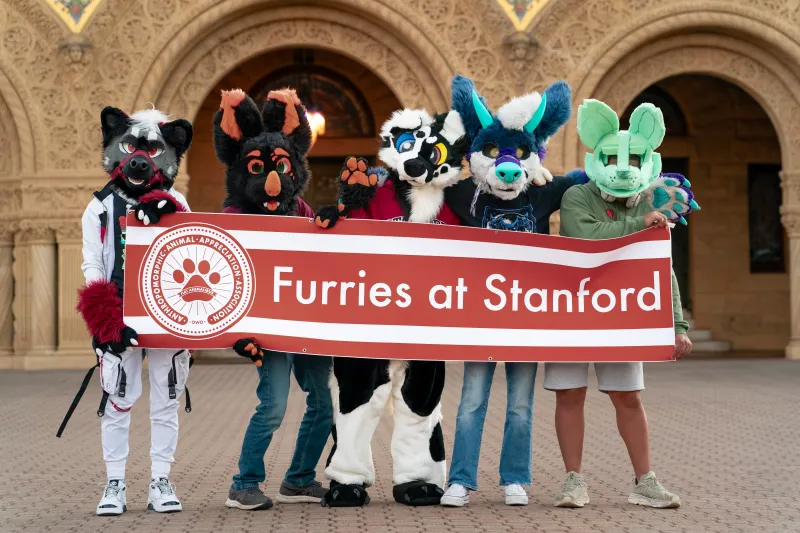
Shortly after coming to the Farm, Wang founded Furries at Stanford in the spring quarter of his first year, inspired by the Furries at Berkeley club. Furries at Stanford now hosts over 80 members from the Bay Area on its Discord server and has 15 regular Stanford members, according to Wang.
“Everyone had roughly the same childhood,” Sophia Zhang ’27, who identifies with the fursona of a Border Collie named Fia, wrote to The Daily. According to Zhang, an “obsession” with the Warrior Cats, Pokémon, Zootopia, My Little Pony, Five Nights at Freddy’s and other series often led people to become furries.
For Lucien Lasseau ’25, who goes by the fursona of a dragon named Hera, the furry fandom stands out from other subcultures for its acceptance of queerness, neurodivergence and “plain being different,” Lasseau wrote to The Daily.
“I knew that I would feel much more at home surrounded by furries than anywhere else on campus, and I was entirely correct,” Lasseau wrote.
New members like Noe Chicas-Aranda ’28, also known as the fennec fox Snicker, have experienced a similar sense of community. “It feels more like a friend group rather than just a club,” Chicas-Aranda wrote to The Daily. “What I love most is the sense of belonging and acceptance — it’s a space where you can truly be yourself without any reservations.”
Since its founding, the club has held events in each quarter, including educational events to learn about the furry fandom and dispel stereotypes, as well as social events, Wang said.

While some events are furry-themed – watching “Zootopia,” for example – others are not. Chicas-Aranda’s favorite was the club’s bonfire event, where he invited friends from outside the community to participate. Seeing people come together to “celebrate each other for who we are” was “a perfect reflection of the kindness and inclusivity the furry community fosters,” Chicas-Aranda wrote.
The club also hosts workshops to make “fursuits” — custom-made animal-based costumes worn by members of the furry community — led by Zhang, where members work with textiles and sewing. Zhang also leads a one-unit fursuit-making class under ITALIC 99SI. “Seeing almost 15 people go from nothing to complete foam fursuit head bases throughout one quarter was so fulfilling!” Zhang wrote.
Furries at Stanford has also hosted speakers. The club invited former Stanford pediatrics professor David Benaron, also known by his fursona, a cheetah named Spottacus, for a Feb. 27 masterclass titled “Furries, Neurodivergence, and STEM: Finding Your Path from Zero to One to One Billion.”
In a 2022 profile, Benaron championed the furry community, telling PC Magazine, “We produce music, science, and art and we freely share our ideas and experiences online. I truly feel I am part of the local as well as international furry community, and how many people can say that these days?”
Benaron’s research at Stanford contributed to novel imaging techniques and laid the groundwork for developing heart rate sensors in smartwatches, according to PC Magazine.
“It’s kind of funny sometimes how people use dismiss[ive] phrases [around furries] because they are just normal people, too. There’s a lot of inventions that come out of the community, and these speaker talks are meant to show that,” Wang said.
Members of the club appreciate Wang’s leadership, with Lasseau writing that “[Wang] uses his leadership skills gained from his teaching work to coax us into something resembling a functioning executive team,” Lasseau wrote.
Going forward, Wang sees himself exploring opportunities to teach game development at Stanford, then pursuing software engineering as a career.
In the professional world, however, “I think it’s a bit unfortunate to have so much stigma around furries because I feel like it’s not a very employable feature,” Wang said. “It’s like ‘these people are either going to underperform’ or they’re not a normal type of people.”
Given such stigma, Wang said he doesn’t think he’s “going to be emphasizing the furry aspect of myself” in career settings.
Instead, Wang expects the furry community will remain a hobby. “I think it’s just gonna be a part of me that I have fun with,” especially in meeting new people, he said.
Nevertheless, Wang’s experience with furries has still shaped aspects of his professional life. When Wang first started with computer science, he saw it as a path to making money. After becoming a furry, he’s become more open to experimenting with design, which he recently declared as a major.
“I think being a furry kind of opens you up to being more carefree, bringing more fun into your work,” Wang said. “I can be silly and I can wear this costume around and not care about what people think.”
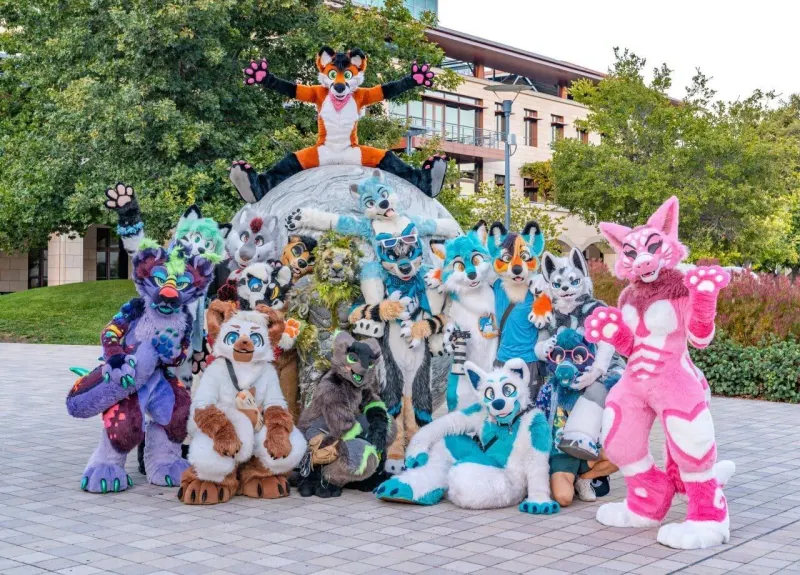
Wang’s open presence has also shaped younger members of the furry community. When Chicas-Aranda first met Wang during Admit Weekend, “he surprised me by waiting outside the dorm I stayed in — fully suited in his fursuit,” Chicas-Aranda wrote.
“At first, I thought it was a little ridiculous, and I’ll admit, I felt shy and unsure about being around him. He was so unapologetically open and bold, which felt overwhelming at the time. But as I started talking to him and learning about his interests, I began to see things differently,” Chicas-Aranda wrote. “Now, I see him as someone who fully embraces who he is and inspires others to do the same.”