
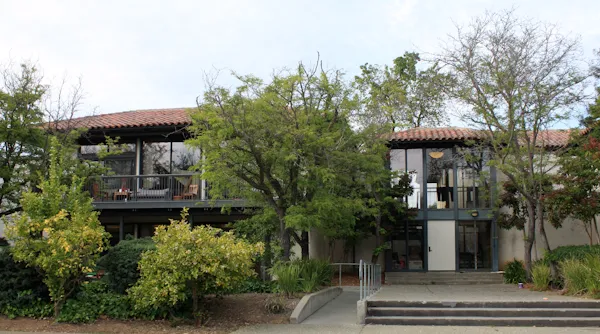
The University will suspend two co-ops, Enchanted Broccoli Forrest (EBF) and Kairos, for the 2025-26 academic year, according to a University statement sent to The Daily on Monday.
Following student complaints to Stanford’s Title VI Office, the University determined that both houses violated Title VI, the federal law that prohibits harassment and discrimination based on race, color or national origin in educational institutions.
EBF and Kairos will be under University management and oversight during the suspension period, which will last at least a year. The University will also remove the names of both residences during their suspensions and refer to the houses by their addresses instead; EBF will be referred to as 1115 Campus Drive and Kairos as 586 Mayfield Ave.
Students who were expecting to serve as resident assistants (RAs) in either house will be replaced by RAs chosen by Residential Education (ResEd), which will also select a resident director for each house. Resident directors will manage and oversee the houses but will not live there. Students who were planning to live in both houses have the option to remain there or re-enter the housing portal.
Incoming RAs for EBF and Kairos declined to comment.
Stanford’s co-ops have offered a vibrant range of living environments for over forty years, allowing students to live together in intentional communities and partake in shared living responsibilities and communal cooking in lieu of dining hall meal plans. Co-op residents save a substantial amount each quarter by foregoing the meal plan.
Co-ops on campus aim to foster empowering communities, and many of these houses have served as hotbeds for political action. EBF dedicates itself to empowering Black, Indigenous and people of Color (BIPOC), gender-marginalized, queer and first-generation and/or low-income (FLI) student voices. Kairos fosters BIPOC solidarity as well as arts appreciation.
The suspension of EBF and Kairos arrive after the University’s Title VI investigations found substantiated claims of discrimination last spring.
According to the University statement, several reports were filed with the Title VI Office against Kairos after “students participating in an extracurricular activity in the house were asked to leave and told, among other things, that the presence of ‘Zionists’ in the group was making residents of the house uncomfortable.”
The Title VI Office said that none of the students in the group shared their political beliefs and that the extracurricular activity had nothing to do with the Middle East.
“The investigation determined that students were targeted based on their perceived Jewish identity,” the University wrote.
In a statement to The Daily, Rabbi Jessica Kirschner, executive director of Hillel at Stanford, wrote, “While it is distressing that any students would act in discriminatory ways towards each other, we are reassured that the university has acted swiftly and decisively to protect Jewish students.”
With regards to EBF, the Title VI Office said an email sent by EBF’s RAs in June to incoming residents was deemed exclusionary toward white students and male students.
Part of the email read: “Enchanted Broccoli Forest is historically dedicated to uplifting the voices of queer people of color, and thus is committed to being a place of refuge for those who are black, brown, gender-marginalized, and FLI. If you are white / white-passing, or if you are a man, do understand that you are being invited into space that wasn’t and isn’t made for you. We welcome you to this community, however ask that you acknowledge and are cognizant of the space you are occupying, and how, by nature, your presence may suffocate.”
Vice Provost for Institutional Equity, Access and Community Patrick Dunkley and Vice Provost for Student Affairs Michele Rasmussen wrote in an email to incoming EBF residents that this behavior “is discrimination under federal law” and that it violates the University’s nondiscrimination policy.
The University added in their email to incoming EBF residents that despite positive intent in supporting students from historically marginalized groups, “all houses at Stanford must be, and are, open to and welcoming of all students without regard to the color of their skin.”
The message from the EBF RAs also included a statement regarding the anticipated use of substances in shared spaces, which Dunkley said “could be interpreted to encourage activities that violate University policy.”
Following one year of suspension, EBF and Kairos will need to undergo the University’s established process for reinstating house status as part of its regular housing review process.
“The process requires compelling evidence of the capacity to self-govern the residence in ways that comply with university policies and applicable laws,” Dunkley and Rasmussen wrote in their email to incoming EBF residents.
The decision to suspend both co-ops comes on the heels of the University’s move to sunset Terra and Synergy, two co-ops that then became “hybrid co-ops” after failing to attract enough pre-assignees.
Now, only three full-fledged co-ops — Hammarskjöld, Columbae and 576 Alvarado — remain.
“The University is committed to having a robust co-op community, and at the same time all campus activities and facilities are expected to be open and welcoming to all members of the community,” Dunkley told The Daily.
This article has been updated to include comment from Rabbi Jessica Kirschner.