
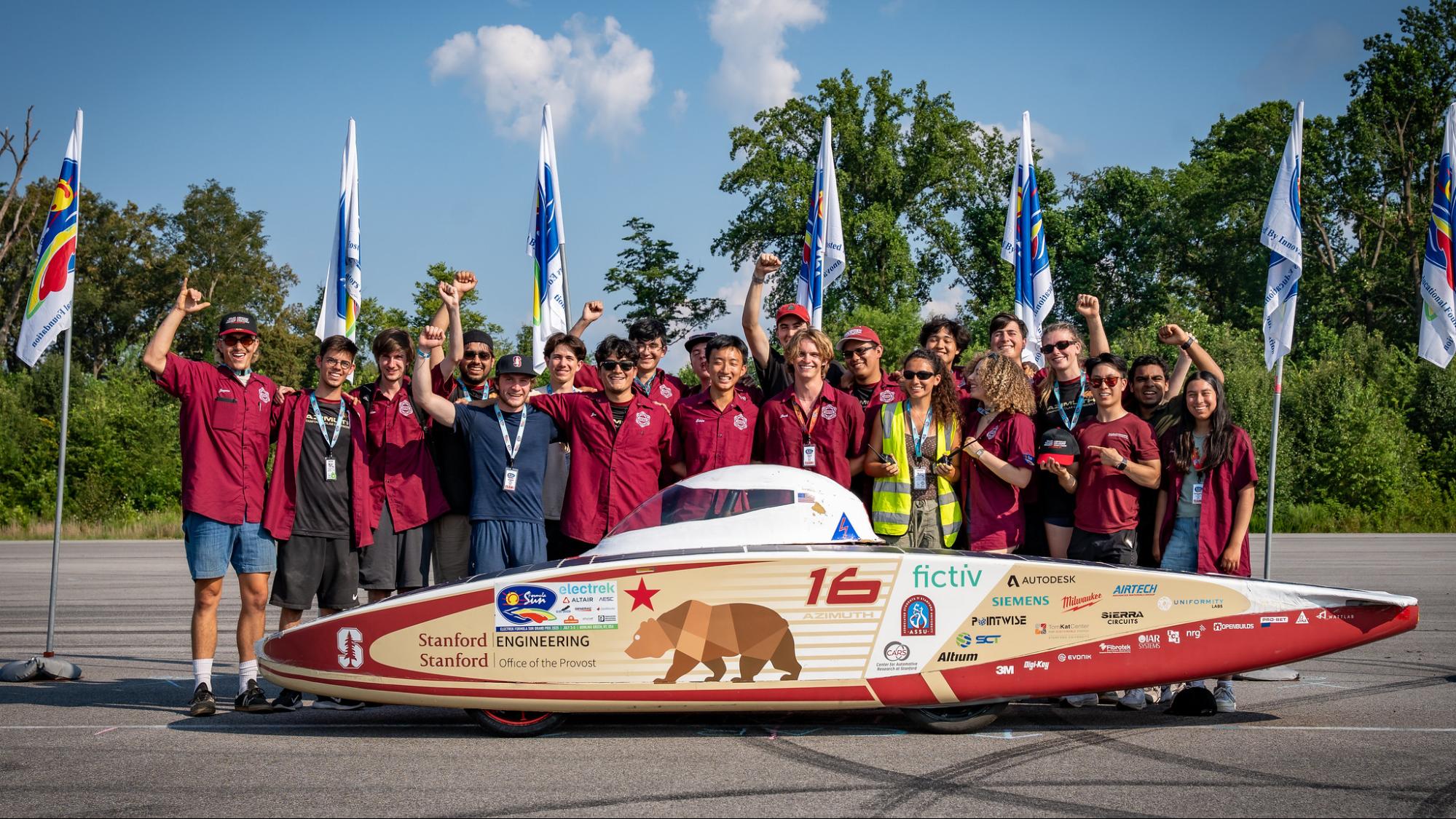
It’s the Fourth of July weekend, and solar-powered cars line up at the National Corvette Museum Motorsports Park in Bowling Green, Kentucky. Teams from universities across the country have gathered for the Formula Sun Grand Prix, a three-day track race for solar-powered cars. After passing scrutineering, a three-day period of safety and specifications checks on their cars, the teams participate in the race from July 3 to 5.
As the race day arrives, the stakes are high. The teams are about to race cars that they have invested deep time and effort into over the past year or more. Students race their cars from sunrise to sunset, and sometimes work late into the night making repairs and fixing maintenance issues with their cars.
In this high-energy setting, the Stanford Solar Car Project (SSCP), a student-run organization working to develop environmentally sustainable solar cars, placed second in the Single Occupant Vehicle Class with their car, Azimuth. The results were determined based on the number of laps each car drove throughout the three day tournament. SSCP’s car drove 212 laps, or 667.8 miles.
“What’s really exciting about the Formula Sun Grand Prix is that it’s a once a year event where university teams from across the country are able to test the limits of the car they’ve been working on all year,” said SSCP array and strategy lead Sofie Roux ’26.
To compete this year, the SSCP team made changes to various parts of Azimuth, from its suspension system to its motor. In 2024, the team took the car to the Formula Sun Grand Prix, but as a result of new car standards the race implemented, they were unable to pass scrutineering in time to be competitive.
Beyond their efforts to pass scrutineering, SSCP also worked to rebuild after the COVID-19 pandemic posed a challenge to the organization’s leadership.
“During COVID, a lot of our members graduated, leading to a huge gap in institutional knowledge,” said Ben Gao ’24 M.S. ’26. “Our faculty members had also left and being such a technical club, with a lot of engineering involved, we needed an advisor to keep us safe and on track.”
However, Gao said that SSCP is a historic club with a strong network of alumni who supported the team as they designed Azimuth, allowing them to navigate the hardship the pandemic posed.
As the results of the team’s work that earned them second place, Gao was inspired by the impact the race had on the team’s newer members.
“It was so touching to see the new students laughing and having fun and getting hands on, knowing those experiences are going to have a huge impact on their Stanford career and beyond,” Gao said.
Gaining firsthand engineering experience in a welcoming space is a significant part of SSCP’s mission.
“One of the biggest misconceptions people have about the team is that you need to have had previous high school robotics or engineering experience,” said safety officer Alec Klaudt ’28. “I basically knew nothing about engineering coming into the team, but it’s just a really welcoming environment.”
Roux added: “I think what we’ve shown is that we’re still able to have awesome outcomes as an engineering club while doing so responsibly and thoughtfully and taking care of and including all of our members.”
Moving forward, the team plans to continue expanding their mentorship of new members by using Azimuth to hone their strategies for racing while working to develop their next car.
“While Azimuth works, it’s probably the most reliable on the track, and it doesn’t have many miles on it,” said chief safety officer and mechanical co-lead Joseph Garcia ’25 M.S. ‘26. “It’s a great opportunity to bring up younger students and show them how to work on a car.”
On top of fostering a welcoming environment, the SSCP team aimed to keep its members as safe as possible as they designed and raced the car. Roux noted that during her first year in the club, before they could even see the car, the members met in a dorm common room to learn about how to handle the car safely.
“We went from not interacting with the car to being able to go to a race and come in second, which speaks to a a whole cohort of this generation of engineers who are doing a lot of really badass stuff like racing a car off of sunlight, but also doing so safely and with a good team culture and a sense of responsibility and care,” Roux said.