
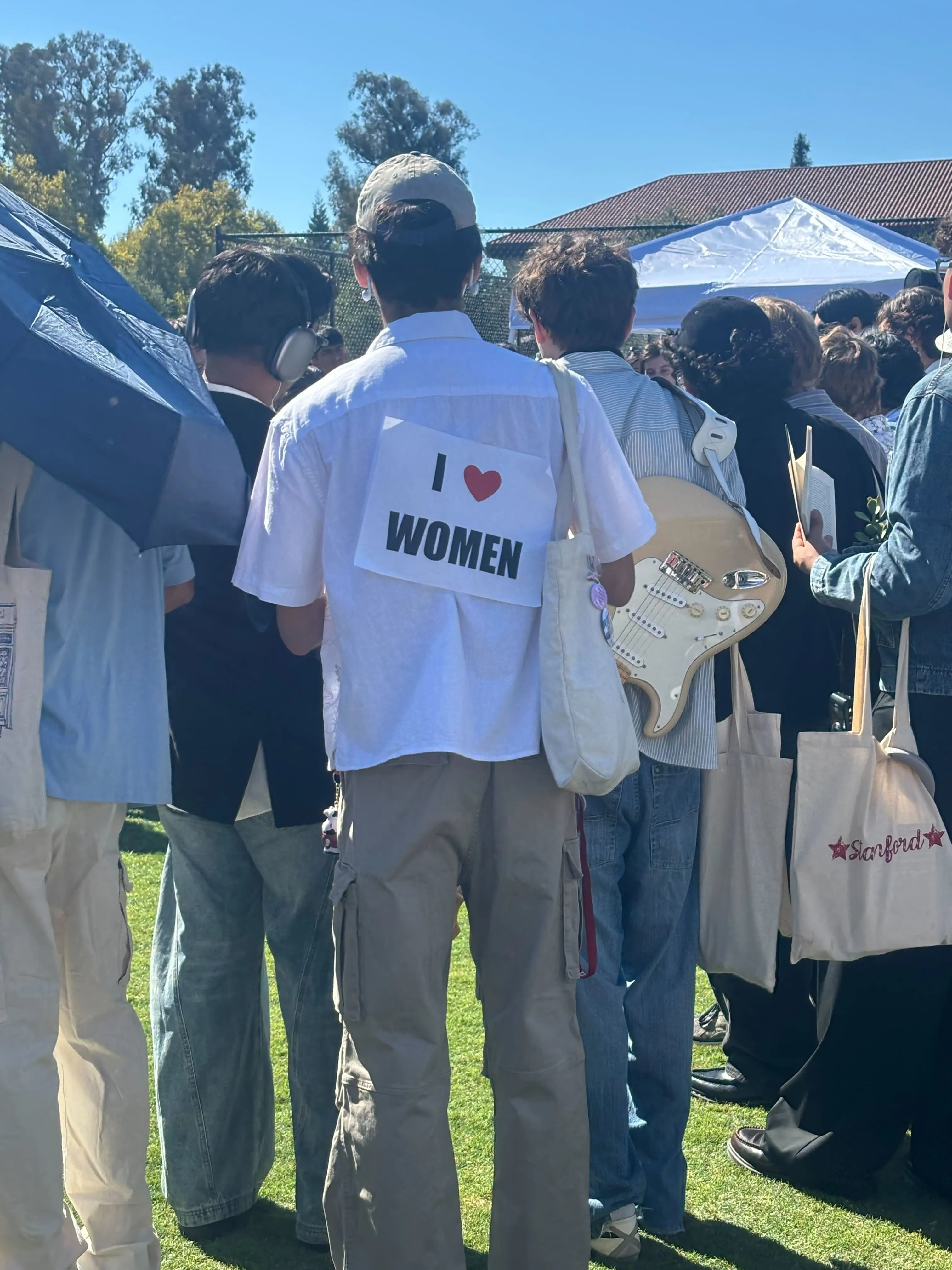
On Sunday afternoon, Stanford Recreation and Wellness shared Roble Field with students armed with matcha, tote bags and Clairo vinyls for a “performative male contest.”
A performative male is a term coined and popularized this summer to describe men who pretend to have traditionally feminine interests, such as matcha-drinking and listening to female indie artistes, in order to impress women. Performative male contests have popped up on college campuses across the country.
Sean Kuwamoto ’29 sported a tote bag from Lady Margaret Hall, one of the first female colleges at the University of Oxford. “I’ve got some matcha mochi here in my pocket, as well as a speaker that was playing Clairo earlier,” he said.
The contest was planned by the founding members of a new calorie tracking application, AYŌN. Neetish Sharma ‘26, the application’s CEO, utilized the contest as an opportunity to promote the diet tool. With free matcha as an enticing means, QR codes for AYŌN littered the field.
The competition spanned two hours, bustling with feminist monologues and guitar riffs of “Riptide” by Vance Joy. In the competition’s final hour, new trending Labubu dolls and eco-friendly tampons filled the pockets of eager participants, all fighting for the coveted title of the ultimate “performative male.”
Among the finalists were collective chants denouncing period cramps, quotations from the discography of popular singer Beabadoobee and one showcase of a slideshow titled “Celebrating Female Strength and Excellence.”
The winning performative male, determined by the loudest audience applause, was declared to be Neel Ahuja ’29.
“My advice to [performative males] is just to keep being performative. Keep supporting to 100%, and the eventual goal is to make the ‘performative male’ the attitude of men overall,” Ahuja said.
While the performative male concept was initiated as a critique of faux-allyship in the digital age, some participants viewed the contest as an opportunity to kickstart conversations surrounding feminism and its contemporary significance.
“I’m out here to support women and women’s rights. I’m a huge ally in the queer community, so I just want to come out and show my support,” Matthew Torre ’26 said, with a matcha and piece of feminist literature in hand.
Paul Fertig ’29, in a manufactured British accent, shared a similar sentiment.
“I think it is important for men like myself to stand up for women,” Fertig said. “In many ways, we have created barriers to women’s success in the workforce and education, and the current administration also is using its platform to continue that oppression, as opposed to alleviating it.”