
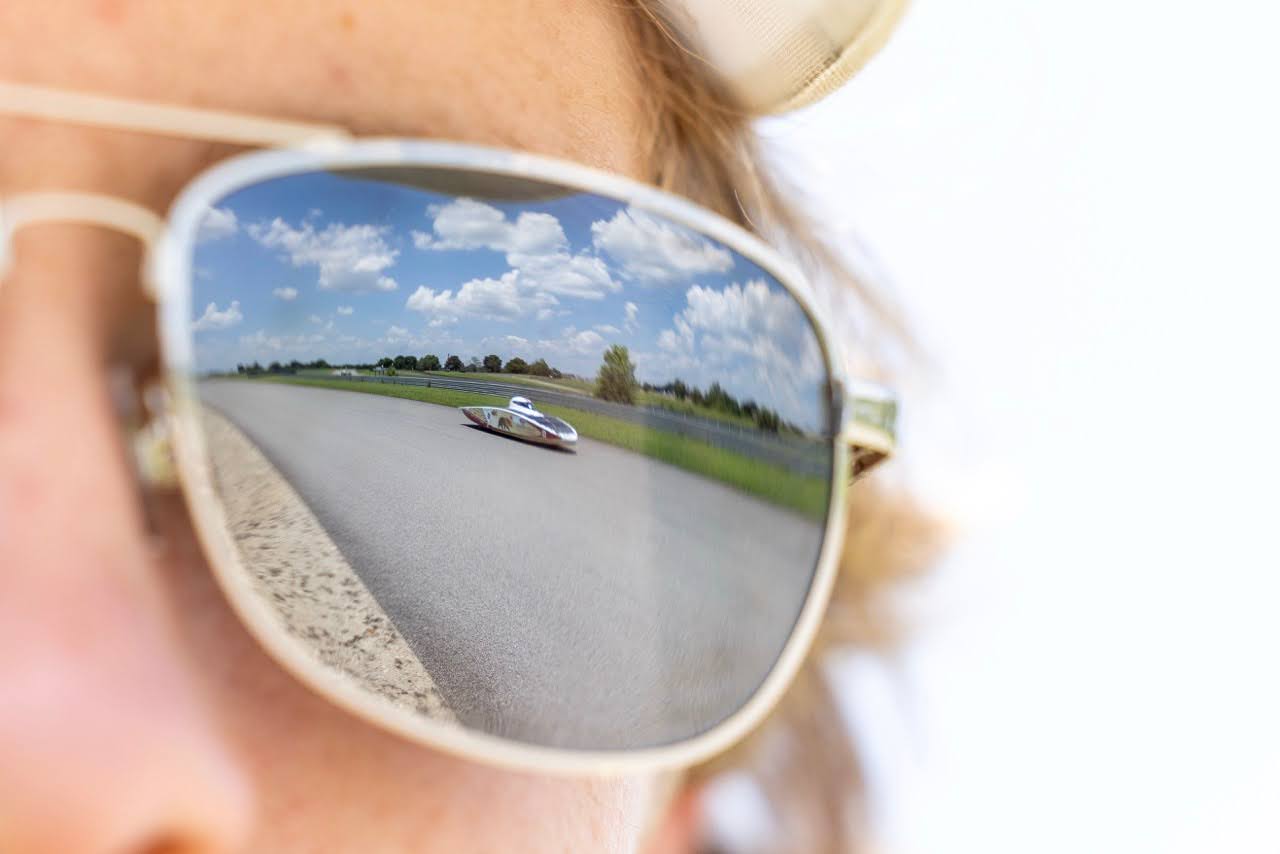
I just met Jacob. He wears a lot of hats — a dozen to be exact. He’s known to balance all sorts of things on his head — bean bags, hats and whatever else his friends challenge him to do on a Friday night. But today, there’s something else on his mind, and we’ve been waiting all day.
“I think I see it,” he suddenly says.
I drop my phone and spring up from my shaded spot, immediately hit by the unrelenting Kentucky summer heat. Climbing onto the sun-baked concrete barrier for a better angle, I scan the horizon but see only the same empty track shimmering in the heat haze.
“Where?”
“Right there.”
I squint harder. Nothing.
“Wait, where?”
“There,” he insists.
“Bro — where…” I say, as I turn to face him, and that’s when I catch it — an unmistakable reflection in his sunglasses, shooting across the track right behind me. I spin back around, but all that greets me is a sudden whoosh of air washing over us. The car is already gone, swallowed by the heat waves, another lap completed before I even knew it was there.
~~~~~
This summer, instead of joining the familiar yearly bustle of internships or research, I found myself on a sun-baked track in Bowling Green, Kentucky for the 2025 Formula Sun Grand Prix, the biggest American solar car race this year. It was there I met great friends like Jacob from App State, and where I watched (and occasionally missed) solar cars glide across the asphalt, including the one I helped build: Azimuth, Stanford’s newest solar car.
Just weeks earlier, I graduated from Stanford. I even dressed up as Azimuth with my friends for Wacky Walk — a tribute to the people and memories that defined my college years. Now I’m working full time and my college days are officially behind me. But that also means solar cars are behind me, and honestly, the two feel inseparable. I joined my first day of freshman year and never left — five whole years building Azimuth. With this chapter of my life closing, I want to take one last look in the rearview mirror at the thing that made my college experience whole.
~~~~~
Five years ago, lost in a pandemic-induced YouTube rabbit hole, I stumbled across a video that would shape my college experience: a Stanford Solar Car documentary. As an unapologetic humanities nerd whose ideal afternoon meant pouring over books at the library, there was something so utterly surreal and otherworldly about a bunch of college kids racing a homemade solar car across Australia in the World Solar Challenge, the top solar car race in the world. It was as if someone had decided to fill in a MadLibs with the most random words and arrived at “college kids race homemade solar cars across 2,000 miles of inhospitable Australian outback.” Yet, something about this mad solar car absurdity instantly mesmerized me.
A few weeks later, when freshman year finally came around, I eagerly joined the team — yes, with absolutely no relevant engineering or STEM experience, but overflowing with trademark freshman enthusiasm. For someone who spent freshman year mostly confined to a screen during the pandemic, solar car was especially meaningful as it represented my first real chance at a college experience. Beyond working on the car, I remember that time by the mounds of spam musubis eaten at L&L, the spontaneous weekend beach trips with the team and the steady rhythm of music, laughter and power tools echoing through the garage as we worked. In a year that would have otherwise felt completely disconnected, solar car provided a genuine and anchoring sense of community.
Toward the end of that summer, we’d gone from designs on a computer screen to a real car we could actually move, packed on a couple extra pounds from all the spam musubis we ate and shared the quiet awe of watching something we’d built with our hands actually work. But one afternoon, our then leadership sat the team down and pulled back the curtain. Behind the scenes, things were getting tough, and about to get much tougher. Most of the team was graduating, and organizational changes within the University would leave our team’s future in limbo.
Leaving that meeting, I felt a nagging sense of unease. Those of us remaining were fairly new to the team, and nobody seemed willing or capable of leading us through the turmoil ahead. When elections came around a few weeks later, there were still no candidates.
Then one night, I got a surprise call from our closest faculty supporters, suggesting I run for team lead. I was stunned. Me? I’d just spent my freshman year hopelessly confused, still unsure which direction tightened screws and genuinely thought “sanding” meant throwing literal handfuls of sand at something. How could I possibly lead the engineering wizards I so looked up to? But with solar car having shaped my year so deeply, I felt a responsibility to try and preserve that experience for others. And so despite having no idea what I was doing, I ran — not because I had answers, but because I knew how much this team could mean to someone else.
The next two and a half years nearly broke us. Immobilized by bureaucratic red tape, the team lay near completely dormant that entire time. Members graduated. Excited newcomers left. University advocates retired. There were entire quarters where we couldn’t even see our lab, let alone work on the car that hadn’t seen any meaningful progress since my freshman summer.
Fighting to keep the club alive was probably the hardest thing I’ve ever done. Occasionally, I still think back to those late nights in the lifeless Wilbur laundry room, my head spinning with vertigo like the washers and dryers around me, desperately trying to figure out how to save our club. Or those empty afternoon moments spent staring blankly at my laptop screen after another failed Zoom call with admin who weren’t just unwilling to help but actively trying to shut us down. In those moments, it was the memory of how much joy solar car brought me as a frosh that made the distant hope of revival feel worth fighting for: the belief that future students deserved to experience those same defining memories.
A couple of years and a few lucky breaks later, we’re rolling again. This summer, at the Formula Sun Grand Prix, seeing a whole new generation of solar car members laughing and cheering each other on was so incredibly touching. They were forming the very memories that had once meant the world to me, but with their own modern twist: feasting on mounds of Buc-ee’s brisket sandwiches, arguing about who was best at Clash Royale and of course, experiencing the thrill of seeing months of work finally come together on the track — the unique bonds that form when you’re part of something truly bigger than yourself. These were memories they’ll carry for years to come, just as I had. That made everything worth it.
~~~~~
A home. A family. A sense of purpose.
To find even one in college is rare, but to find all three in one place is genuinely extraordinary. For me, that place was solar car, especially during my freshman year when the pandemic had locked away so much of what makes college so meaningful. Starting that year, solar car became the anchoring force that made my college experience whole.
Solar car isn’t the only community that can provide this, and my hope is that everyone can find something like this — a place, a people, a purpose — to call their own. In a beautiful speech at Baccalaureate, this year’s student speaker reflected on how Stanford’s omnipresent motto, “A place for you here,” has resonated so deeply because of all the different spaces the University has to offer.
With the uncertainty that universities across the country are facing today, my hope is that institutions like Stanford prioritize preserving these communities. Whether it’s our wonderful a cappella groups, beloved themed houses, pioneering research labs, or any other of the countless other cherished spaces where students find their people and community — these aren’t just random groups on CardinalEngage or placeholders on a University website. They’re the places where students discover who they are and who they want to be. The effort I put into keeping Stanford Solar Car alive is now mirrored by countless community heroes across campus, each fighting not just for their own spaces, but for the continued legacy of impact these communities will have on students for years to come. The impact is real and tangible — every student who finds their home is because someone before them fought to preserve it.
Somewhere out there, another lost freshman might stumble across a video that changes everything — maybe it’s solar car, maybe it’s something completely different. But whatever it is, I hope Stanford remains the kind of place where that moment of discovery can bloom into four years of purpose, community, and growth. Because that’s the real magic of “a place for you here” — it’s not just about having space, but about having the freedom and opportunity to explore who you’re meant to be.