
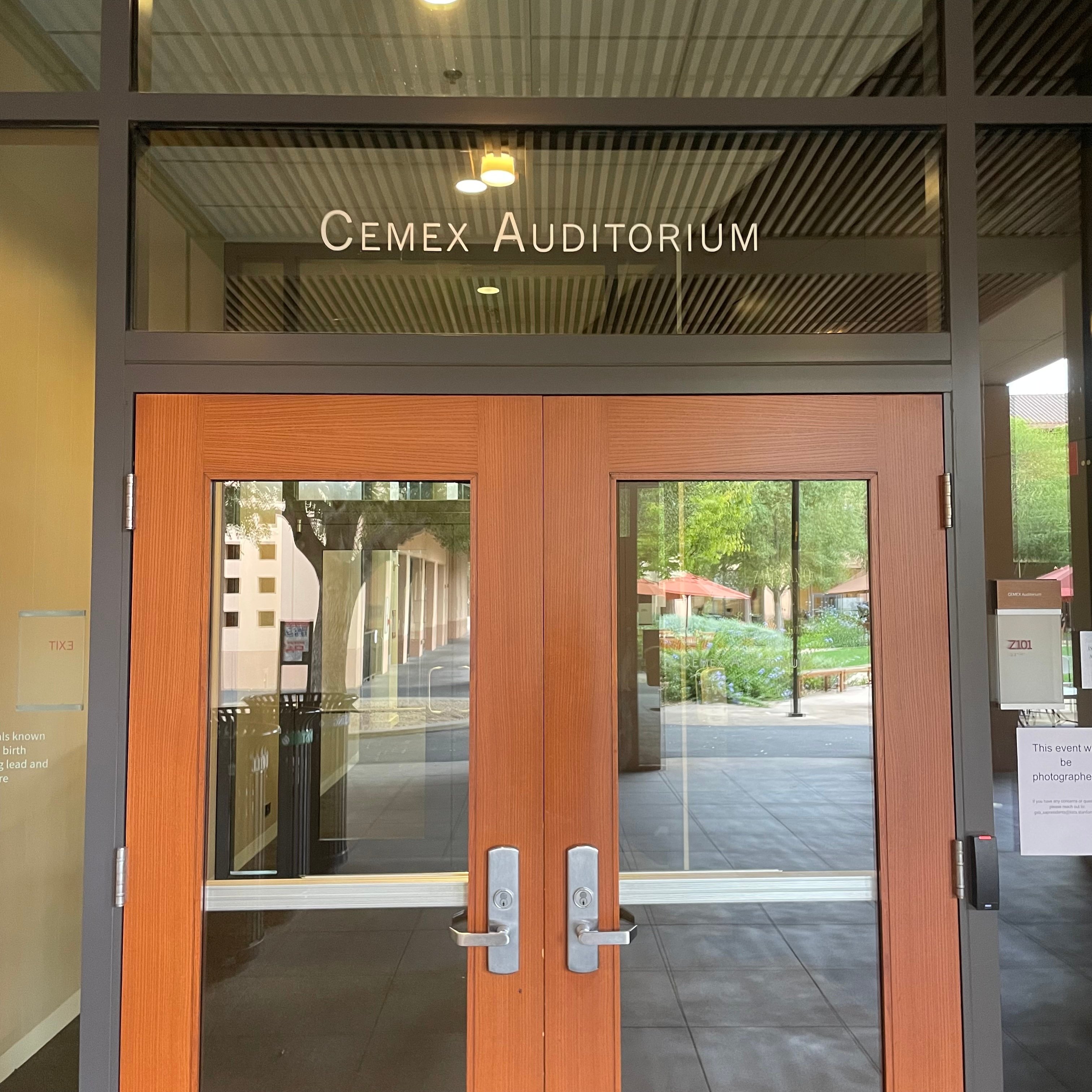
New York Times journalists and Pulitzer Prize winners Thomas Friedman and Nicholas Kristof joined Emerson Collective founder Laurene Powell Jobs in a Monday evening panel at Cemex Auditorium, where they called attention to the importance of strengthening democratic resilience in the U.S.
The panel was the first session of the speaker series course POLISCI 31: “Which Side of History? How Democracy, Technology, and Our Lives are Being Reshaped in 2025” and was moderated by the founder and CEO of Common Sense Media, professor Jim Steyer.
Friedman and Kristof drew on their experience as foreign correspondents, and Powell Jobs on her work in philanthropy, to examine the U.S.’s role at home and abroad. They highlighted American democracy’s decline and urged students and audience members to come together — across the political divide — to defend it.
“This is the fight of my life,” said Friedman, who writes a weekly opinion column for The New York Times. “This is why I became a journalist, and I’m not tired.”
Friedman added that, while covering the Lebanese civil war as a foreign correspondent, he learned that a country can survive tremendous stress as long as its institutions endure. He warned that President Donald Trump’s attack on institutions like the justice department thus threatens U.S. democracy.
Kristof, meanwhile, said his experience as a foreign correspondent in China taught him the authoritarian playbook: First, authoritarian leaders corrode checks and balances within the government; second, they attack independent referees like journalists and lawyers; and third, they use violence as a force for intimidation. Kristof argued that Trump has employed the first two tactics, and expressed concern he may turn to the third.
“The pardons of the January 6 protesters… created impunity for violent acts,” Kristof said. “I think the use of masked federal agents who don’t offer identification is also a really gross step in that direction.”
At the same time, Kristof said his career taught him “what works to challenge authoritarian regimes,” including storytelling and political satire.
The panelists admitted that Trump is not solely responsible for democratic backsliding in the U.S.
“We democrats, also to some degree, did this to ourselves,” Kristof said.
Powell Jobs said that she was disappointed with the Democratic Party’s leadership on the national level and particularly frustrated with how former President Joe Biden’s administration demonized the corporate leaders.
“You can’t be only for labor, because labor works for businesses,” Powell Jobs said.
According to Kristof, the Democratic Party has also failed the working class.
“One reason working-class communities have turned against Democrats, including communities of color, is a feeling that elites just don’t care,” he said.
The speakers emphasized the need to find common ground and cooperate across the political aisle. Kristof advocated for Democrats and Republicans to listen to one another and Friedman encouraged the parties to showcase greater humility, because both have made mistakes.
Friedman pointed out that it was only when Republican Sen. Ted Cruz defended Jimmy Kimmel’s right to free speech that the late-night host was reinstated.
“Right now… we have to rely on courageous Republicans more than anything,” Friedman said.
The panel ended with a dialogue on America’s role overseas. Kristof criticized Trump for “taking an axe” to international institutions like NATO and for weakening America’s soft power influence over countries like Russia.
Friedman voiced his support for Trump’s proposal to end the war in Gaza, which he called “perhaps impossible but never more necessary.” He argued that a two-state solution is the only just and stable peace plan.
In their closing comments, Powell Jobs, Friedman and Kristof called on the audience — a full auditorium and over 1,000 Zoom attendees — to do their part for democratic resilience.
“Get out and register someone to vote,” Friedman said. “Someone… who will put the Constitution before their own personal interest and party.”
Correction: This story was updated to include the preferred name of a panelist.