
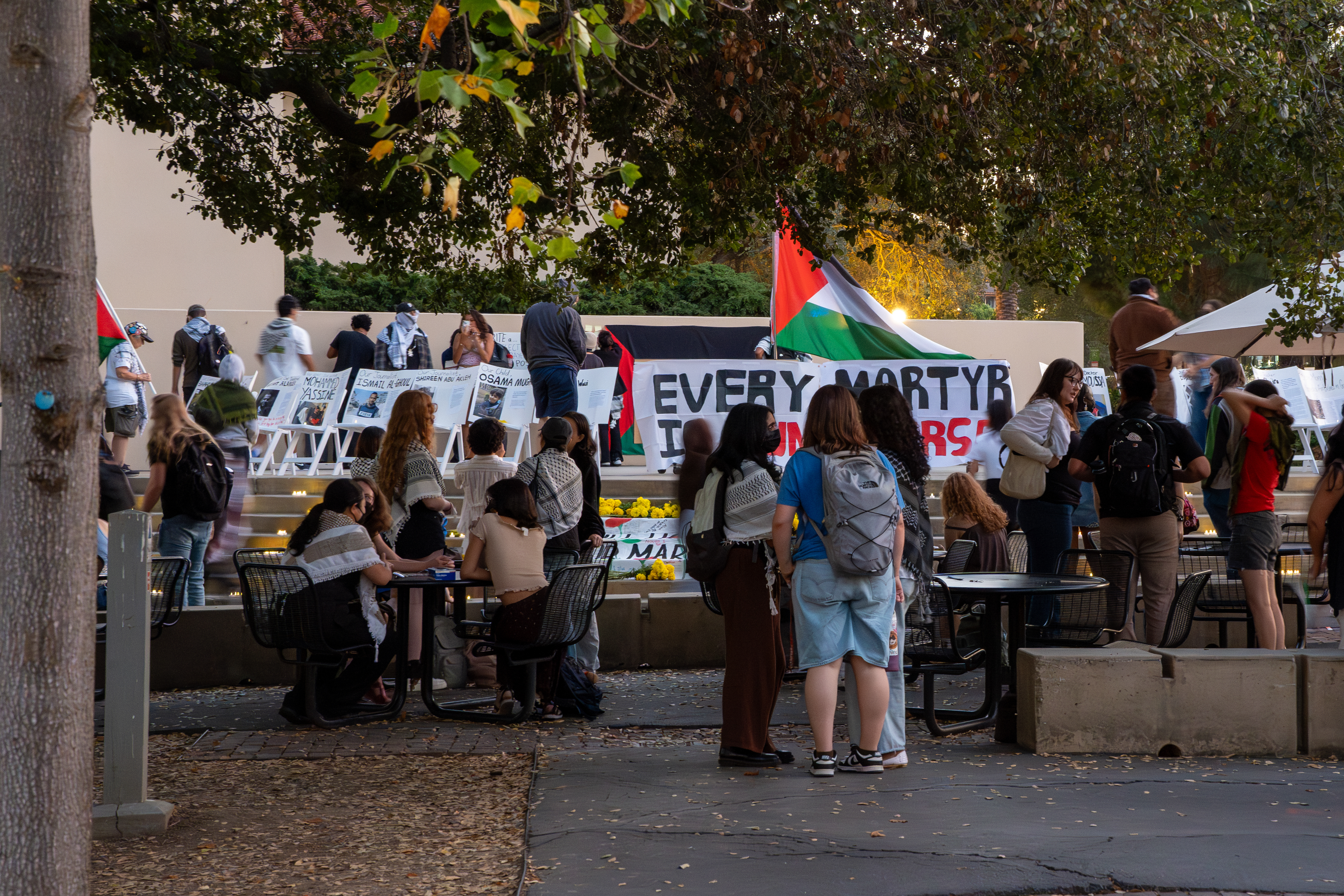
Members and supporters of Students for Justice in Palestine (SJP) gathered at White Plaza on the two year anniversary of Oct. 7 for a vigil honoring lives lost in Palestine. The vigil included speeches, prayers and poem recitations from multiple campus groups, including Jewish Voices for Peace (JVP) and the Native Action Contingent.
“The purpose of [the] vigil is to remember a genocide,” said a member of the Muslim Student Union (MSU), who requested anonymity for fear of retaliation.
Attendees began the vigil by chanting “Free, free Palestine.” Organizers then stated their rules and expectations for the vigil, including a no-tolerance policy for any type of hate, including Islamophobia, anti-Semitism and racism.
Around five counterprotestors attended the event, occasionally attempting to interrupt speeches. University administration and security were also in attendance.
Participants were attentive as MSU co-president Hashem Albezreh ’27 spoke on the importance of faith and religion during the ongoing war, specifically the significance of martyrdom and the afterlife for the Muslim community.
“They are with their lord now,” Albezreh said.
After his speech, the vigil transitioned into an Islamic prayer on the space facing the Claw fountain. Shortly after, more students gave speeches focused on the importance of diversity and unity, calls to action and criticisms of Stanford’s response to President Donald Trump cracking down on student protestors. In between speeches, speakers recited poems, including “If I Must Die” by Palestinian poet Refaat Alareer.
“What will you do to be a part of that movement? Today is not the end,” one speaker who introduced himself as Roberto asked the audience. Another said, “We must hold space for one another.”
“It’s a space also for us to take care of each other, grieve together, but also to build on that hope for a free Palestine in our lifetime,” Amanda Campos ’26, an organizer with SJP, said about the significance of the vigil.
Throughout the day, posters set up by SJP displayed lives lost on the stage in White Plaza. In between speeches, attendees walked up to the stage to read the posters. They were also given the option to “write a reflection or prayer” on a post-it note to stick on a wall behind the stage.
Organizers added candles and flowers on the steps in front of the posters before the vigil started. The largest sign at the center of the stage read “Every Martyr is a Universe” with a Palestinian flag waving above it. On the ground near the stage another sign read “Divest Now, #SITWITHUS #DIVESTSTANFORD.”
When asked for comment on the SJP event, Rabbi Jessica Kirschner of Hillel at Stanford stated that “On October 7 itself, the focus belongs on October 7, which Israelis and many Jews feel the world has forgotten, or failed to acknowledge in the first place.”
She added that “there has been so much suffering over the last two years, but I think the worst impact now on our campus is a continued empathy gap. Too many people can only acknowledge the pain of the group they identify with, while also feeling deeply wounded that their own isn’t sufficiently seen… Giving each other space to mourn could be a place to start.”
A few counter protesters, who spoke up occasionally throughout the vigil, held signs that read “All Eyes on Hamas” and “If you aren’t demanding Hamas accept this deal you were never for peace or a ceasefire,” referring to a potential ceasefire deal that is currently being debated.
The attendees of the vigil did not acknowledge the counterprotestors.
After the speeches finished, SJP members remained to discuss the vigil. One member embraced another, saying, “It’s been so long.”
Campos, reflecting on what the Stanford community should take away from the event, said, “I hope that all of Stanford can see how important it is to stand up for Gaza in Palestine as a whole, no matter our background, no matter our experiences, it is crucial to realize that the freedom of Palestinians is very much intertwined with ours.”