
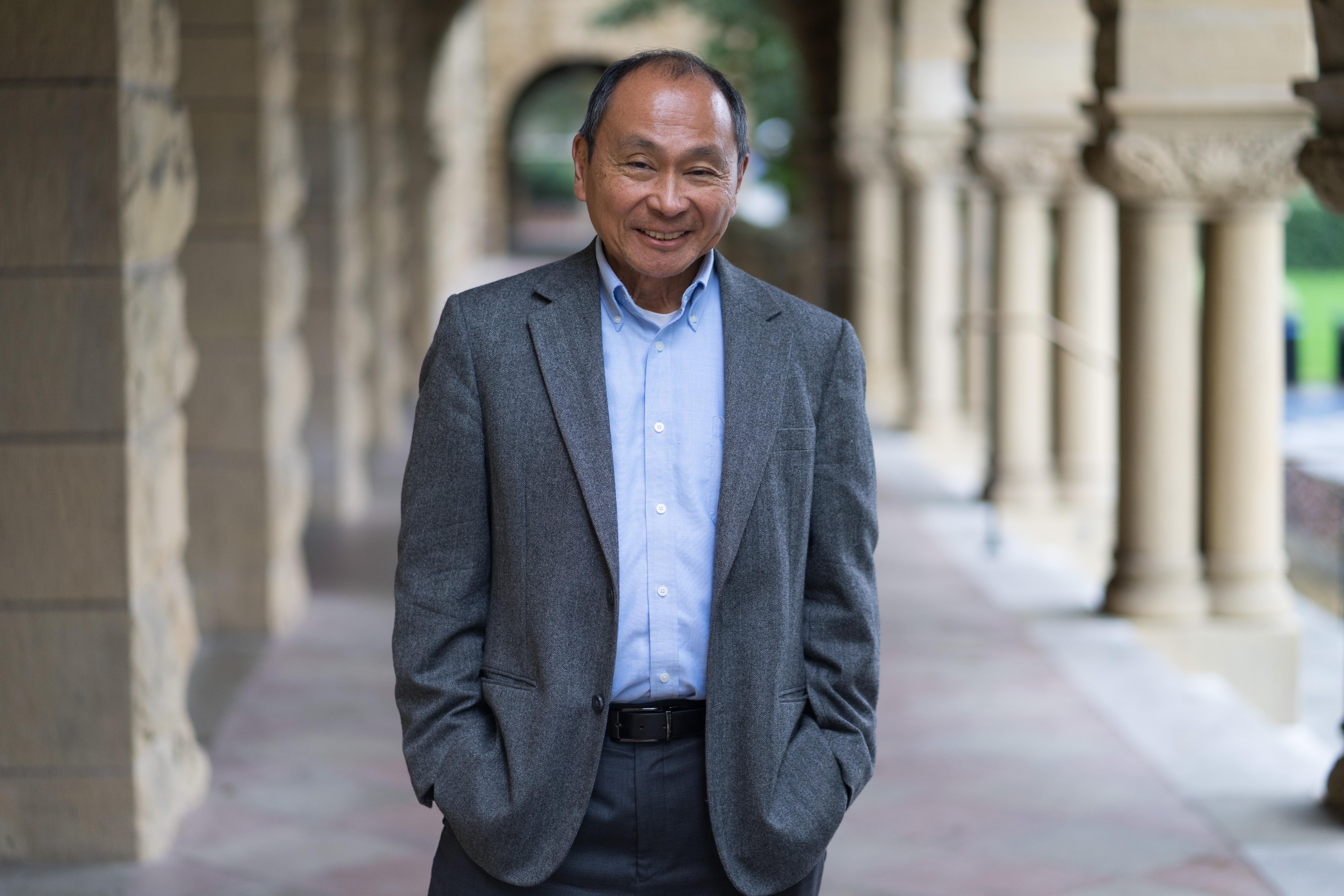
The Stanford Continuing Studies Department launched its second annual “Reimagining Democracy” weekly webinar speaker series on Oct. 7, featuring professor Francis Fukuyama, an Olivier Nomellini Senior Fellow at the Freeman Spogli Institute for International Studies (FSI), as the first guest speaker. Fukuyama spoke on the global crisis facing democracy.
Hosted by Debra Satz, dean of the School of Humanities and Sciences, and Larry Diamond, Mosbacher Senior Fellow in Global Democracy at FSI, the series brings together Stanford scholars to explore today’s challenges to democracy, investigating its decline and the ideas that could help revive it.
“Our democracy is a concern for all of us,” Satz wrote to The Daily in an email. “[Diamond] and I were motivated to bring these issues to a wider public.”
One of Fukuyama’s core beliefs is that a key factor contributing to democracy’s current crisis is a growing sense of general distrust in democratic institutions.
“The decline in democracy reflects a global lack of trust,” he said at the event.
Nate Boswell, assistant dean of Stanford Continuing Studies, asked Fukuyama about the concern over the lack of trust in institutions amid administrations seemingly waging “a war on knowledge” against universities — a trend tied to broader democratic distrust.
In response, Fukuyama suggested that part of the decline in intellectual cohesion originated within academia itself.
“For this decline of a common understanding of our narrative, it actually falls on the left,” he said, specifically mentioning how in elite universities, there are core western civilization courses students take, including some formerly offered at Stanford.
Satz added that this war of knowledge has led to an attack on freedom of speech and independent expression.
There are definitely things that universities have done that should be criticized and deserve criticism,” she said. “But the sledgehammer approach to fixing those problems is not a productive one.”
In addition, the speakers raised concern over the difficulty of engaging younger generations. Fukuyama emphasized the roles that race and gender play in this challenge.
“One of the things that put Trump over the top last November was actually a shift in the young male vote,” he said. “That included African Americans and Hispanics, especially. So there’s something about the failure to recognize the particular problems of that demographic that I think contributed to the way that young people voted.”
He suggested that overlooking the specific social and economic challenges faced by different demographic groups can have significant political consequences, shaping voting patterns and influencing democratic outcomes.
Along with race and gender, Fukuyama identified the declining legitimacy of political parties as a source of distrust from the youth.
“Political parties are more comfortable staying in power than fixing problems,” Fukuyama said, which leads youth to vote for outsider populist candidates. In the U.S., this manifested in more young people voting for President Donald Trump in the 2016 and 2024 elections.
However, Fukuyama pointed to technology as the primary reason for distrust in democracies. When Satz pointed out that there have been previous periods of illiberalism in the U.S., Fukuyama responded that this crisis is different because the internet and social media have fundamentally changed the way people engage with politics.
“The ability to reach mass audiences is different,” Fukuyama said, with social media platforms becoming more concerned with gaining viewer interaction than spreading true information and promoting respectful dialogue. As a result, there has been a rise in extremist polarized political speech, with figures like podcaster Joe Rogan capturing the public’s attention and largely influencing their political opinions.
Diamond agreed that all of these factors have accumulated in democratic blacksliding.
“We’re in a long-term period of democratic decay, not just in the United States but in other democracies as well,” Diamond said. “The usurping of leaders, the stacking of courts, the purging of the bureaucracy — it’s a tough legacy to overcome.”
Still, Satz and Fukuyama believe that all hope is not lost.
“[Voting is] still the most powerful check you have on this authoritarian power,” Fukuyama said. He urged the audience to “go vote! Tell your friends to vote!”
Noting that the next installment of the “Reimaging Democracy” series will occur on Oct. 14 at 4 p.m., Satz added that democracy is not easy to carry out; rather, it is a constant work in progress.
“[I find] some solace from the fact that if you look at history, there have been times when people thought we were in a dark place and there was no hope, and then some group burst into the scene and… enacted change that helped society move forward,” she said.