
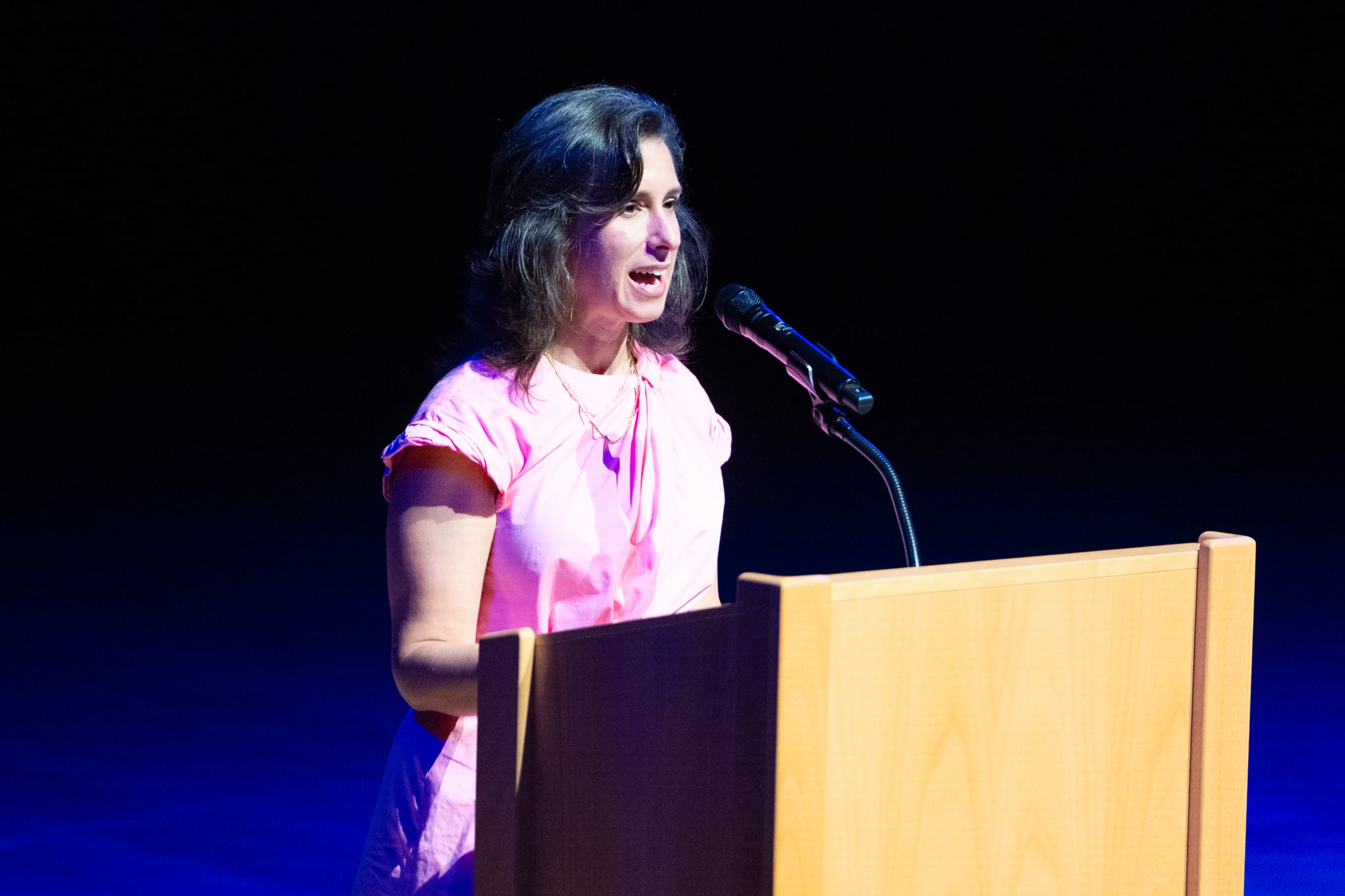
Jodi Kantor, a New York Times investigative reporter who broke the sexual assault allegations against film producer Harvey Weinstein in 2017, emphasized the importance of transparency and accountability in a lecture Thursday evening.
“What She Said: A Conversation with Jodi Kantor” was held by Stanford Live in partnership with the Michelle R. Clayman Institute for Gender Research. The event served as the newest installment of the Jing Lyman Lecture Series, which recognizes feminist trailblazers who contribute significantly to gender equality in their lifetime.
Kantor, who co-authored the best-selling book “She Said” based on the Weinstein investigation, said that investigative journalism is a vital tool for uncovering information of public interest.
She claimed social progress depends on trustworthy information and a shared reality: “You can’t solve a problem that you can’t see… and you can’t have a very good debate about what should happen — what kind of accountability or punishment or repair is necessary — if the facts themselves are not agreed upon,” Kantor said.
The exposé she and co-worker Megan Twohey published eight years ago revealed Weinstein’s history of sexual misconduct and victim settlements. It also helped sparked the #MeToo movement, in which women across the globe came forward to report their own experiences with sexual violence and harassment.
“We published what started as one story in one newspaper and led to a worldwide gender reckoning,” said Kantor. “Women all over… said, ‘I work in a totally different industry. I work in a totally different place. But you are describing what happened in my first job, down to the language.’”
During her talk, Kantor posed a pertinent question to her audience: if the Weinstein story were published in 2025 instead of 2017, would it have the same effect today?
Kantor said The New York Times remains equally committed to telling the “hard stories,” that women continue to face similar challenges in reporting sexual misconduct and that non-disclosure agreements, or NDAs, still exert a powerful silencing effect.
At the same time, she pointed to key differences between the challenges she confronted in 2017 and those that journalists face today.
During her investigation, Weinstein hired ex-Israeli intelligence agents to track and deceive Kantor to prevent the publication of her story, a task that carried a $400,000 bounty. Kantor expressed concern that such intimidation tactics could intensify in today’s media environment.
Kantor also argued that it would be harder to achieve a factual consensus on the Weinstein story in the current era of misinformation, especially amid widespread political polarization. “People really… got the message that [sexual misconduct] is universal,” said Kantor of the 2017 publication. “It’s not a right thing or left thing. It happens in every segment of society.” She raised doubts that people would interpret the story in the same way today.
Kantor drew a parallel between the crises facing the natural environment and the information environment. Both, she said, are vital to humanity’s well-being yet suffer from increasing pollution and decay.
In conversation with Pamela Karlan, a Kenneth and Harle Montgomery professor of public interest law and the co-director of Stanford’s Supreme Court Litigation Clinic, Kantor highlighted her recent investigation of the inner workings of the Supreme Court, including behind-the-scenes deliberation before the overturning of Roe v. Wade.
Kantor warned that the Court holds immense power but lacks transparency or accountability mechanisms. In particular, she called attention to recent emergency docket rulings tied to the Trump administration with no legal rationale.
Kantor challenged the idea that telling the truth is destructive.
“A single individual who shares information with a journalist can help trigger change all over the world,” Kantor said.
“What is a Stanford education for?” Kantor asked students in the audience. “How are you hoping to use it? For knowledge, for inquiry, for investigation?”