
Hitchcock’s mysteriously romantic movie, “Vertigo,” features a scene set in the San Francisco Legion of Honor. Hoping to discover the spirit of the movie, I found myself, on a windy but lovely day in San Francisco, visiting the Legion of Honor.
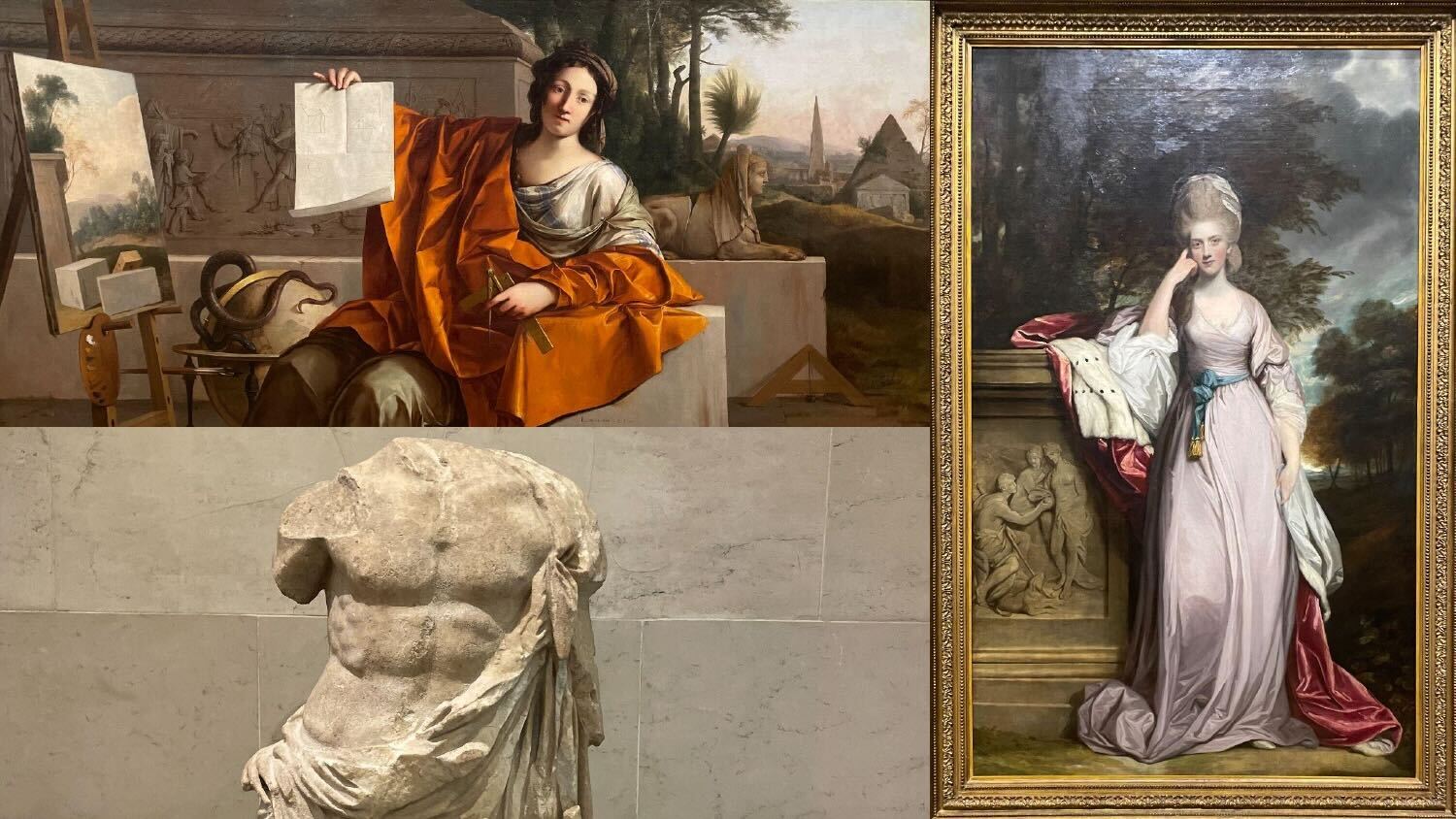
Wandering through the 17th-century European art collection, I encountered a large horizontal painting of a woman surrounded by Egyptian antiquities. In the background of the painting, there is a pyramid and an obelisk. Behind her, the glimmer of a sphinx statue. And to her left, weathered stone carvings that look ancient, creating an illusion of traveling back in time to ancient Egypt. She felt like a spirit from ancient times. In her hand, she holds mathematical tools for drawing circles and triangles. In the other hand, she presents a sheet of paper with various geometrical shapes, showing us what she has been working on. My eyes searched for the title of the painting to understand who she was: Allegory of Geometry. I smiled as I recognized her as a symbol of geometry in human form. According to the painting’s description, ancient Egyptian elements hint that geometry was invented in ancient Egypt. Together with the mathematical tools she holds, her true identity became clear.
But the painter, De La Hyre, didn’t have these ancient Egyptian monuments in front of him when he painted this masterpiece in 17th-century Paris. Perhaps it was the misplacement of these elements in time and space, the transcendence of ancient Egyptian elements from their context to his canvas in the modern day, that created the aura of geometry. They are no longer pyramids or obelisks but timeless symbols of their era and of the development of mathematics. This was a moment of anachronism.
Entering the gallery of 18th-century British art, another portrait of a woman pulled my gaze: Portrait of Anne, Viscountess Townsend by Sir Joshua Reynolds. In the painting, the figure stands elegantly in her long purple dress. A forest with long trees sits in the background. Yet, what I found most interesting about this painting was the ancient Greek frieze that she rests her hand upon, which felt out of place and out of time.
In the Greek frieze, there is a boy with an apple. In front of him, there are carvings of two women. This is the tale of Paris, who gave a golden apple to the most beautiful deity, Aphrodite, when he chose her above two other goddesses.
Yet, there are only two goddesses depicted in the frieze. This is the magic of the painting — in the frieze, it seems as though Paris is reaching out of the frieze towards the Viscountess Anna. Paris is choosing Anna, and the painter is telling us that Anna is the most beautiful, and that Anna is Aphrodite, metaphorically. Isn’t that so beautiful?
In this painting, the artist reimagines an object of ancient Greece and a mythological tale to portray a viscountess, paying her a secret compliment that can only be deciphered with careful eyes. In the 18th century, when the painting was made, the ancient frieze was a symbol from the past; for us, now, both ancient Greece and the 18th century are the past. Still, the magic of painting is preserved. Even though it’s the past, it’s somehow forever.
I think I liked this painting so much because I found a part of myself in it. Paris is the prince of Troy, the famous city where the Trojan war began. Troy is in modern-day Turkey, which is where I am from. Before anything, the story of Paris was already ingrained in me, as I grew up in the same lands of Troy. There is a sense of home in this painting.
Elements of antiquity continued to welcome me in the hallways of the museum. Downstairs in the Legion of Honor, there are ancient Greek statues and artifacts. I came across a marble bust of a deity I immediately recognized: Asklepeios, the deity of medicine. The snake that spirals his arm gives it away. I experienced a moment of time travel to my childhood, when I walked around the ruins of the temple of Asklepeios in western Turkey on an August day. How far a memory that has become…
The statue wasn’t discovered in San Francisco, clearly, but instead on the other side of the globe, excavated from somewhere close to my home. Now, it’s here. Misplaced. So am I, I feel for a second. Just like the statue, I am somewhere I am not from. Now, I have these memories of home that surface when I encounter pieces from it, like this statue. For a second, the art isn’t the only entity experiencing anachronism — I am too.
I think I’ve found the mysterious spirit of “Vertigo” I was searching for. I certainly left the museum with questions in my head.
In this museum, I found paintings that gained meaning through ancient symbols and artifacts represented in art. And sometimes, I feel out of place and out of time, just like the representations of these ancient artifacts. So, in the beautiful courtyard of the museum, looking over the ocean, I questioned if I will ever belong here — and if anything misplaced can ever belong.