
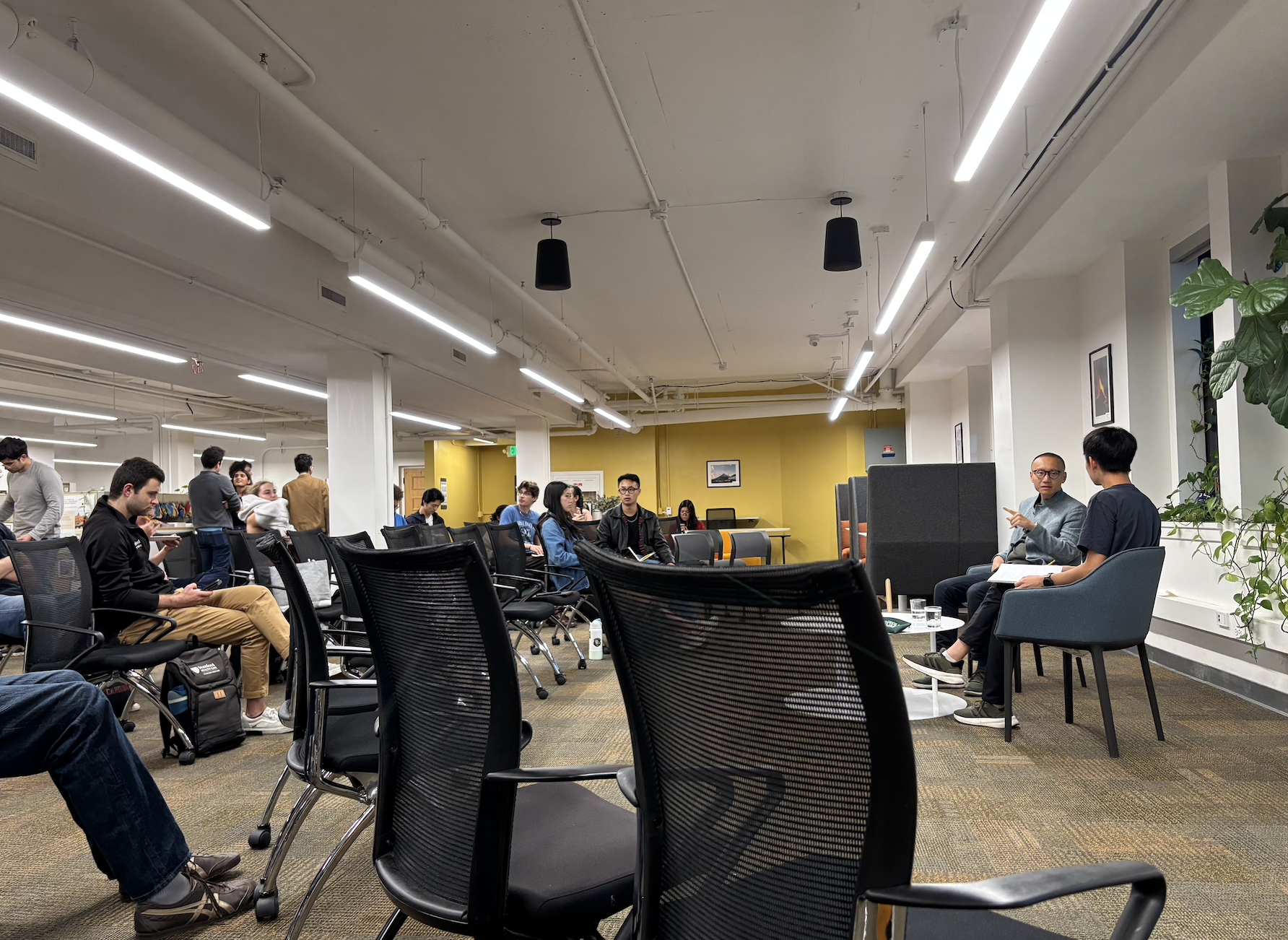
“Who here wants to own a house in their lifetime?” Stanford Abundance co-president Victoria Ren ’26 asked an audience of students.
Almost everyone raised their hands.
Last Thursday, students of all majors gathered in Encina Hall to hear from author and Hoover fellow Dan Wang. Facilitated by Stanford Abundance and the Society for International Affairs at Stanford (SIAS), the speaker session “America’s Lawyers vs. China’s Engineers” left attendees with new insight into how cultural work ethics affect not just policy but the real outcomes of people’s lives
“Not a ton of people at Stanford are necessarily thinking, I want to build something that is going to help my society,” Stanford Abundance co-president Shreya Mehta ’26 said. “Maybe they say that on their college application, but I think after they come here, people tend to stray a little bit away from that.”
Countering this mindset, the abundance movement is a relatively new, nationwide coalition of students, academics and policymakers that believe America must return to building up the very foundations of society. It places an emphasis on affordable housing and transportation infrastructure — but also healthcare, energy and education. Founded a year ago, Stanford Abundance is the University’s chapter.
“We really want to emphasize an ethos of doing things to make our campus and our local areas better and deliver tangible results,” Ren said. ”We place a lot of emphasis on supporting campus bureaucracy reform.”
After meeting Wang through an abundance conference in Washington, Ren invited the former Yale Law School Fellow to outline the framework of his newest book. In “Breakneck: China’s Quest to Engineer the Future,” Wang dissects America’s governing class and examines China’s accomplishments to determine what we can learn from our global adversary.
“There is kind of this deep sense of dissatisfaction with America’s inability to build things and really deliver for the people,” Wang said. “There’s recognition among both the left and the right that some things in America are very deeply broken.”
Wang called China an “engineering state,” where most high-ranking officials have a background in the field. He attributed the nation’s intense focus on engineering to its accessible housing, extensive transportation network and manufacturing dominance. When the Chinese Communist Party (CCP) says a bridge must be built, it is built with efficiency and speed, Wang said.
In contrast, the most common pathway into American politics is law. The first 16 U.S. presidents were lawyers, and every Democratic nominee since 1980 has gone to law school. Lawyers, Wang said, “are much better at obstruction than construction.”
He cited how, facing a student housing shortage, the UC Berkeley sought to build more developments only to face a lawsuit arguing that undergraduate students are a source of noise pollution. Wang acknowledged the merits of building regulations and environmentally-conscious policies — but not to the extent that they can be abused and gridlock progress for all.
“We need to be thinking quite carefully about what the regulations are and whether they could be subverted by anyone with an expensive lawyer,” Wang said.
To Wang, getting caught up in the problems of past generations and ensnared by bureaucratic red tape is exactly how the U.S. lost its manufacturing power.
“[We] need better, cleaner technology,” Wang said. “I think [the abundance movement] has a lot of the right solutions here to make sure that our government is able to do the things that it wants to do.”
Beyond concrete solutions, Wang recommended a forward-thinking approach in American citizens, lawyers or not, where people are motivated to build more and better for one another.
“I would like to see a student body where Stanford students are really excited to solve those problems,” Mehta said. “I would hope the government incentivizes and comes up with really exciting projects that young people are energized for.”