
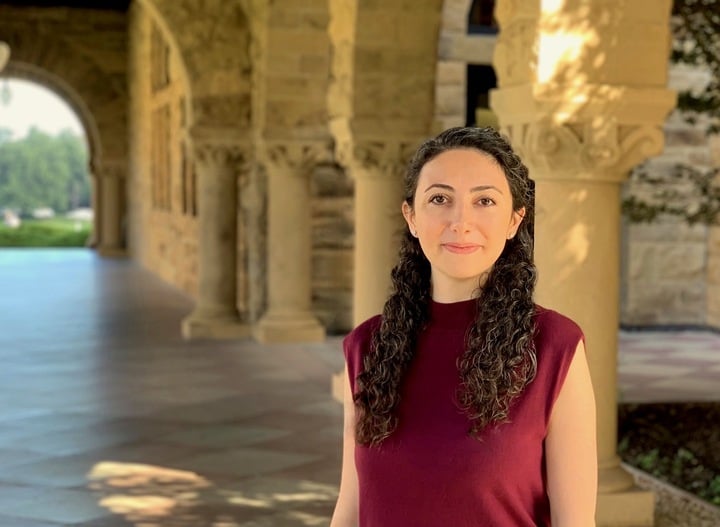
When Lernik Asserian thinks about designing a new math course, she doesn’t start with textbooks or syllabi. Instead, she asks: what would I have wanted as a student?
That student-centered philosophy has driven the senior lecturer to create and redesign multiple courses at Stanford, from MATH 18 — an introductory course that prepares students for quantitative coursework across disciplines — to this fall’s launch of MATH 195, a senior capstone in mathematical synthesis. Her work earned her the 2023 Lloyd W. Dinkelspiel Award, which recognizes exceptional contributions to undergraduate education.
“I felt really honored to receive that award,” Asserian said. “It also reinforced my love of teaching to be recognized.”
Asserian’s path to Stanford took her through community college, UCLA, NASA’s Jet Propulsion Laboratory (JPL) and a Ph.D. in applied mathematics at USC. But before that, she was volunteering as a math tutor in local high schools and role playing as a teacher with her cousins.
It was teaching that truly captivated her. “The very first quarter at USC, I already knew I was going with the teaching route,” she said. “So, I decided to TA for a new class every single semester. Every single semester, I would ask for a new class, because I wanted to make sure that I’m broadening my skill sets for teaching different ranges of classes.”
Since arriving at Stanford in the fall of 2021, she has taught an impressive range of math classes: MATH 18, 19, 20, 51, 52, 53, 56, 104, 131P and now 195.
“Teaching different classes … I’m using different sides of myself, and I really like that. It requires a different way of thinking and approach,” Asserian said.
Creating MATH 18 required Asserian to think beyond the mathematics department. She consulted with lecturers in physics, economics, biology and chemistry to ask a crucial question: what math skills do students need for your introductory courses?
“We wanted to make sure that we’re covering all the skills needed for those quantitative fields,” she said. The result was a course that serves as a bridge, preparing students not just for advanced math but quantitative work across Stanford’s curriculum.
For MATH 195, a senior capstone launched this fall, Asserian again centered student needs. Putting herself in the seniors’ shoes, she incorporated skills she would’ve benefited from as an undergraduate, such as writing in LaTeX, conducting math research and group collaboration.
Jessica Su ‘28, a former student in Asserian’s courses, captures the impact of this approach: “She likes to include applications for different equations and I found that especially helpful. Not only to learn math but to understand the beauty of math.”
In class, Asserian deliberately mentions common mistakes as an intentional strategy for creating a welcoming environment.
“I learn something new every day myself. I think that really helps me to understand what it means to be a student,” she said. “And I think that helps me to teach with some empathy and patience.”
She reads her students constantly during class. “I can tell when they’re bored, when I’m going too fast, when I have to pause, I have to repeat something,” she said.
This creates what she calls a positive feedback loop: engaged students give her energy, which fuels more passionate teaching, which keeps students engaged.
“I’m always impressed by Prof. Lernik’s ability to balance depth with breadth so perfectly,” said Rebecca Wu ’26, another one of Asserian’s student. “In just 50 minutes, she can explain complex material to students of all academic backgrounds, math majors or humanities students.”
Asserian has also created new lecture notes for every class she’s taught at Stanford, sharing them with new hires and postdocs. Looking ahead, she hopes to create a workbook for MATH 18 based on three years of teaching experience.
Her goal remains consistent: creating a lifelong appreciation of math in her students.
Asserian doesn’t point to awards or accolades as the most memorable moments in her teaching career. Instead, she said “[her] interaction with students” makes the job worthwhile.
“Whether they are biking and saying ‘hi’ to me, whether they’re in my office asking for advice, whether I’m mentoring them on what classes they need to take. That interaction with students … is really one of the key things that keeps me energetic and passionate about my job,” Asserian said.