
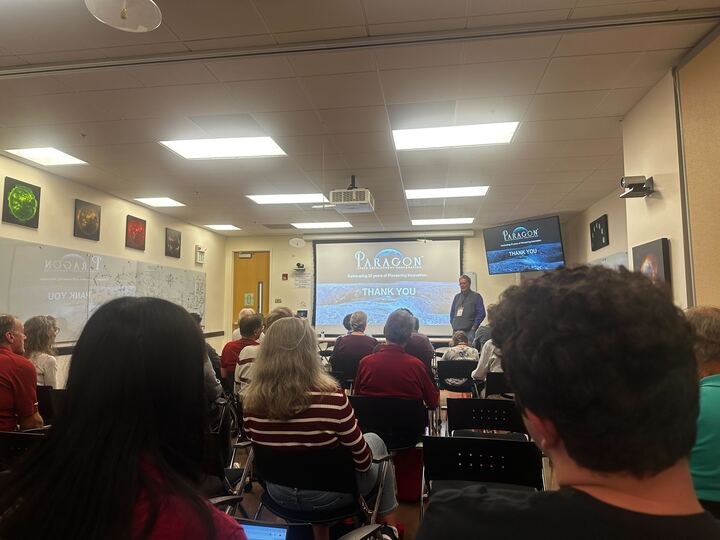
It’s been 53 years and counting since the Apollo 17 mission, the final time any human set foot on the Moon. But that hasn’t discouraged alumni of the Stanford on the Moon Club (SOM), who held a reunion on Friday Oct. 17 at the Varian Building to discuss the club’s mission for the next 50 years. At the reunion, SOM awarded the Stanford Student Observatory (SSO) and Physics Department 50% of SOM’s endowment fund for the next 50 years.
Steve Durst ’65 M.A. ’66, founder of SOM, addressed the future goals of the club, an alumni group which was founded in 2000 to gain a significant lunar presence for Stanford by 2025.
“The central point of this meeting is to take a 50-year look at this idea to send Stanford on the Moon,” Durst said.
Along with alumni members of Stanford on the Moon, faculty of the Bing Overseas Study Program (BOSP) were present. Adrian Doyle, BOSP’s Director for Student and Academic Services, discussed the importance of study abroad programs for undergraduate students.
“Stanford has been one of the early pioneers in study abroad in national schools,” Doyle said. “We started a very hands-on model of operating.”
Roger Romani, a professor of physics who is also involved in BOSP, was also present, and accepted the award on behalf of the SSO.
Much of the conference was led by Grant Anderson ’85 M.S. ’86, co-founder and former Chief Innovator of the Paragon Space Development Corporation, which develops life support systems for space missions. Anderson recently stepped down from his position and was appointed as a member of the newly formed Arizona Space Commission by Arizona Governor Katie Hobbs.
In his presentation, Anderson discussed his career at Paragon as well as the Artemis program, a NASA-led lunar exploration program launched in 2017. The original program intended to land astronauts on the Moon by 2024, but that has been delayed until 2027 for a variety of reasons.
“This is a perennial problem in NASA programs,” Anderson said. “[Private space exploration companies] guess three years and make it in six. We [NASA] tend to guess six and make it in twenty.”
Anderson attributed the disparity in the efficiency of privately- and publicly-funded space exploration to a lack of financial motivation for NASA to complete projects quickly.
“Once a program gets going, how it keeps going is how many people are on the payroll in different congressional districts,” he said.
While publicly-funded space exploration via NASA allowed the original Apollo program to flourish, Anderson said that it was time to “let American industry or free-enterprise industry get going on [space exploration].”
After Anderson’s presentation, Michelle Zheng ’27, co-president of Stanford SSI, presented on the developments and future goals from the organization, which is the University’s largest engineering club, according to Zheng. Mason Matich ’27, co-lead of the satellites branch of Stanford SSI, accompanied Zheng.
The presentation highlighted the initiative’s accomplishments, which include sending experiments to the International Space Station, collaborating with NASA and launching three satellites into space. While much of Stanford SSI consists of engineering students, Zheng noted that members hail from a variety of majors.
“Space is a very interdisciplinary area,” she said.
Including the satellites program, Stanford SSI is divided into seven teams which work on projects for rockets, high-altitude balloons, astrobiology, policy and exploration of Mars.
“A lot of [Stanford SSI members] will intern and eventually work at space exploration companies [including SpaceX and Blue Origin],” Zheng said.
Stanford SSI also received an award from the SOM Endowment Fund, which was accepted by Zheng.
Correction: A previous version of this article incorrectly stated the recipient of the SOM Endowment Fund, a detail about the SSI award, and the funding relationship between SSI and SOM. The Daily regrets these errors.