
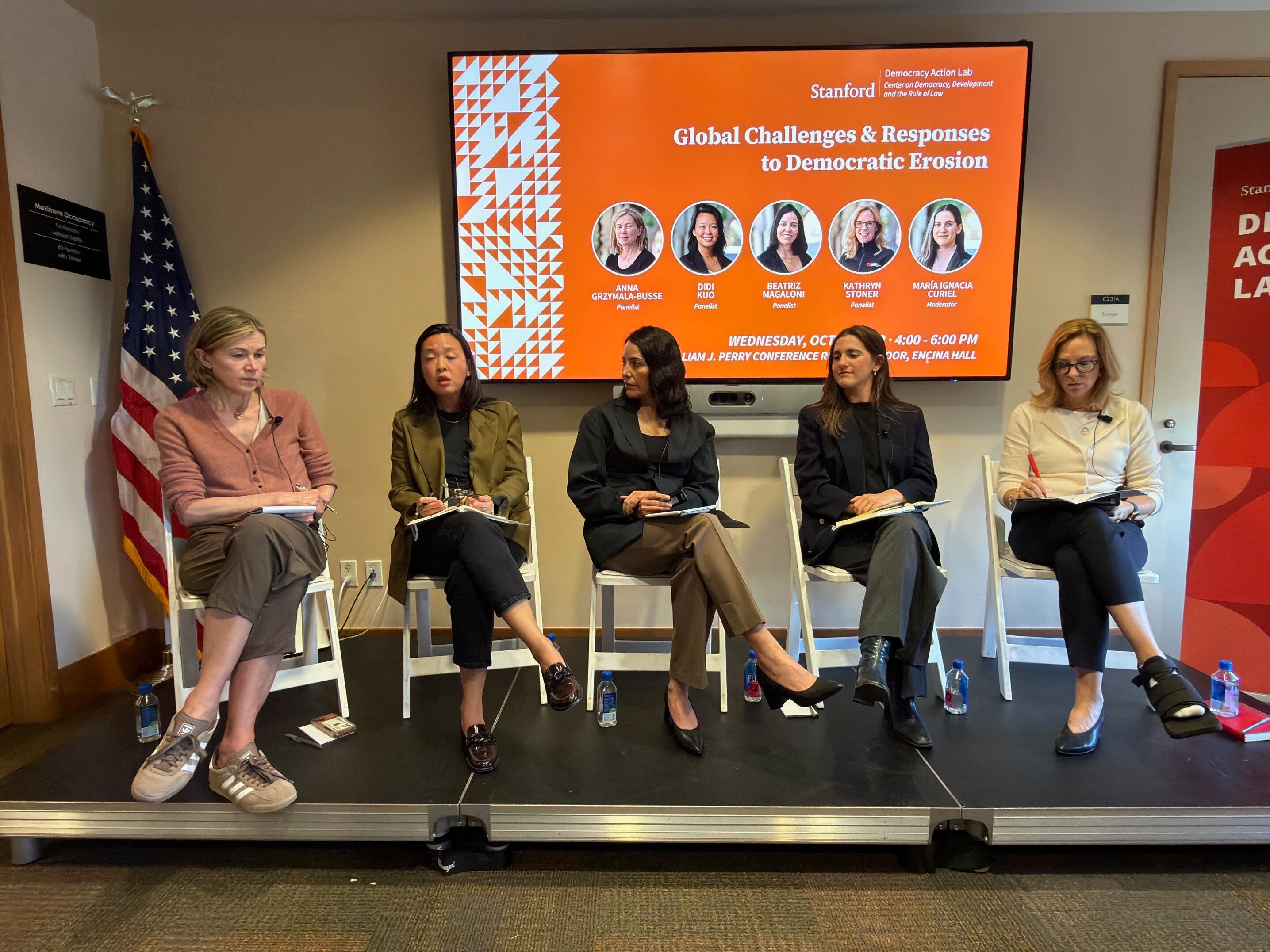
Political science scholars examined worldwide democratic backsliding and emphasized the need to strengthen pro-democracy coalitions during a Wednesday event titled “Global Challenges & Responses to Democratic Erosion.”
The speaker panel, hosted by the Center for Democracy, Development and the Rule of Law (CDDRL), marked the launch of the Democracy Action Lab (DAL). The lab will study the dynamics of democratic erosion through cutting-edge research methods and feature a “Democracy Garage” where researchers, activists and practitioners will co-create tools for democratic resilience.
“Around the world, democracy is under pressure, but it’s not defeated. Everyday people stand up for freedom, justice and dignity,” said CDDRL Mosbacher Director and political science professor Kathryn Stoner in her opening remarks. “We want to understand why democracy finds itself in this predicament in 2025 and how society can prevent and resist backsliding.”
After the Cold War and the dissolution of the Soviet Union, political scientist and Freeman Spogli Institute Senior Fellow Francis Fukuyama famously predicted the “end of history” marked by the triumph of Western liberal democracy.
While a wave of democratization spread across Eastern Europe and parts of Africa in the early 1990s, Stoner said this progress has since come undone, suggesting we have reached “the end of the end of history.”
She pointed to autocrats like Vladimir Putin who have sought to degrade the quality of democracy worldwide, citing Russian interference in the 2016 Presidential Election as an example.
While Stoner traced the history of democratic erosion, Senior Fellow at the Freeman Spogli Institute for International Studies and political science professor Anna Grzymala-Busse provided two explanations for this transition as it has occurred in Europe: economic crises and immigration.
According to Grzymala-Busse, some people view immigration as a double threat because it undermines cultural heterogeneity and increases competition for public services. She called this perceived danger “an incredibly powerful force” in the hands of illiberal populist parties.
As a result, these parties have gained control of governing coalitions in places like Poland, Hungary and Turkey, undermining formal institutions and redefining national identity narrowly, she said.
Grzymala-Busse explained that in countries with proportional representation systems, illiberal populist parties can accomplish little without majority control — but warned that the United States does not have that “luxury,” as it lacks proportional representation.
DAL co-director and political science professor Beatriz Magaloni also addressed democratic decline in the U.S., pointing to recent ICE raids that violate due process and the deployment of the national guard in Democratic-led cities — practices she compared to those of authoritarian Latin American states.
Center Fellow at the Freeman Spogli Institute for International Studies and political science professor Didi Kuo said that to stop such democratic backsliding, it is essential to build pro-democracy coalitions. First and foremost, this requires setting aside all policy and partisan differences, she asserted.
“What matters right now is thinking of yourself as a democratic citizen and a democratic agent,” Kuo said. “Right now, anyone who cares about having policy plans and winning a policy goal needs to preserve democracy first.”
Kuo called the recent “No Kings” protests — a series of demonstrations against President Donald Trump’s so-called authoritarian tendencies — a “really good start” for pro-democracy coalition building in the U.S.
At the same time, Kuo said it takes time and focus to build a coalition. She explained that to build one requires a new politics of coordination, rather than the usual politics of advancing a policy goal.
Despite the panelists’ sobering assessment of global democracy, Kuo cited Brazil, Poland and France as examples of countries where opposition forces have managed to stop illiberal populist candidates from winning election or reelection.
Each speaker highlighted the importance of DAL’s mission to preserve democracy globally.
“At a time when authoritarian entrepreneurs are drawing on a shared implicit playbook to dismantle democracy … we want to use research findings to provide those defending the democratic idea and democratic institutions on the ground with effective countermeasures,” said Stoner.