
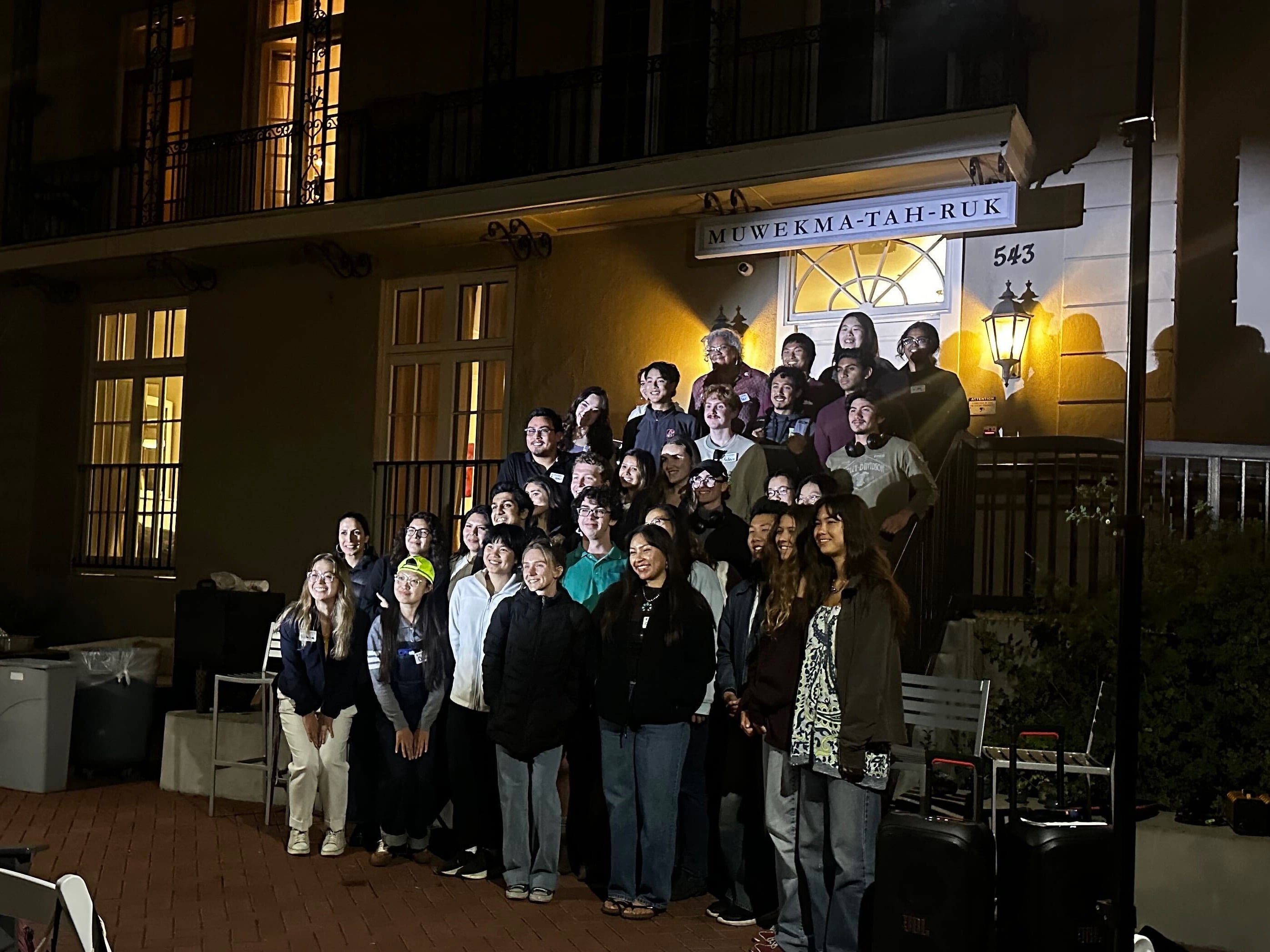
On Tuesday night, Mukwema-Tah-Ruk, the house dedicated to Stanford’s indigenous community, hosted a panel titled “Tribal Sovereignty and Clean Energy,” featuring Pilar Thomas ’83, who reflected on her four decades of experience in energy policy and advocacy on Native American lands.
The panel was led by Chazlyn Curley ’26, a resident assistant (RA) at Muwekma-Tah-Ruk and a member of the Diné tribe, commonly known as the Navajo; Ada Argueta-Guox ’26, an RA at Otero, whose family is Maya K’iche’-Huehuetenango of Guatemala; and Lizbeth Zambrano-Sanchez ’26, an RA at the Explore Energy House and a descendant of the P’urhépecha from Michoacán, Mexico.
The event marked the fourth year of collaboration between the Muwekma-Tah-Ruk and Explore Energy Houses, and the first year of incorporating Otero, Stanford’s Public Service and Civic Engagement theme house.
“We think that this partnership between the three houses is going to hopefully motivate everybody within these spaces to embed tonight into their own journey here at Stanford,” Curley said.
The event invited the greater student body to create a discussion at the intersection of tribal land rights, infrastructure and public service.
Addressing everyone before the panel began, Lupe Carrillo Ph.D. ’14, emphasized the need for a commitment to indigenous visibility. Carillo is the assistant dean at the Doerr School of Sustainability.
“We need people from all diverse backgrounds and perspectives to solve these really hard issues,” Carrillo said. “Today is an example of why we need voices from every community, because there are a lot of inequities and injustices.”
For Argueta-Guox, “every community” has to refer to diasporic indigenous communities as well. Many indigenous communities of Guatemala immigrate to the city of Oakland, and the Bay Area is home to Oaxacan and southern Mexican indigenous peoples. Their insight, Argueta-Guox said, is invaluable.
“I feel like this talk not only motivated the future leaders in our communities, but also gave concrete steps on how we can support Native communities and our own communities back home as well,” Argueta-Guox said.
During the panel, Thomas and the student organizers discussed the importance of Native American tribal sovereignty with respect to energy infrastructure. Thomas is a member of the Pascua Yaqui tribe of Arizona, and previously served in the Department of Energy as deputy director of the Office of Indian Energy Policy and Programs in the Obama administration. Much of her career has focused on supporting Native American tribes’ sovereignty with regard to energy policy.
“I have spent 20 years trying to convince tribes to take advantage of that [sovereignty],” Thomas said. “Some do what I tell them to do. Most don’t. But that’s okay, because I’m going to keep at it until they all do what I tell them to do. That’s the point of being a lawyer.”
Thomas noted that the economies of many Native American communities rely on non-renewable sources of energy, such as natural gas. She emphasized that many tribes have to make a difficult decision between sustaining their economy and protecting their local environment and tradition.
“[One of my clients] will have up to two gigawatts of solar in operation in the next three years, and they’ve bladed a lot of desert to do it, but that’s the price they’re willing to pay,” Thomas said. “They don’t have any other sources of revenue, and they need to run a government and build housing and take care of their people.”
According to Thomas, because of the nature of tribal sovereignty in the U.S., environmental protection is controlled by reservations and by the federal government via the Environmental Protection Agency (EPA). State governments generally lack jurisdiction regarding environmental policy in tribal territory. Thomas added that the current upheaval in the Trump administration’s EPA poses an additional challenge for tribal governments.
“The EPA has gotten out of the environmental protection business, and they have started to abandon the tribes in that process,” she said. “We’re going to have to step up and start building our capacity. That’s a function more of tribal law and tribes passing laws that are environmental protection laws.”
For the student representatives of Muwekma-Tah-Ruk, Explore Energy and Otero, leading the panel with Thomas carried personal significance. Curley spoke to the isolation she has felt in the Stanford “bubble.” To Curley, being at school, away from her cultural roots and unable to participate in her community, is a “sacrifice”
“The goal should always be to take as many resources from Stanford and pour them back into the community, especially back into communities that have been historically harmed and excluded from Stanford,” Zambrano-Sanchez said, referring to the Muwekma Ohlone Tribe.
Zambrano-Sanchez would like to see all students bring intentionality to their allyship with historically marginalized communities.
“One thing I would really recommend for students to do is to see what they can do in their capacity,” Zambrano-Sanchez said. “How can they carve out part of their day, part of their year, to support communities that have been historically harmed?”
Blue Tarpalechee, associate dean at the Native American Cultural Center and member of the Muscogee Nation, offered his takeaway from the panel: “Stanford folks, you guys are young leaders. You’re going to go out, you’re going to make changes in the world, and I think a big part of that is to listen to our elders and to listen to the people who have been out there, and to see how they can guide us in those directions.”