
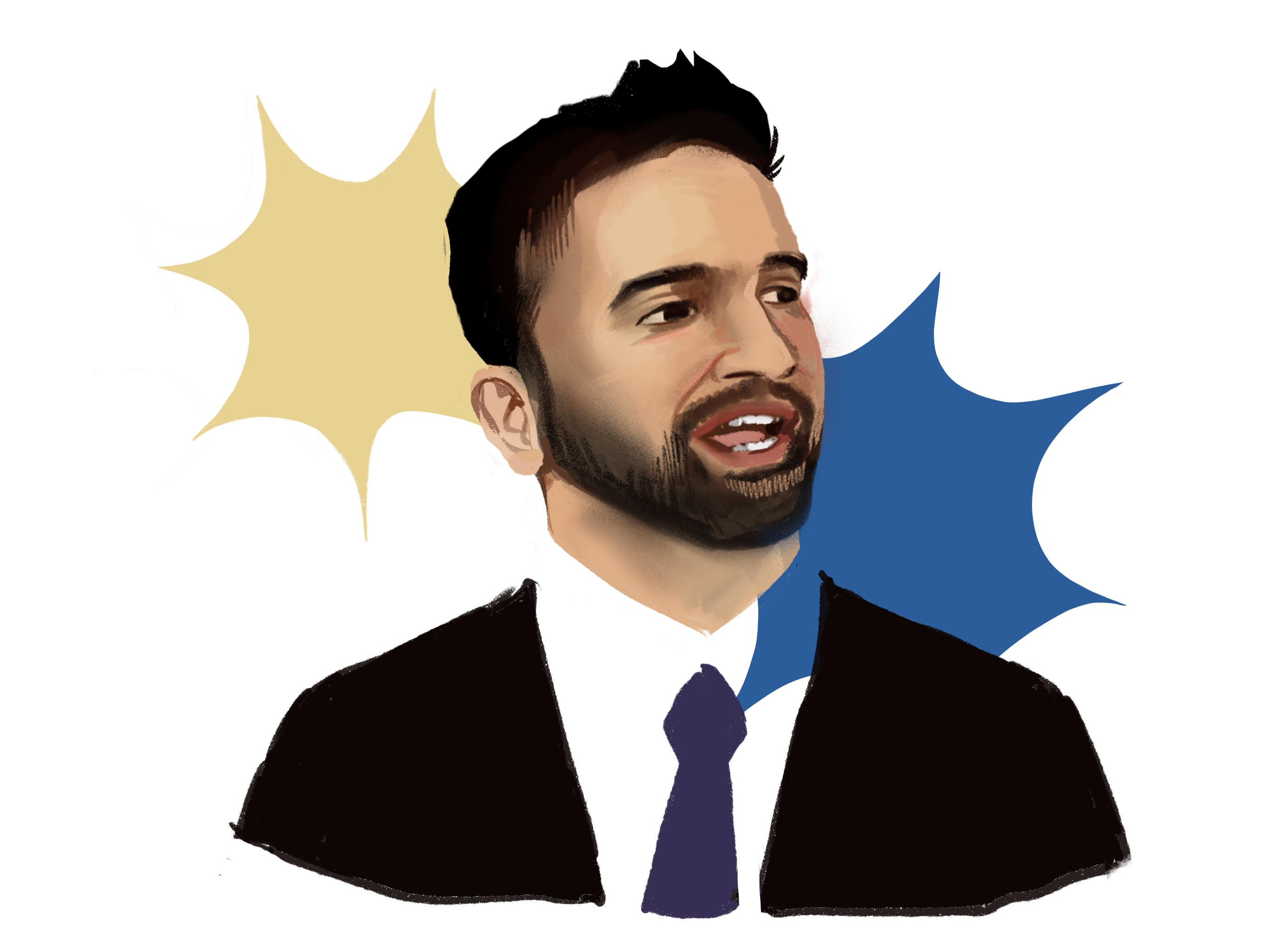
After former Gov. Andrew Cuomo suggested he would cheer another terrorist attack, New York City mayoral candidate Zohran Mamdani didn’t falter. He recounted an experience where an older Muslim New Yorker once advised him to keep his religion private for his political career. Rejecting fear, he asked, “Will we continue to accept a narrow definition of what it means to be a New Yorker that makes smaller the number of those guaranteed a life of dignity? Will we remain in the shadows? Or will we together step in the light?”
The provocation was deliberate and a perfect example of what makes Mamdani’s grassroots campaign for mayor of New York City so disruptive: rather than retreat into respectability politics, Mamdani outrages prominent state Democrats, strikes fear among billionaires and stirs excitement in younger, middle-class voters. As a native New Yorker, it’s been astounding to watch someone rally widespread, grassroots support across a progressive city that has been slowly turning more red.
Coming from the city of immigrants, it’s unsurprising that a man running on a “for the people” campaign is an immigrant himself. However, Mamdani’s ideology marks a radical departure from the assimilationist politics often expected of Asian Americans. As a South Asian Muslim American born in Uganda but raised in New York, he represents a generation who rejects respectability politics and sees activism, not assimilation, as the truest form of belonging.
The term “Model Minority,” coined in 1966 by sociologist William Petersen, cast Asian Americans as proof that individual discipline without systemic change could overcome racism. It designates proximity to whiteness for Asian Americans, offering them seemingly “positive” stereotypes: Asians are good at math, Asians are good workers, Asians are successful. Many of these notions have a deeply sinister root: the “good worker” stereotype started when Chinese immigrants began work on the transcontinental railroad. Corporations took advantage of their poverty and desperation for work to underpay them, causing the American labor movement to vilify them as sinister usurpers of work and money — enemies to the white working class. Asians became economic and political scapegoats, simultaneously exploited and excluded.
Mamdani stands in direct opposition to that logic in both rhetoric and policy. He critiques the structures the myth was designed to uphold: suppressed workers’ rights, corporate hierarchy and racialized meritocracy. His platform — advocating for free public transit, affordable housing, free childcare and wealth redistribution — redefines “success” not as individual advancement but as collective liberation. He does not seek proximity to whiteness or establishment approval; instead, he calls out the systemic inequities such proximity depends on.
Take his most costly proposal: universal childcare for children six weeks and older. While critics and supporters alike adhere to the snappy “tax the rich” refrain when asked how the city will afford a billion dollar proposal, Mamdani’s policy is based on government research revealing how much revenue the city loses from parents who leave the workforce to care for their children. He reframes “work ethic,” a cornerstone of the model minority myth, as a reciprocal exchange between the state and workers rather than something workers owe to their employer. This isn’t just progressive bluster, it’s internally consistent policy.
This vision extends to his confrontation with federal power. After President Donald Trump threatened to send troops and withhold federal funds if Mamdani was elected, Mamdani pledged to speak and work with him on their shared goal to lower the cost of living. However, he reiterated his commitment to challenging federal overreach and standing up for New Yorkers’ rights, particularly for the three million immigrant residents living there. He refuses to choose between confrontation and collaboration, instead insisting that principled opposition and pragmatic negotiation can coexist, rejecting performative resistance from the Democrats that so often yields little to no change.
This makes Mamdani not just a cultural outlier but a political one. Mamdani deviates from politicians on the left and right who rely on criticizing their opponents instead of offering alternatives, fleshing out policies of his own that are reliant on wider scale collaboration, as evidenced by his recent polling numbers across demographics. He is certainly outspoken about his competitors’ flaws, but he backs up criticism with policy proposals that demonstrate what an alternative vision looks like — not just what he opposes, but what he’s fighting for and how he will get there. Unlike major New York Democrats, he does not toe the line or hug the establishment of his political party, and his approach is clearly working. After a huge victory in the primary, he’s kept his momentum going with small-dollar campaign donations and over 50,000 volunteers. More than anything, his campaign has gotten New Yorkers involved, one of the most difficult tasks in an era where more and more voters have become disillusioned with civic engagement.
I know that if elected, Mamdani will not achieve all that he promises. New York’s budget shortfalls, entrenched bureaucracy and ambiguous relationship with Trump make universal, radical programs like taxation changes difficult to implement. But feasibility is the wrong metric for a movement designed to shift an entire political party. When you ask for a mile in politics, you get an inch at best. Pushing for radical change does not guarantee implementation, but it does open the door for negotiations that would have been unthinkable under a more moderate starting position.
The goal is not to win every single policy battle but to redraw the boundaries of what is possible: to make collective improvement, rather than assimilation, the new measure of success in social and economic equity. Mamdani’s campaign and his expected victory have reshaped what Asian American political leadership can look like — it doesn’t require reshaping one’s values according to an arbitrary standard to achieve legitimacy, it demands using identity as a source of moral and political clarity. Whatever happens on Tuesday, Mamdani’s proven that the model minority framework isn’t just ethically bankrupt. It might be politically obsolete.