
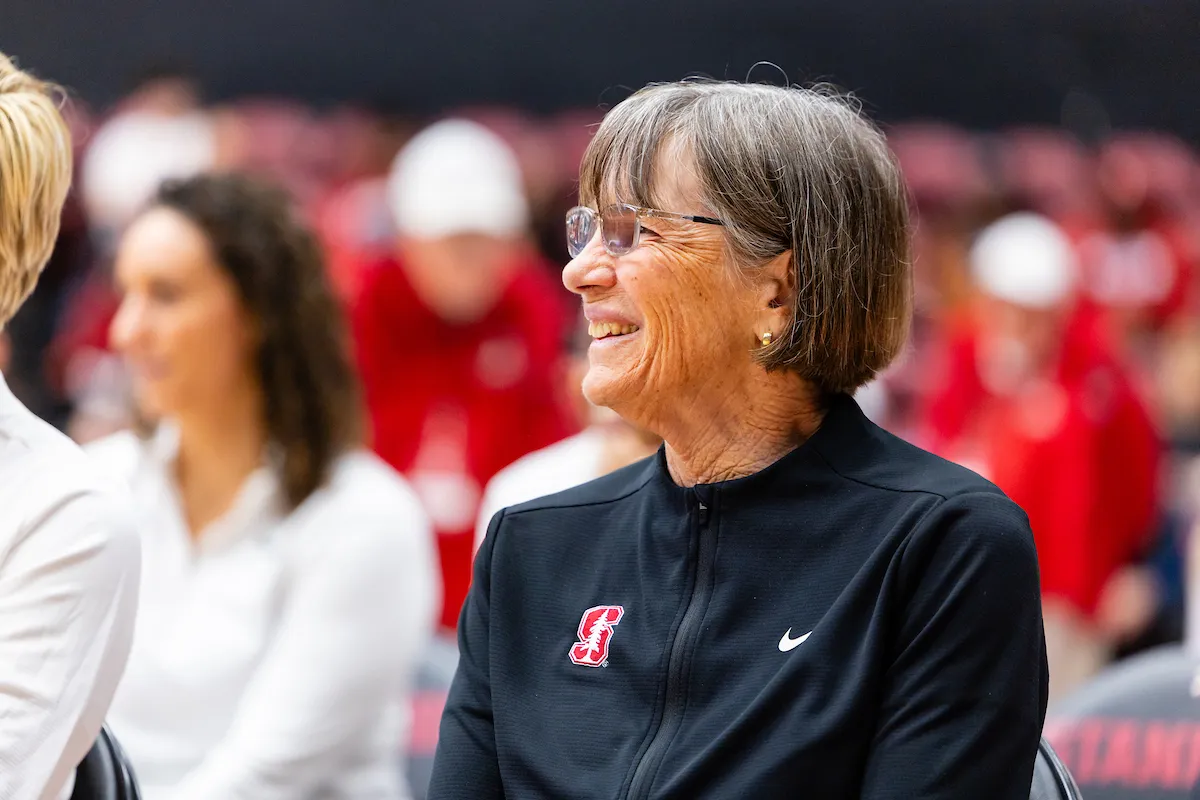
She sits a few rows behind Stanford’s bench, warmly greeting old friends as the women’s basketball team faces their first opponents of the season. Even for an exhibition game, she demonstrates her support in a Stanford pullover.
To the casual eye, she would seem like any other basketball fan taking in the game and rowdy atmosphere of Maples Pavilion. Those who know Stanford women’s basketball, however, will recognize her as Tara VanDerveer, the former head coach of the team and a pioneer in the sport.
Three national championships. 18-time Pac-12 Coach of the Year. Women’s Basketball Hall of Fame inductee. Second winningest coach in college basketball history. VanDerveer has done — and won — just about everything one can in college basketball.
However, what VanDerveer remains most proud of, more than any accolade or accomplishment, is the culture of sisterhood she built and instilled in each of her players. Her love for the program is evident not just in her dedication as a fan but in her praise of Stanford’s players, both former and current.
The Stanford Daily’s Remy Kim spoke with VanDerveer about her life after coaching, her thoughts on the women’s basketball team this season and the legacy she left on the sport as a whole.
This interview has been lightly edited and condensed for clarity.
The Stanford Daily (TSD): How have you been since you stopped coaching?
Tara VanDerveer (TV): Well, I still work in the athletic department, and I work for our athletic director. He calls me the “ambassador for the athletic department.” A lot of it is going to watch [games], helping coaches if they have questions or if they just want to talk to somebody. I guess you could say I’ve been here a long time, so I understand.
TSD: I heard you also taught a class at Stanford — Basketball: A Masterclass — last year. What was that like?
TV: I’m gonna teach it again. Last year, it was a little bit of Xs and Os. We’re going to talk about topics like gambling, so I’ve got a gambling expert. We’re going to talk about leadership, sports performance and all kinds of different topics. And then, I’ll invite some of the former players to come back and show where they are now. Someone like Karlie Samuelson or other great players.
TSD: Sounds amazing. Is there anything else you picked up since you stopped coaching? Any hobbies maybe?
TV: I have a lot of hobbies. My number one favorite thing in the summer is water skiing. I love to water ski.
TSD: In Minnesota, right?
TV: Yeah. I went about 100 times this summer, so I love that. I have dogs. I play bridge. My mother is 98, and I play bridge online with my mother and my sister. I have a bridge partner that lives in France right now, and we play pretty much every day. And then I come watch practice or come to games, and I just see everybody. It’s really fun.
TSD: Obviously, you’re still incredibly involved at Stanford, but are there any aspects of the head coaching role that you miss?
TV: Well, I miss really getting to know the players, working with them day to day. But Kate [Paye] is doing a fabulous job, and she has a great staff. It’s going to be a phenomenal team. It’s going to be awesome this year, and I’m really excited for that. Yeah, I miss it. I miss it a lot, but I was ready to make a change. There are other things you have to do in your life.
TSD: Speaking of Kate Paye, she told me the other day that Karlie Samuelson [a former Stanford player who recently joined the Stanford women’s basketball coaching staff] was someone she could always tell would end up coaching. Was that something you ever sensed with Kate, or was it more of a happy surprise when she started coaching?
TV: Kate as a player was incredibly competitive. She was very physical, too. You did not want to be out there with her. Kate can do anything she puts her mind to. I mean, she went to law school and Stanford Business School. She could be a lawyer if she wanted to. I would not want to see her on the other side of the bench because, whatever she does, she does really, really well. I just think she loves basketball, and she realized that it’s fun.
TSD: In regards to this year’s team, what excites you about this group and the players on the floor today?
TV: Well, first of all, the team suffered last year not going to the NCAA tournament, and every disappointment can be a blessing. I think this year’s team is a hungry team and they have some nice young freshmen that are very talented and really good kids. But the players that return I think still have to have a little stone in their shoe, you know?
TSD: Like a chip on their shoulder.
TV: Yeah, exactly. They have to want payback. The returners really know what it’s like, and they have to lead the way. I’m really excited about the freshmen, and they’re all doing really well, but the returners are gonna have to lead the way. They’re gonna have to compete hard every day, practice hard every day.
TSD: Shifting gears a little bit, I know this week is really important in the WNBA with all of the collective bargaining agreement (CBA) negotiations. You coached so many WNBA players, both former and current, as well as the president of the WNBA’s Players Association. Is that whole conversation something that you’re involved in, or is that something you’ve been keeping your distance from?
TV: Well, first of all, the Players Association is so lucky to have Nneka [Ogwumike ’12] as their president. Besides being super smart, she is such a genuinely great person. She’s all about doing things right and being right and fair and honest. I think she’s just a fabulous representative of Stanford, and for the players to have it on her side, I’m very confident that they will work it out. This is a really important time for the WNBA with the new teams coming in, the success of the Valkyries and all of the great players that they have. They’ll figure it out, but there is no better leader than Nneka. Yeah, I loved coaching her, oh my God. Have you ever met her?
TSD: No, I haven’t had the privilege, but I’ve watched her play a ton.
TV: Yeah, there’s no better person today.
TSD: Kate Paye actually mentioned that she inspired the team’s phrase: “sisterhood.” She said that it really came about from watching Nneka and the teammate she was to Chiney.
TV: I think they might have been the first sisters, and then Karlie and Bonnie and the twins, Lexie and Lacie. When you have sisters on the team, that’s a real sisterhood, you know? But I think this team is the real sisterhood. What we do, it’s not easy. Being a college athlete. You’re writing for The Daily, right?
TSD: Yes.
TV: If you put one thing in that I say, I want the students at Stanford to hear this: we have so many great, incredible, brilliant students at Stanford. I want them to remember, it’s one team. We’re all on Stanford’s team, and we want to support each other in whatever we do, whether that’s music or sports or whatever. And I think that Stanford is really a special place. Whoever you are, we just have to remember it’s one team. These student-athletes are taking all the classes. They got in. They did the application. It’s a different world, the athletic landscape, and they’re going to the east coast to compete, so I think the student support is something that means a lot to the athletes. It’s really fun when the student sections are filled up. I just really want to encourage not just the freshmen but all the undergraduates to come on out and watch these kids play, because they play hard.
TSD: They absolutely do play hard. And one final question: we as sports fans are just so lucky to see the impact you’ve had on women’s sports and women’s basketball. Is legacy something that you thought about while coaching or is that something that kind of happened organically? Are you glad to have left one?
TV: I kind of live in the present. You look down, you see your name on the floor or the banners or championships. And it’s like, was that my life? Yeah, I loved it. I absolutely loved it. But what’s really important is what we already talked about with Nneka or Karlie or Chiney or any of the other great players. Not just All-Americans, but All-American people. They’re doctors and teachers and moms, and they’ve been impacted in a positive way by being at Stanford. Our team has a very strong sisterhood. I think that’s the thing I’ve taken from it more than anything else.