
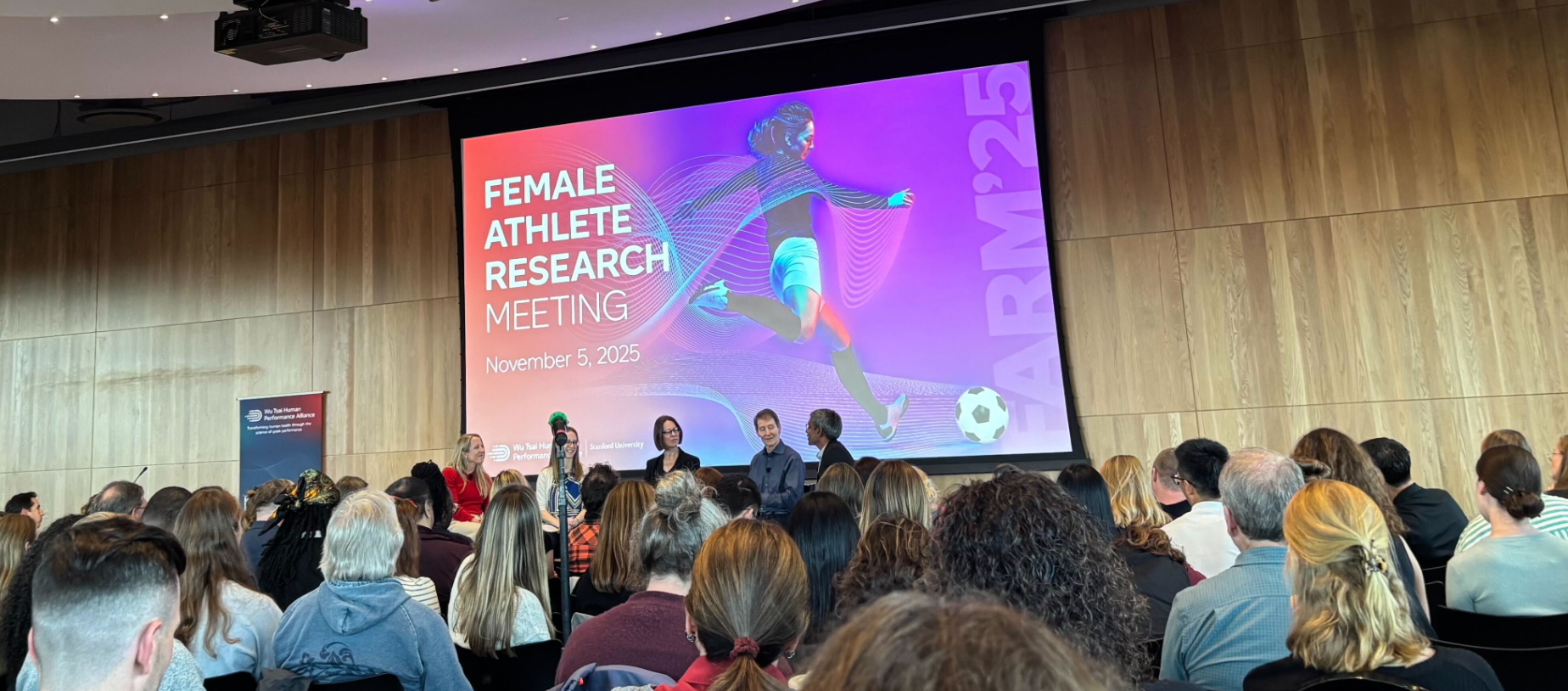
Scientists, clinicians and sports practitioners gathered in the Computing and Data Science building Wednesday to discuss breakthroughs in women’s athletic health research for the Female Athlete Research Meeting (FARM) conference.
Hosted by the Wu Tsai Human Performance Alliance, the conference explored how factors such as genetics, training, sleep, nutrition and mental health shape female athletic performance.
“Female athlete research is a major priority for the Wu Tsai Human Performance Alliance,” said Joy Ku ’98 Ph.D. ’04, senior director of the research initiative. “We hope the event will inspire new collaborations and innovative ideas that further advance the well-being and performance of girls and women in sports.”
In a welcome letter for FARM, Jennifer Hicks M.S. ’06 Ph.D. ’10 and Scott Delp M.S. ’86 Ph.D. ’90, event leaders and directors of the alliance, wrote with Kraus that “the health and performance of women and girls in sport have been understudied, but that is finally starting to change.”
The team wrote that they envisioned “a future where fewer athletes face devastating ACL injuries… and where the principles of female performance are not a patchwork but a comprehensive playbook.”
Claire Swihart ’29, an attendee who has experienced Relative Energy Deficiency in Sport (RED-S), a condition where an athlete’s caloric intake does not support their level of physical activity, said she held a strong interest in optimizing nutrition and performance for female athletes and was eager to explore all the opportunities that FARM had to offer.
“It’s such an amazing opportunity to talk to people who are also interested in female performance, and I’m excited to learn more about what the new developments are in the field,” Swihart said.
One of the event’s central discussions, “Nutrition and Fueling,” focused on emerging research on how food timing, diet composition and gut health influence athletic outcomes. Emily Kraus, director of Stanford’s Female Athlete Science and Translational Research Program (FASTR), and Kristen Gravani, director of Olympic Sports Nutrition, moderated the session.
Kraus opened the panel by calling nutrition and recovery “some of the most under-researched and often misunderstood areas in sport science, especially for the female athlete.”
She then introduced Micheal Fredericson, the head team physician for Track & Field and Swimming, who presented the “Healthy Runner Project,” a seven-year study targeting bone stress injuries in collegiate runners at Stanford and the University of California Los Angeles (UCLA). The project introduced team-based nutrition education and individualized fueling plans to address under-fueling, which is often linked to bone stress injuries in female athletes.
The results were striking.
“We cut our bone stress injuries down by over half [at Stanford],” Fredericson said. “Stanford women had a reduction from 63 injuries per 100 person-years to 28. It took time, but we were able to get buy-in from everybody — from the coaches, the athletes, the administration — to really change the culture of the team.”
Next, Satchin Panda, a professor at the Salk Institute for Biological Studies, discussed his research on time-restricting eating and circadian rhythms. Panda’s lab found that aligning feeding schedules with biological clocks could enhance endurance in animal models.
“At least in mice, time-restricted feeding can improve performance irrespective of what diet they ate,” Panda explained. “Female mice are more sensitive to change in diet quality or timing… metabolic flexibility may be key behind all these performance improvements.”
While the work is preclinical, Panda suggested it may have future implications for optimizing training and recovery cycles in athletes.
Finally, Erica Sonnenburg, a senior research scientist in microbiology and immunology at Stanford, highlighted the gut microbiome’s role in athletic resilience. Sonnenburg’s research found that fermented foods can improve microbial diversity and reduce inflammation.
“Participants increased their microbiome diversity by about 25% and decreased many markers of inflammation,” she said. “Fermented food is a clean lever, both on the microbiome and our immune status.” She also advised athletes to seek evidence-based information, warning that “there’s a lot of misinformation out there.”
Co-moderator Gravani reflected on the decade she spent directing nutrition for the university’s athletic teams.
“One of the most impactful things was not just seeing the change in injury prevention, but also the organizational culture,” she said. “Athletes began prioritizing their health and educating the next generation.”
Gravani urged athletes to adopt a long-term view of their health.
“Sometimes [prioritizing long-term health] comes at the expense of the quick fix everyone’s looking for,” she said. “But we need to look more strategically at your whole season, your entire career — not just this one moment.”
Correction: A previous version of this article contained a misspelling of Joy Ku’s name and misstated her role in the Wu Tsai Performance Alliance. The Daily regrets these errors.