
“Toxic poison.”
“Too consuming.”
“My engagements were inauthentic.”
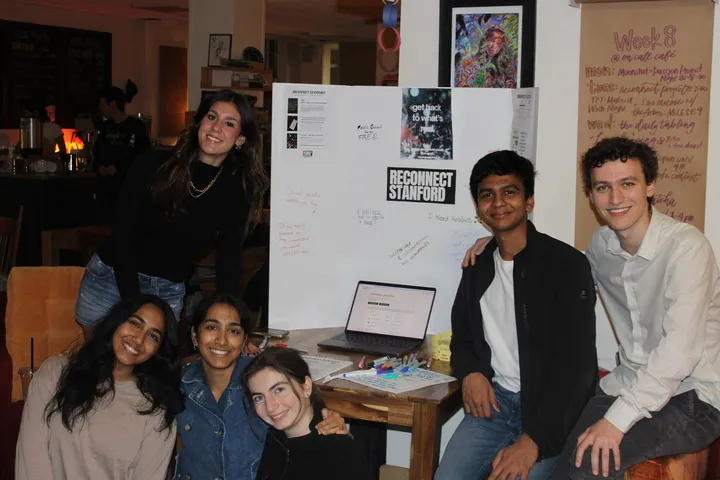
These were some of the testimonials written on Tuesday night by students who gathered at On Call Café for a “mass social media deletion event” hosted by Reconnect Stanford, a student organization, committed to encouraging and supporting students through “social media sobriety.”
By the end of the night, 25 students had quit social media and added their names to a growing list of objectors. They also received a free On Call drink and the opportunity to engage with like-minded students, free from the distraction of doomscrolling.
“We are living through a loneliness epidemic, and no one is talking about it,” Emi Sakamoto ’28 wrote in her testimonial. Sakamoto deleted Instagram two months before Tuesday’s event as one of the earliest additions to Reconnect Stanford’s movement.
“I’m ready to start practicing the principles I believe so strongly in,” Sakamoto wrote.
For the founders of Reconnect Stanford, social media deletion is more than a pathway to being a productive or present individual — it’s a requirement for a healthy society and well-functioning generation, they said.
“Our idea is, by the time we graduate, to have this campus be a place where nobody has [social media],” co-founder Ben Botvinick ’28 said. “I’ve never heard of somebody deleting Instagram and regretting it. I’ve never heard of somebody deleting TikTok and regretting it. It just doesn’t happen.”
Co-founder Truitt Flink ’28 deleted social media a year ago and felt the positive impacts of her decision ever since.
“I realized I was missing out on moments in my life, moments that were only being viewed through a screen or through a falsified version of them that I was later going to craft and post on my feed,” Flink said. “That mattered more to me than the real moment, and I didn’t want that to be the case anymore.”
Eight weeks into her first year at Stanford, Allegra Bockhaus ’29 felt there was no longer a place for social media in her life, she said. Bockhaus deleted TikTok at Reconnect Stanford’s event.
“I realized how many opportunities there are [in college], and I want to take every opportunity and live life to the fullest,” Allegra said. “I feel like social media holds people back from that.”
Other students expressed similar sentiments, including Diya Bhattacharjee ’28, who deleted Instagram on Tuesday night. Bhattacharjee said that social media felt like a “cloud hanging over” her head, and she felt tired of considering how she was being perceived online.
“My mental space is the most valuable thing I have,” Bhattacharjee said. “Someone else [online] is taking that away from me, and they don’t deserve to do that. If I want to live the most fulfilling life, I need to use my brain to my full capacity, which can’t happen when I have social media.”
In speaking with students at Tuesday’s event, Flink and Botvinick found that most people dislike the role social media plays in their lives. Student testimonials acknowledge apps like TikTok and Instagram as a time drain and a source of anxiety. However, most social media users find a reason to keep it downloaded, whether to stay in touch with long-distance friends or follow news and campus events.
Botvinick likes to point out to students on the fence about deleting their accounts that the ability to do those things predates social media.
When she represents Reconnect Stanford, Flink said she doesn’t try to tell students what to do or how to live their lives. Instead, she said she poses a thought experiment: imagine yourself on your deathbed confronted with the way you chose to spend your life. If you have regrets or unfulfilled goals, imagine how that would change if you could get your time spent scrolling back.
Reconnect Stanford aims to be “like Alcoholics Anonymous for social media,” Flink said.
“We created Reconnect Stanford to empower people to continue making this choice every day and to be with people who have made the same choice, because that’s how addictions work,” Flink said. “You have to have a support network.”
In the future, Reconnect Stanford hopes to have a row house for their growing community. They envision a space that fosters connection, where people engage with one another at all hours of the day instead of scrolling.
However, leadership members missed the application window to establish a theme house, and the University only reopens applications every four years. As sophomores, Botvinick, Flink and other founding members will graduate before having the chance to apply again, but this has only further motivated Botvinick.
“If we can’t have a house, make it the whole campus,” he said.
Future Reconnect events in the works include phone-free dinners and parties. The co-founders of the organization encourage anyone interested in Reconnect Stanford’s movement to reach out at any time.
“It’s very clear that this is something this campus needs,” Flink said. “We’re really excited to fill the need and welcome people into a community that’s devoted to real connection.”