
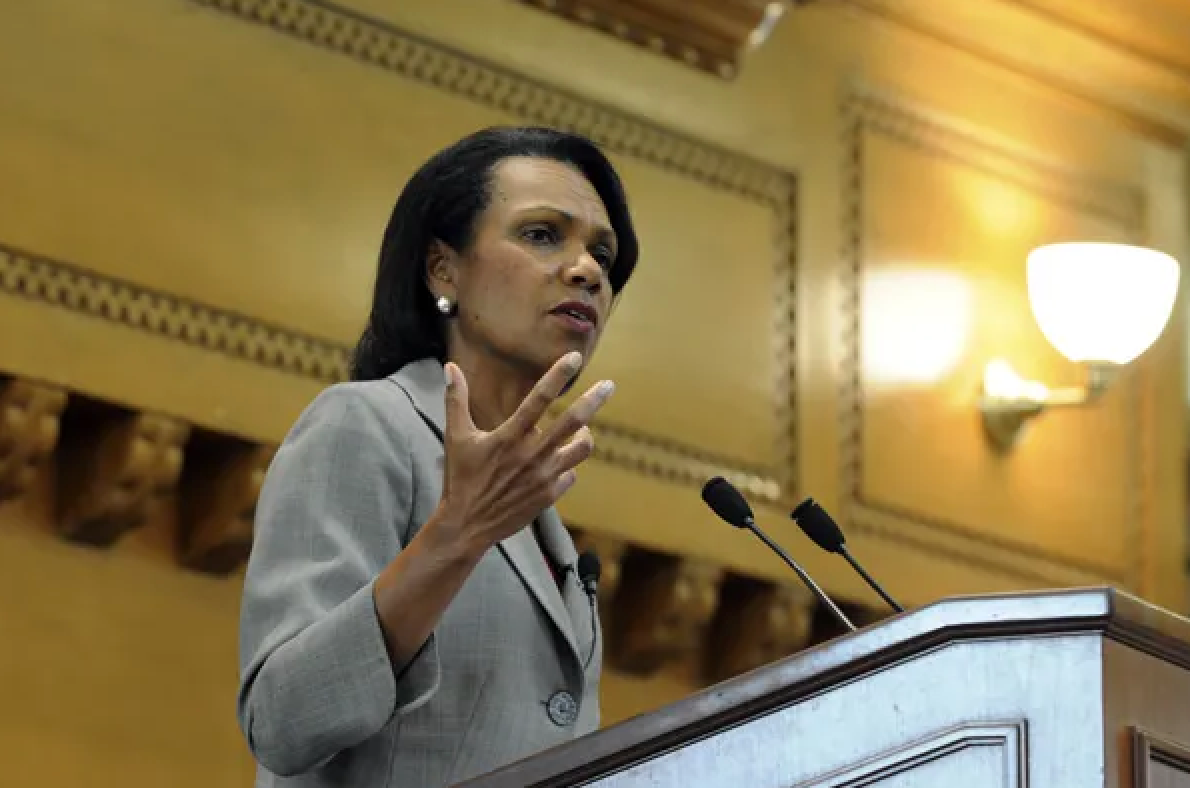
Stanford Continuing Studies, a program that shares educational resources with adult students, hosted the sixth and final installment of its “Reimagining Democracy” speaker series on Nov. 11. Coinciding with Veterans Day, the virtual webinar brought in Condoleezza Rice, former Secretary of State, director of the Hoover Institution and Senior Fellow on Public Policy, to discuss restoring faith in American institutions.
She was introduced by hosts Larry Diamond, Mosbacher Senior Fellow in Global Democracy at the Freeman Spogli Institute (FSI) for International Studies, and Karina Kloos, executive director of ePluribus Stanford. The two moderated the discussion, asking Rice about how citizens and leaders can help reinstate public confidence in democracy.
Before proposing how to reduce the stresses on democracy, Rice addressed the roots of declining trust in American institutions, citing waning confidence in electoral systems, civic structures, universities and even the military.
“There is an across the board sense that Americans don’t think their institutions are trustworthy,” she said.
Rice argued that this dissatisfaction stems from the belief that these institutions are not living up to constituents’ expectations. “When people elect their officials, they expect them to perform and be able to solve their problems,” she said. “[People pursue] circumstances in which they can build a fulfilling life,” which can lead to “a disappointment in the capacity of democracy to deliver.”
She pointed to Congress as an institution in need of reform, suggesting term limits could bring “fresh blood” and new perspectives to the House and Senate, where roughly 20% of members are 70 or older. Diamond agreed, suggesting that the older age of many representatives might be hindering fresh ideas and adaptation to modern issues.
“I don’t think the framers imagined you’d have members of Congress living into their eighties and nineties and still serving in Congress,” he said.
Rice also emphasized the role of civil education in strengthening faith in democratic institutions. She called for a larger focus on educational equity, not only in higher education but also in K-12 schools.
“The real force of mobilization, which is a high-quality education, is becoming class-based,” she said, which leads to “politics of resentment rather than a sense of opportunity.”
In reforming education, Rice feels that there is an opportunity to promote public service. She urged the audience to find ways to serve, whether through the military, organizations like Teach for America or engaging with local government through campaigns.
More than anything, though, Rice stressed the importance of being open-minded and willing to learn from different opinions. She highlighted two key practices for doing so: listening and civility. “Learning to listen to other people is important. You have to be open to changing your mind. If you aren’t open to changing your mind, we won’t get anywhere,” she said.
Rice added that Americans have a responsibility to “engage in a way that is civil, that is respectful, in a way that furthers the conversation rather than shutting it down, with your fellow citizens.”
Kloos, who leads Stanford’s Democracy Hub, echoed this, noting that civic dialogue is central to the undergraduate COLLEGE course that she teaches. “There’s lots of tools, including dialogue [in democracy],” Kloos said.
Rice concluded by reminding the audience that democracy depends on the will and participation of its citizens.
“Democracy requires each and every one of us to participate in it. If you aren’t active in your democracy, then you deserve the democracy you get,” Rice said.
Despite the challenges facing American democracy, Rice expressed confidence that the U.S. system remains a model for the world. “Democracy is hard, and we’ve certainly had our stumbles. But there’s no better system that’s ever been founded than when humans have the dignity to choose who represents them,” she said.