
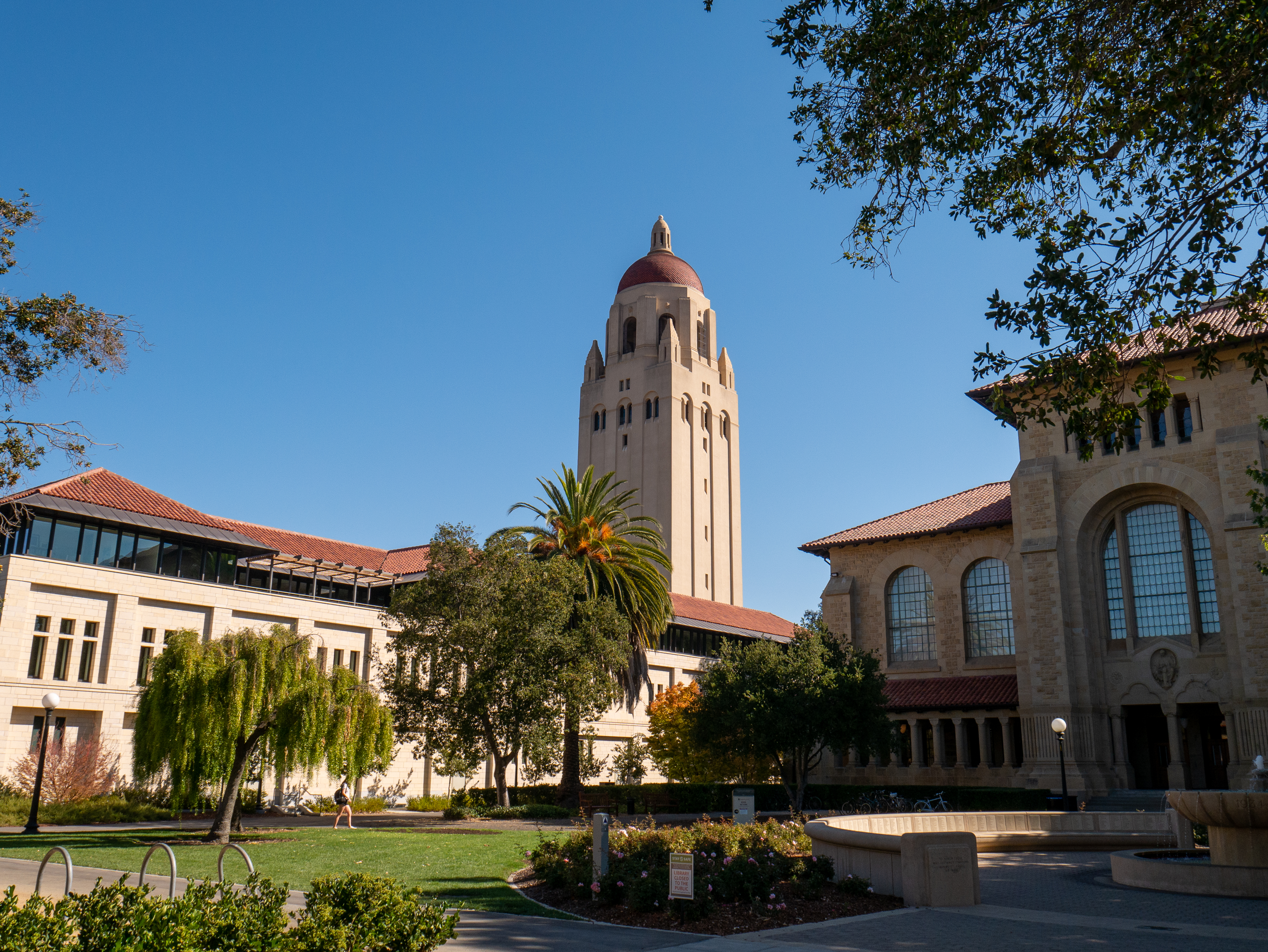
Hoover Tower looms over campus, dominating our skyline in a metaphor for the political power that permeates society.
It may seem counterintuitive that the largest landmark at a school known for its stellar sciences and proximity to Silicon Valley is not tech-oriented. In 1941, the tower was commissioned by former U.S. President Herbert Hoover to house “rare library and archival materials.”
Over 80 years later, I now frequent the tower as a student fellow at the Hoover Institute and am equally invested in government through my political science major. And so, I was recently disappointed to see a news piece from The Daily on the apparent apathy students felt towards political engagement and the low attendance for Democracy Day panels and events on Meyer Green last week.
I was on one of those panels, and we discussed the First Amendment, a relevant and contentious issue on most college campuses. The panel held voices across the political spectrum, including me and Jennifer Levine ’28, the co-managing editors of The Daily’s Opinions section, Joe Nail MBA ’26, the founder and president of the America Club and Robert Liu ’28, the vice president of Stanford College Democrats.
The low turnout wasn’t a hit to my ego. I enjoyed the conversation with the other panelists, and I attributed the sparse audience to a busy midterm season, tired students and, hopefully, off-campus voting.
However, I’m not so sure the low turnout for events on Meyer Green that day accurately reflected the entire Stanford student body. The night of Democracy Day, I attended Dine and Dialogue, an event that brought together faculty and students through engaging political discussion. Unlike earlier programming, the event was so packed that I, along with several other students, had to wait for more chairs to be brought in. Some students had to stand next to tables to join the conversation.
Student interest in government isn’t just limited to Democracy Day, either. When Gov. Ron DeSantis came to speak, the auditorium was filled, and most students were unable to get access to the event. The classes I take as a political science major are usually so popular that professors have long waitlists, and the discipline provides unparalleled access to professionals working in government.
Although computer science is the most common major at Stanford, political science and international relations also rank in the ten most popular majors.
As a testament to Stanford’s robust academic political scene, I’m in an American intelligence class taught by Amy Zegart called “Spies, Lies, and Algorithms,” where we’ve had the privilege of hearing from guest speaker Christopher Wray, the former director of the FBI. This past weekend, the entire class engaged in a day-long intelligence simulation where we worked in teams acting as different intelligence agencies (what the intelligence community calls “wargames”). A class with roughly 100 students waking up at 8 a.m. participating in a simulation on a Saturday does not signal apathy. It demonstrates a deep passion for policy and government.
We have spaces for liberals, moderates and conservatives. The Hoover Institute, although officially nonpartisan, has a reputation for conservative leanings. Students on The Stanford Review staff feel Stanford offers more to conservatives than the Ivies do.
But unlike the Ivies or other top East Coast schools, Stanford’s political fervor feels limited to the minority of students actively engaged in politics. The dominating culture on campus feels largely apolitical. Policy obviously affects our personal rights and interests. And yet, I’ve noticed that aside from ultra-significant issues like abortion, it’s often hard to feel like policy matters in our isolated Stanford bubble.
Involvement in government is still essential for everyone. Although I study political science, am a Hoover undergraduate research fellow and remain engaged in the campus political scene, I don’t plan on starting my career in Washington. I’m invested in politics because, while I pursue other professional interests, from finance and media to consumer retail and real estate, policy remains steadfastly intertwined in everything I do. Financial markets are tied to geopolitical events, such as the Middle East crisis in Gaza. The media is not always safe from governmental powers. Consumer and retail patterns are shaped by tariffs implemented by new administrations. Real estate regulations limit both platforms and properties.
Computer science majors, too, should be engaged in government. Artificial intelligence (AI) policy is crucial to the future of the technology sector, and the startup world is reliant on public policy. The longest government shutdown might have finally ended because of a reopening deal involving healthcare policy.
The basis for all these disciplines — university research — is very political. In 2024, a Daily article found that 75% of Stanford’s 7,500 research projects were funded by the U.S. government.
Policy is embedded within all disciplines and professions. I urge Stanford students to take this to heart — and turn that conviction into action. No matter what you’re studying or what your post-grad plans are, policy will always be relevant.
I’m almost certain that the political science major won’t surpass computer science anytime soon. And next year, my feelings won’t be hurt if you don’t show up to the panel discussions, even if I’m speaking. My wish for the Stanford community is for all students to see the value in increasing their engagement in government and understanding the relationship between policy and their interests.
To create lasting impact, we must realize that policy transcends the ballot. It’s critical to everything we do.