
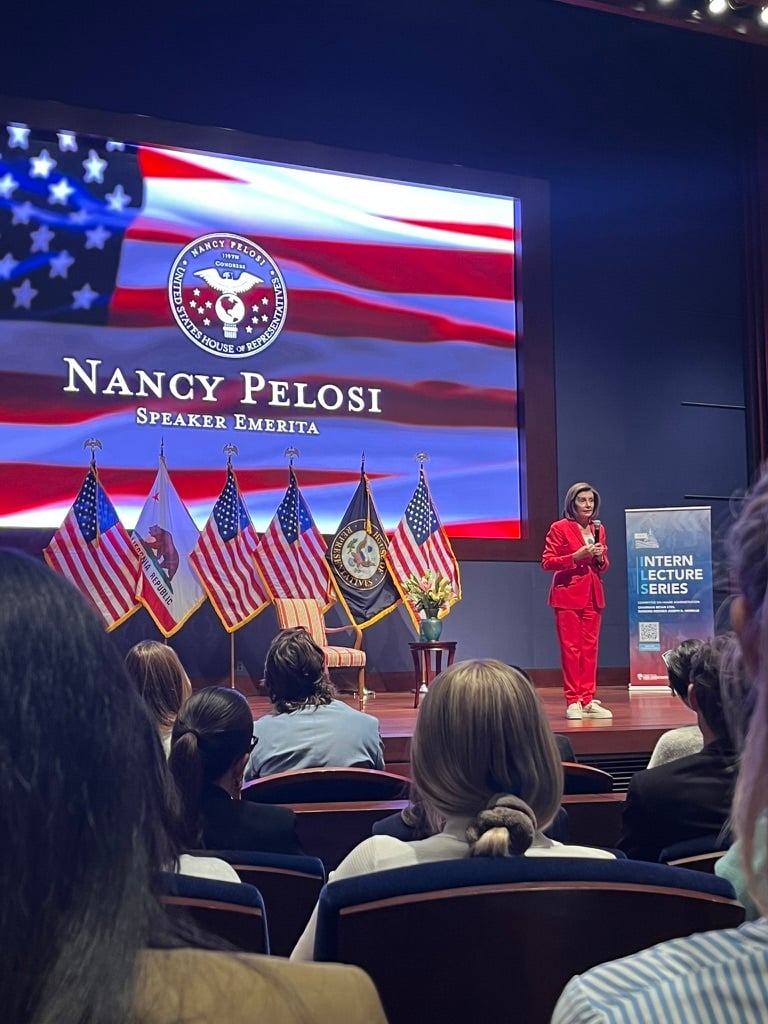
Rep. Nancy Pelosi (D-Calif.), two-time Speaker of the House of Representatives and the first woman to serve in the position, announced on Nov. 6 that she would not run for reelection to Congress in 2026, capping off a nearly four-decade-long career in politics.
In light of her retirement, Stanford faculty and students highlighted Pelosi’s congressional successes and her role as a pioneering woman in American politics.
Pelosi, who has represented San Francisco in Congress since 1987, led House Democrats from 2003 to 2023 under four presidents: George W. Bush, Barack Obama, Donald Trump and Joe Biden. Defining her two speakerships were the passage of the Affordable Care Act (ACA, also known as Obamacare) under Obama and two impeachments of Trump. In 2007, Pelosi became the first female speaker and the highest-ranking woman in U.S. history until Kamala Harris was elected vice president.
In 2023, she announced that she would retire as House Democratic leader and was succeeded by Rep. Hakeem Jeffries (D-N.Y.), but she has continued to serve in Congress with the title of speaker emerita.
As of Nov. 17, two Democrats have announced they will run to succeed her: State Sen. Scott Wiener (D-Calif.) and Saikat Chakrabarti, former chief of staff to Rep. Alexandria Ocasio-Cortez (D-N.Y.).
Ava Acevedo ’26, the president of Stanford Women in Politics, said she considers Pelosi a “tremendous trailblazer” and role model both as a woman in politics and as a legislative leader who has remained faithful to her principles.
“I think that many women interested in the political sphere are sometimes intimidated to an extent by a space that wasn’t really built for us,” Acevedo said. “She carries herself so unapologetically, with such confidence and sticking true to her values, in a way that is very inspirational to myself and other women in just showing what is possible.”
Adrianna Zhang ’26 M.A. ’26 described Pelosi as someone who has “opened the door behind her to let people in,” emphasizing her role in recruiting female candidates to run for Congress in 2006 and 2018. Zhang added that by not shying away from her role as both speaker and a mother, Pelosi has demonstrated herself to be both “the strong leader of a household and a country.”
Zhang, a San Francisco resident and an Assembly District Delegate for the California Democratic Party, also said she believes that Pelosi has remained committed to her district, despite her national profile.
“Pelosi is thinking about how policies can help the United States as a whole but especially uplift the place she represents,” Zhang said, citing Pelosi’s presence at local events and the funding she earmarked for the city.
According to public policy professor and former Democratic California state legislator Joe Nation, when Pelosi was first elected to Congress, “not very many people took her seriously.” However, he said that she “surprised” people with her focus on “getting stuff done” over the prestige of any political title or office.
Hoover Senior Fellow and political science professor David Brady said that speakers should not be evaluated based on their policies, but rather by “the coalition they had to deal with” to pass legislation and the specific political context they faced. In particular, he explained her key role in the passage of the ACA in 2010.
Brady noted that when Pelosi was first elected speaker, she navigated Democrats’ ideological diversity to prevent hurting the Democratic Party’s popularity ahead of the 2008 presidential election. One such example, Brady said, was her refusal to support an impeachment effort against Bush.
He added that Pelosi helped ensure the passage of the ACA after Democrats lost their filibuster-proof majority in the Senate, forcing the House to approve the Senate-passed version as-is. “Irrespective of whether you like the policy or not, she’s been a very effective speaker,” he said.
Nation also highlighted Pelosi’s political acumen in pushing the ACA through the House. “I don’t know if it would’ve happened without her,” he said. “I don’t think anyone would call her a policy wonk, but she is a political wonk. She knew how to get stuff done and still does.”
According to Brady, Pelosi has also been a “formidable fundraiser,” which he considers one of a speaker and party leader’s most important roles. Both he and Zhang said that Pelosi played a major role in the passage of Proposition 50, which California voters approved on Election Day this year.
Nation said that when Gov. Gavin Newsom introduced the proposal in August, “there was real doubt about whether it was going to pass,” but Pelosi’s immediate support for the measure catalyzed fundraising and support for the campaign. “I think she was instrumental in terms of… seizing the opportunity and then getting the money behind it to make it happen,” he said.
Even with Pelosi’s pending departure from elected office, both Zhang and Nation expect her to continue to play a leading role in Democratic politics.
“She’s left a great foundation for whoever comes next to be able to thrive, but I’m sure there are still plenty of people knocking on her door to ask for advice and understand the direction of where the Democratic Party should go,” Zhang said.