
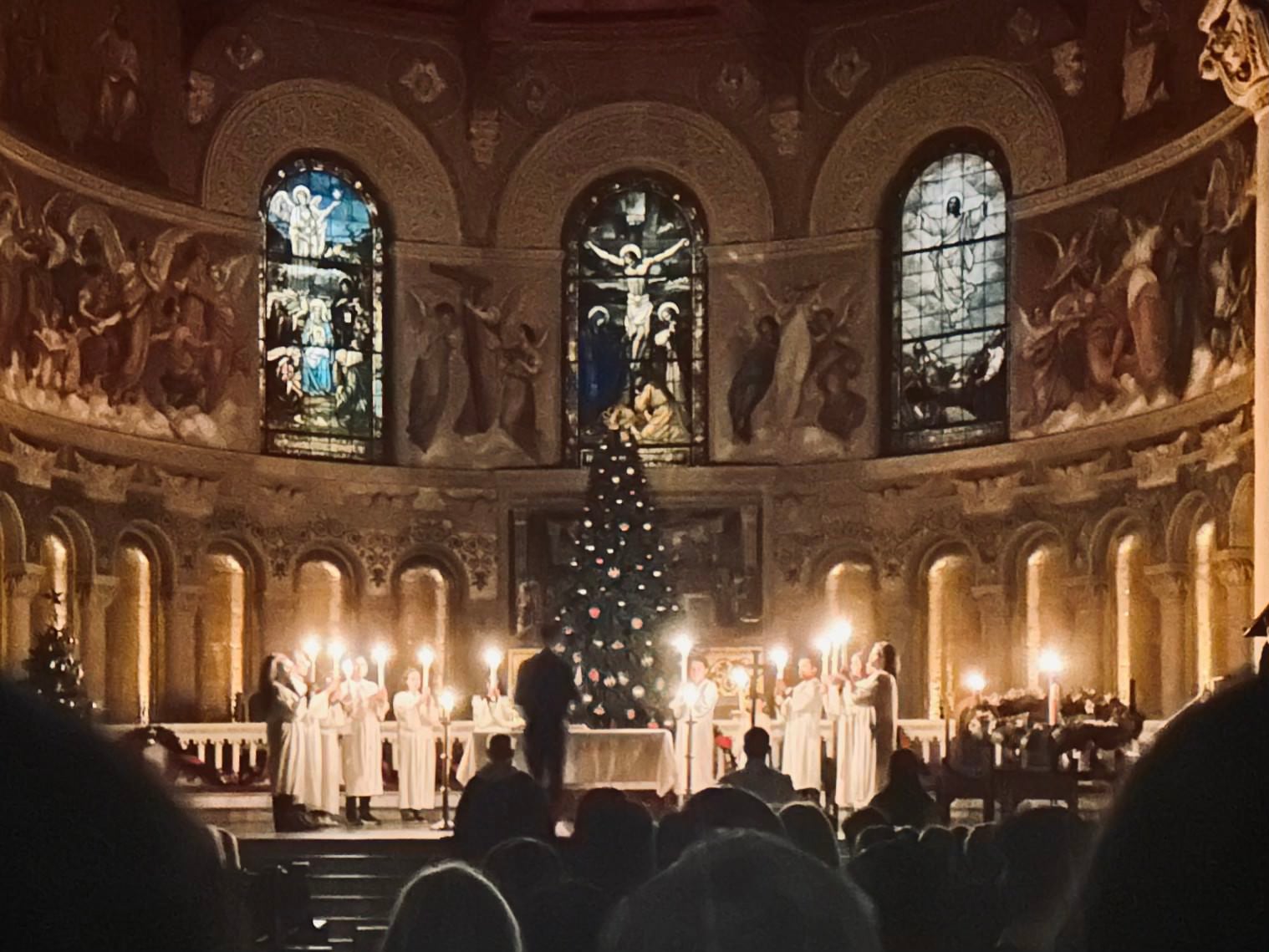
I’m sitting on a freezing wooden pew in the back of the St. Paul Cathedral as I wait for my first mass to begin. Unlike most Catholics, this first-time attendance happens when I am seventeen rather than seven. Also unlike most Catholics, I am not Catholic. I’m an atheist curious to see what draws more than 15 million Americans out of bed every Sunday.
The deacon begins the sermon, displaying impressive control of scripture as he guides us through fiery verses. A professional vocalist even sings a few poignant hymns. Then, abruptly, the sermon halts. “The Minnesota End-of-Life Option Act,” the deacon proclaims, “is something I must bring to your attention.” The bill he’s referencing would allow terminally ill adults to consent to physician-assisted suicide. “They’re not talking about this bill in the news — they’re trying to quietly pass it,” the deacon continues. “I can’t allow that to happen. God will decide when we are called home. It is not my choice to make when I die.”
The deacon is not alone in his stance. Primarily due to religious belief, only 11% of Catholic clergymen across the U.S. think physician-assisted suicide (PAS) should be legal. Other Christian denominations are not nearly as against it — around half view doctor-assisted suicide as immoral. The general population is even less opposed to PAS, as 66% of U.S. adults support legalizing it.
At its core, physician-assisted suicide is a personal decision. If presented with the option of PAS, the deacon would probably refuse it; a different Christian might not.
This is not an advocacy piece for its legalization. There’s pragmatic discussion across party lines on whether PAS is a slippery slope to euthanasia or if it overrides the integrity of physicians otherwise entrusted to heal.
But the deacon didn’t mention either of those discourse topics in his sermon. I can’t help but assume that when he filled out his ballot, his vote against PAS was dictated by his religion. He knew that others, even fellow Christians, didn’t share his interpretation of God’s word, and yet he still voted as if every American were a member of the pew.
I think voting this way is a problem.
The vast majority of Americans believe religion and government should remain separate. That’s why the U.S. doesn’t resemble Medieval Europe, where the Catholic Church held immense direct power over policy. But if the religious institutions of today can’t whisper in the ear of politicians, the next best thing is to have their believers, like the deacon, vote on their agendas. In a way, each time someone considers the Church’s opposition to a personal choice and votes to prohibit others from making it, the Church regains some of its power over the state.
That defeats the purpose of separating religion from government, which is to prevent a single group’s value system from caging Americans into one way of thinking.
However, not all religious beliefs have the same problematic effect on voting. The kind of impact we should avoid is when religion constricts the right to choose. To help identify which beliefs do that, I’ll classify them into two categories: views shaped by religion, and religious views.
The former is an understanding of the secular world adjusted by faith. For example, 53% of Americans claim religious teachings greatly influence their understanding of right and wrong. For them, spirituality has helped create their morality, which in turn allows them to think critically about who and what to vote for.
In contrast, a religious view, as I define it, is a belief about how a religious person should lead their life. A Protestant might have conviction in traditional gender roles, or a Sikh man might be dedicated to wearing the Five Ks. Not everyone believes in the same practices or structures, even within a single faith. So, voting to hold everyone to these customs doesn’t make sense.
Physician-assisted suicide is just one personal choice issue where people extend religious views to the voting booth. The same dynamic appears, perhaps more visibly, in debates over LGBTQ rights. For instance, the right to same-sex marriage has remained a central political battle even more than a decade after its legalization in Obergefell v. Hodges. The link between opposition to same-sex marriage and religious belief is indisputable — just 10% of people who oppose it consider themselves religiously unaffiliated, whereas 84% of those against it are not only religious, but Christian in particular. Religious justifications for opposition are mostly rooted in a desire to uphold tradition, or, in other words, impose personal preferences about sexuality on society at large. To that end, the first explicit formal request to overturn Obergefell was based on religious ideology.
Further, religious views have fueled attacks that restrict the personal choice of people who cannot vote to protect themselves, such as transgender youth. Thus far into 2025, over 100 anti-transgender bills have been signed into U.S. law. The strong correlation between transphobia and religion suggests religious views helped drive that legislation. Therefore, voting based on religious preference is partially responsible for 40% of transgender youth in the U.S. living in the 27 states that have banned access to gender-affirming care, sports participation or bathroom use. Passing these kinds of state-level anti-transgender laws is associated with an up to 72% increase in the statewide suicide rate of transgender youth.
I make this point not to condemn religion, nor the people that follow it. I do not think believers should abandon their ideas or change how religion influences their personal lives. I only hope that I, and countless others, should not be made to live according to how one God or another asks us.
When I left the St. Paul Cathedral that day, I was not angry. I did not think less of Catholicism, nor of the deacon. I would still love to sit down with him and learn more about his beliefs. But I would like him to share his faith — not legislate it.