
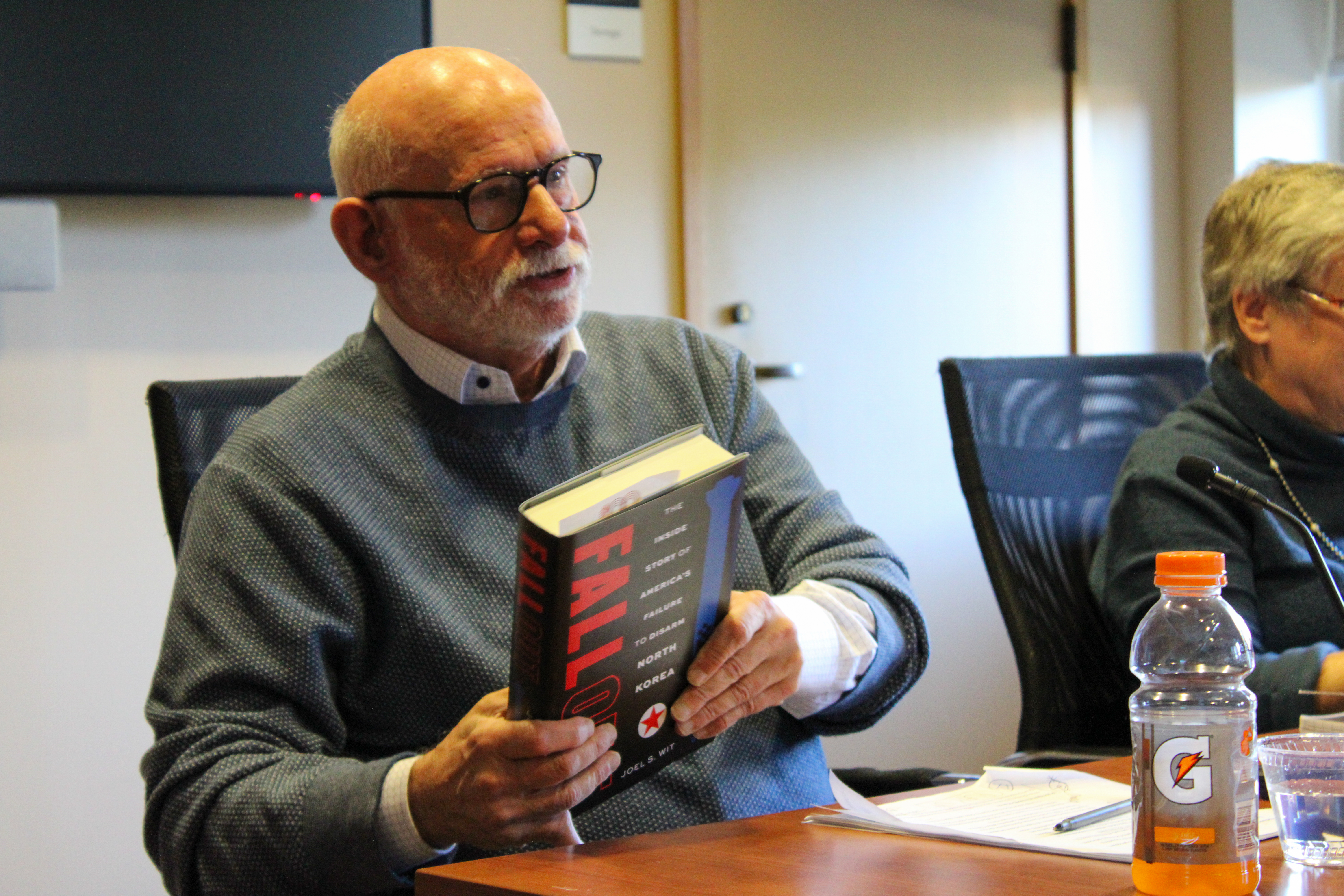
Under the Obama and Trump administrations, American foreign policy toward North Korea has been defined by a mix of presidential ignorance and internal inertia, former State Department official Joel S. Wit argued at a Tuesday event held by the Center for International Security and Cooperation (CISAC).
The talk was moderated by Rose Gottemoeller, the William J. Perry Lecturer of the Freeman Spogli Institute and former U.S. Under Secretary of State.
Wit, who helped negotiate the 1994 U.S.-DPRK Nuclear Agreed Framework, spoke about his new book, “Fallout.” His talk drew on his insider’s account of how the U.S. government failed to stop Pyongyang from becoming a nuclear power.
CISAC communications and administrative associate Gabby Ermanni wrote in an email to The Daily that the center decided to host the event to generate discussion about North Korea-U.S. relations, the topic covered in “Fallout.”
“CISAC scholars have a long history of interest in the North Korea nuclear weapons program, dating back to the tenure of Dr. Siegfried Hecker, former CISAC co-director [and] former director of Los Alamos national laboratory,” Ermanni said.
Wit began the talk with the claim that the Trump administration entered its first term ill-equipped for the complex issue of North Korea.
When Donald Trump was officially elected President in 2016, then-President Barack Obama knew that North Korea was going to be a central topic of conversation between them, according to Wit.
Wit recounted an instance when Trump appeared unaware of the basic geopolitical reality of the peninsula.
“Indeed, there were reports that he did not know there are two Koreas,” Wit said.
But Wit’s critique was bipartisan. He argued that the Obama administration, which is often credited with a more measured diplomatic approach, did not perform well on the matter of North Korea.
He pointed to 2014, when Obama was “not happy about” the U.S. military’s inability to eradicate North Korea’s new mobile missile launchers. A strike to eliminate them was brought up by the White House but not executed after the Pentagon’s report, Wit said.
According to Wit, when Obama was briefed as the president-elect by then-Director of National Intelligence Mike McConnell, the two paid little attention to the issue of North Korea, focusing on Iran instead.
“[Obama] told aides that he will negotiate with dictators, but not the North Korean dictators,” Wit said. He also said that Obama once proclaimed that North Korea is a “crime family, not a country.”
Wit pointed to the 2019 Hanoi Summit as a blunder of Trump’s first term — a moment that “could have been a big success.” Instead, Wit said, the summit ended in “big failure” when Trump proposed an ultimatum for North Korea — destruction of more nuclear facilities or preservation of economic sanctions — that left the meeting without a resolution.
International policy lecturer Daniel Sneider, who was present at the event, challenged Wit’s account of North Korea-U.S. relations and his interpretation of the summit.
According to Wit, the U.S. and North Korea drafted a ten-page document before the Hanoi meeting containing conditions to settle the issue of nuclear weapons. Wit “doesn’t think people understand how close” the issue was to resolution.
However, Sneider said that Wit’s interpretation is “off-base.” According to Sneider, the alleged document did not resolve the most important issue of nuclear solution.
According to Sneider, Kim was not sincere in abandoning nuclear weapons. “[Wit] said that this was a failure in American diplomacy … I am not disputing this claim [in terms of the consequences], but it is because the North Koreans decided to go down the road,” he said.
Sneider critiqued Wit’s failure to mention South Korea’s presence at the summit. According to Sneider, progressive South Korean president Mun Jae-in was eager to pursue a deal.
Wit’s talk came as the speculation of a fourth Trump-Kim meeting garnered media attention several weeks ago, when Trump visited South Korea for the first time in his second term.
Responding to an audience’s question on the current re-building of U.S.-North Korean relationships, Wit said the “step one” is getting Russia and China on board.
“[That includes] getting realistic goals … [for instance] not to totally eliminate North Korea’s nuclear weapons,”Wit said.