
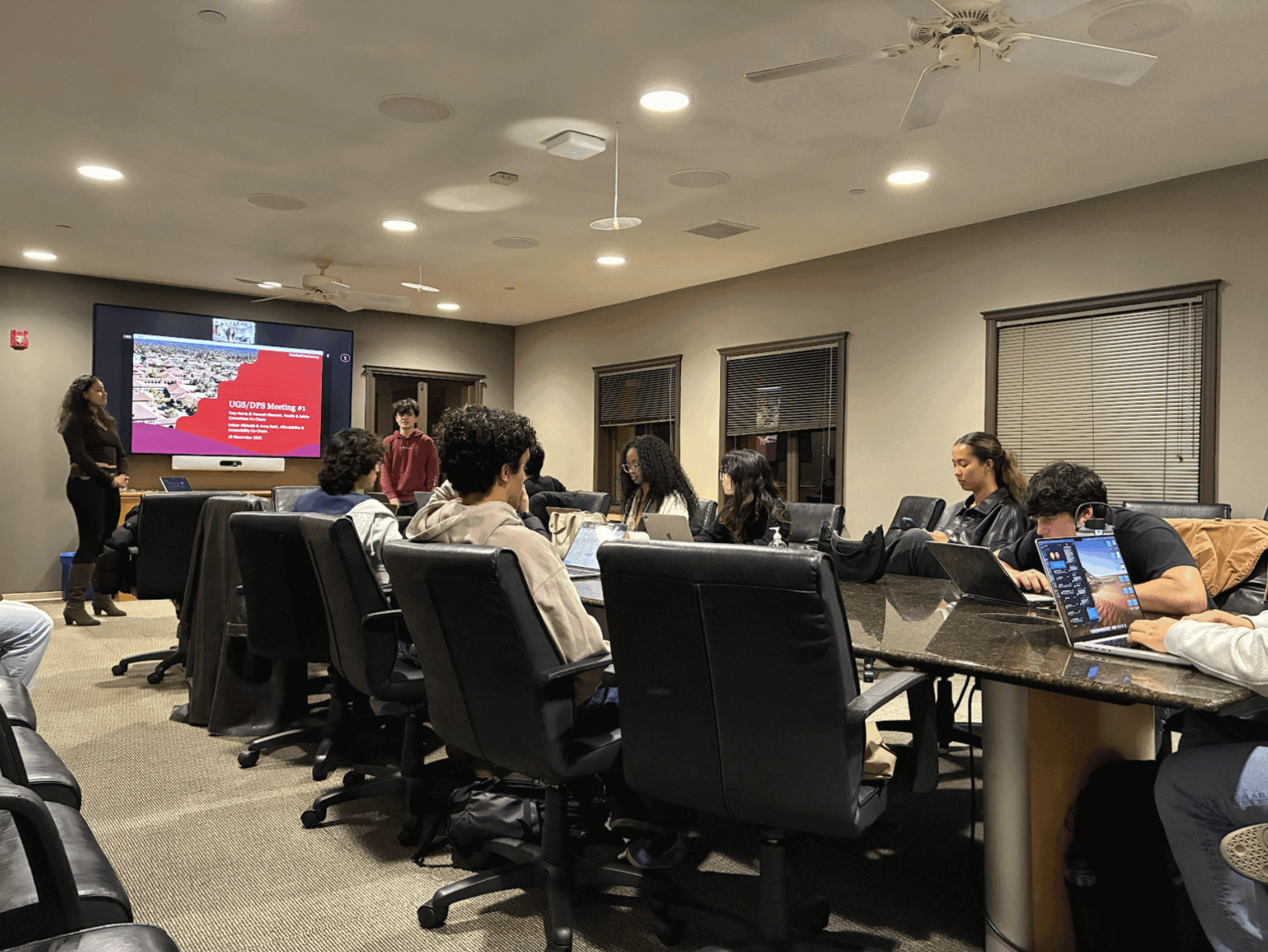
At its Wednesday meeting, the Undergraduate Senate (UGS) heard a presentation from Aileen Rubio ’26 and Dawn Ariel Royster ’26, Resident Assistants (RAs) for Burbank and Branner Hall respectively, on the current state of RA vacancies.
In the presentation, Rubio and Royster noted that there are currently RA vacancies at Rinconada, Synergy, Terra, Branner, ZAP, 586 Mayfield and Junipero. Rubio also said there has been a lack of transparency from ResEd regarding if or when these vacancies will be filled.
Rubio and Royster said that the vacancies have led RAs to feel overwhelmed and unsupported.
“When we are overwhelmed and understaffed, we become less effective RAs … and that was a lot of what RAs were feeling at the beginning of this quarter,” Royster said.
Rubio noted that a lot of First-Generation & Low Income (FLI) students look to become RAs for financial security, and firings can lead to housing and financial stress for these students. Royster also added that the perceived lack of transparency and suddenness of RA firings have led some RAs to fear retaliation from ResEd.
“If we have no protections, how will we feel safe asking for help?” Royster said.
In response to the presentation, the UGS voted to send to the undergraduate body a petition calling for ResEd to resolve the current vacancies. The petition demands the reinstatement of a ZAP RA, Emmanuel Angel Corona-Moreno ’26, who was fired for missing training while positive for COVID-19 and a plan to fill all RA vacancies by the end of the quarter.
The UGS also heard a presentation from Health and Safety Committee co-chair Troy Harris ’27 and Housing and Dining Committee co-chair Intisar Alkhatib ’28 on their meeting with the Department of Public Safety (DPS).
In the presentation, Harris and Alkhatib brought up several initiatives to improve bike and scooter transportation on campus.
Alkhatib noted that the DPS and Student Housing are in the early stages of a process to build areas where students can park electric scooters. Harris also mentioned a new online bike safety class in the Stanford Training and Registration System (STARS) that students can take to learn about campus navigation and the rules of the road.
“We were recommending, and they were open to this, making this a NSO required course,” said Harris.
Harris also mentioned that one resource that the DPS emphasized was the SafeZone app, a mobile app that allows students to call 911 or the DPS office and immediately send their precise location.
“It’s basically a faster version of calling 911,” Harris said.
The UGS also passed the Joint Bill to Dissolve the Club Sports Funding Umbrella and Require Direct Team-Level Grant Applications for Transparency and Compliance. The bill will now move to the Graduate Student Council (GSC) for a vote.
This bill would dissolve the Club Sports Council, which currently receives funds from the Associated Students of Stanford University (ASSU) and allocates them to individual club sports. The bill states that under the current system, several clubs have been allotted a different amount of money than was indicated in the voter-approved budgets.
Under the new system, which will be fully implemented next academic year if the bill is passed, individual club sports will apply directly to the ASSU for funding.
“We are doing something that I believe is going to return the will of the voters, when it comes to funding club sports, back to them,” said UGS Chair David Sengthay ’26.