
“What Makes Us Human?” is a biweekly column where Emi Sakamoto ’28 investigates the question on everyone’s mind to better understand human-centered meaning in the midst of a rapidly evolving artificial landscape.
This article’s permission for publication is predicated on a promise. This is my attempt to sharpen its edges.
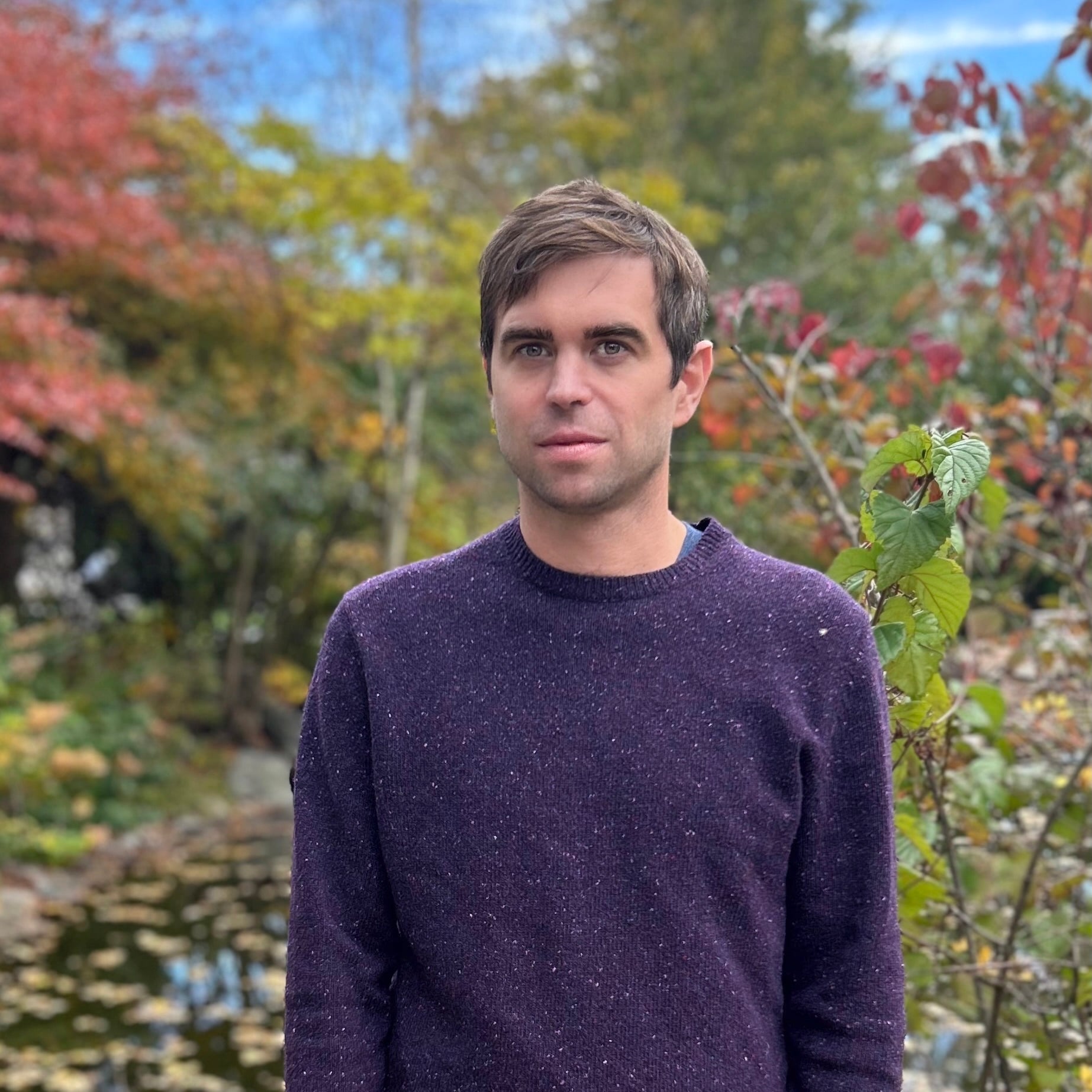
To introduce Lowry Pressly by title or accolade would be a disservice to the depth and degree to which he inspires. But to keep you (the human) in the loop, he is an assistant professor of political science at Stanford and the author of “The Right to Oblivion: Privacy and the Good Life.” This column emerged from his teachings, and I’m hardly prepared to articulate the weight of the worldview which emerges from it. As I write this, the pressure is palpable, and I will ultimately fall short. But in the spirit of his teachings, and perhaps precisely because of it, I have decided to struggle with this paralysis: to sit silently, pained and a little panicked, and write anyway.
The following is an imperfect convergence of some of the meditations we shared in conversation, over two cups of coffee, on an average Wednesday morning, 9:30 a.m.
Pressly began our conversation in an entirely human way. As a father of two, he shared with me a picture of his children smiling joyfully amidst the evergreen backdrop of Muir Woods National Park. He had just dropped them off at school, and he voiced a feeling of distance from them. He remarked, “I’m closer to them than I could ever be to anyone, and yet nevertheless, I see their individuality, their distance from me, their unreachability.” There are parts of their inner worlds which are entirely unknown to him, and he marveled at this ineffable facticity. I began to, too. And thus began an invitation into the world of oblivion.
Instead of defining what oblivion is, we’ll begin with what it is not: knowing. This is anathema to our information age, one that is flattened by an obsession with answers generated by search engines and language learning models. Our insatiable desire to know is seemingly matched by the rate at which technology promises to answer. Technology provides us with a sense of certainty and controllability. The Enlightenment ethos is an admirable one, but Pressly invites us to dare beyond its borders and into the inexhaustible unknowing, or as he coins it, oblivion.
Oblivion compels us to consider, as Pressly says, the “beautiful beyond that is nevertheless a part of our world and expands it.” While it cannot be constrained into just one type of epistemic relation, it is helpful to understand an important distinction between two of its subtypes: secrecy and privacy. When we fail to consider this distinction, conversations on data and privacy merely dance around the heart of the problem. Pressly explains, “What secrecy conceals is information, which some know and some don’t. But what’s on the other side of privacy isn’t information. Privacy protects against the creation of information.” Instead of asking how we ought to protect our privacy, Pressly challenges us to consider a far more important question: why should our lives become information in the first place?
The consequences of chronic datafication are condemning. If every part of ourselves — our idiosyncrasies, ironies and introspections — were entirely accessible to others, what weight would a simple question carry? How meaningful would conversation be? How incorrigible would our character be?
Oblivion, then, is a humble and human acknowledgement of what is inherently valuable: parts of ourselves which remain unknown to others, even to those whom we love most. Without oblivion, we lose sight of that which cannot be known, or that which may have otherwise become. It is oblivion itself which radically defies the laws of stasis and deepens the unknown depths of what moves us to tears and towards meaning.
Pressly explains that part of the experience of this kind of depth is precisely its inarticulability. The inability to express and articulate perfectly is a profoundly human thing. It means that we have been lucky enough to bear witness to, as Pressly says, “something that is beautiful and emotionally affecting, yet evidently exceeds our ability to fully articulate in words.”
This beauty is something which technology tears us away from. As artificial intelligence (AI) begins to develop astonishing capabilities, swallowing even the art form, it is impossible not to ask ourselves, “What’s the point?” It may feel despairing to create art that AI can spit out far faster than you can, but that is precisely the point. To feel, viscerally and fully, how hollowing that is. When we allow ourselves to offload our process for the sake of product, we deprive ourselves of the very struggle that makes life worth learning from and through.
Inarticulability is just one kind of the very struggle which AI promises to steal away from us. Pressly reminds us that there is value to “the struggle to know my own mind, to develop my own mind, to think for myself. To take this away from me is not just to take away a burden, it is to take away a vital part of what it means to be a human being.” As soon as we allow a machine to do this for us, we abdicate a piece of our humanity. We must not forget that we are capacious creatures, deserving of the time and turbulence it takes to dive deeply, humbly and wholeheartedly into the depths of our oblivion. Rapidly evolving technological advancements only force us to consider these old questions more urgently.
Because our conversation was rooted in the power of oblivion, I was admittedly hesitant to ask the final question, “What makes us human?” In a long and stilled silence, I wrestled with this paradox. After garnering the courage to ask anyways, Pressly recognized this struggle (recognized my humanness). He encouraged, “There you go, there’s the struggle. This is an impossible question, and that is exactly why you should ask it.” A few moments later, he followed with his response: “The human is the creature who is profoundly limited and vulnerable, like all living things, but perhaps uniquely can spin depths and wonder out of those limitations and vulnerabilities.”
As I walked away from our conversation, I didn’t know what to say. But it was that very unknowing which left me with the fullness I feel to this day.