
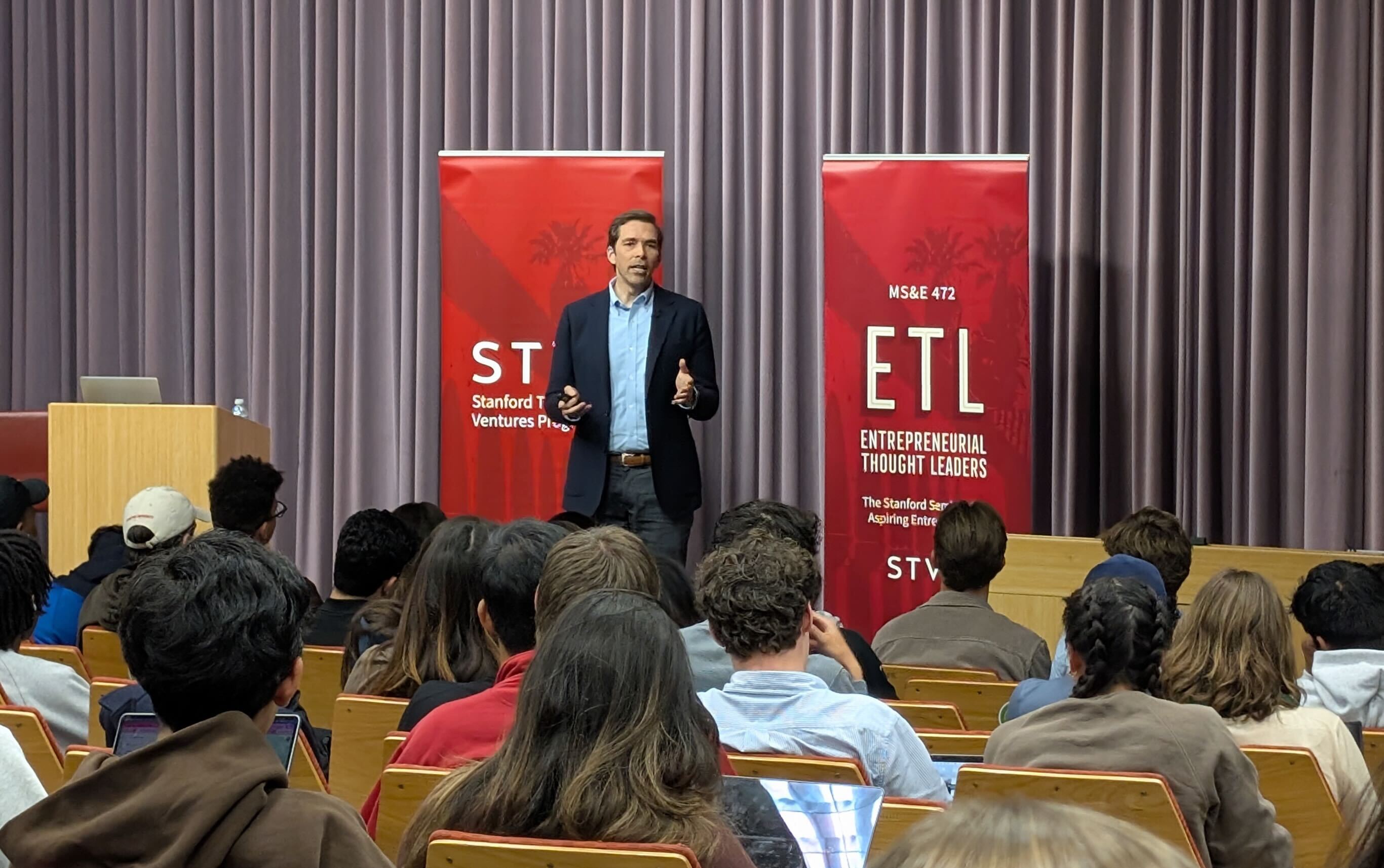
Eric Volmar Ph.D. ’19, a former chief strategy officer in the U.S. Office of Strategic Capital, said the next generation of startup founders will need to develop a new playbook shaped by deep tech, national policy and long-horizon capital at a Wednesday event.
“It’s never been a more exciting time to be an entrepreneur,” Volmar said in the talk, which was part of Stanford Technology Ventures Program’s speaker series. “But we are not just extending the trajectory of the last 30 years. We’re in a fundamentally new place.”
To explain the shift in modern entrepreneurship, Volmar began with the 1990s, when the internet facilitated conditions for software’s explosive rise. For the first time, Volmar said, startups could scale globally in months and venture capital could thrive on fast, high-risk returns. After the Cold War, the federal government stepped back from the front lines of technological innovation, allowing private companies to expand with little intervention.
Volmar described how this rapid growth in startup emergence made entrepreneurship into a profession, leading to the creation of companies such as Google, Amazon, Facebook and Netflix.
“But the forces that shaped that world aren’t the forces shaping the world today,” Volmar said.
Volmar described how the recent wave of expensive foundational technologies — including artificial intelligence, quantum computing, photonics and more — left room for family offices, sovereign wealth funds and patient private capital to play larger roles in startup emergence today.
However, Volmar said the most dramatic change in modern entrepreneurship was the federal government’s return as a key player in technological innovation.
Over the last decade, the U.S. and other governments have re-engaged in frontier technology to safeguard national competitiveness and security. For Volmar, who worked with the Air Force before joining the Office of Strategic Capital, the change has been significant.
“It’s like entering another country,” he said. “Different norms, different language, different rules.”
He pointed to companies such as Joby Aviation, which worked with regulators on aircraft certification, and Hermeus, which partnered with the Air Force to develop hypersonic vehicles. In these cases, the government acted not only as a regulator but also as a financier and potential customer.
“That’s the reality of the new entrepreneurship ecosystem,” Volmar said. “Your first customer might also be your regulator.”
“Eric’s message about the necessity of Silicon Valley’s expertise in the government and the intricacies of innovating in a field where the same entity is an investor, customer and regulator makes me think differently about the future of entrepreneurship,” Jacob Yurev ’28 said.
Volmar encouraged students to recognize that today’s innovation landscape requires the integration of technology and policy.
“Think about the research you’re doing,” he said. “If you plan to take it out of the lab, are you ready for new forms of capital? Are you ready to work with government partners?”
He added that students entering mission-driven fields would need to orient their work around principles that last beyond political changes.
“Anchor to the surest foundation: the values of individual freedom, freedom of expression and self-determination,” he said. “If you frame your work in those principles, it can withstand political change.”
Some audience members said Volmar’s talk left them with an understanding of how entrepreneurship may be changing in an era where the government is a key contributor to a company’s success.
“It was interesting to hear how the role of the government in business has evolved and what that relationship might look like in the future,” Sophie Profit ’28 said.
Volmar closed by urging students to think seriously about their own role in this new landscape.
“And if you choose to engage with the big missions of our time, it will change your career forever… I couldn’t have predicted where stepping into government would take me,” Volmar said. “But it’s been the greatest privilege of my life.”