
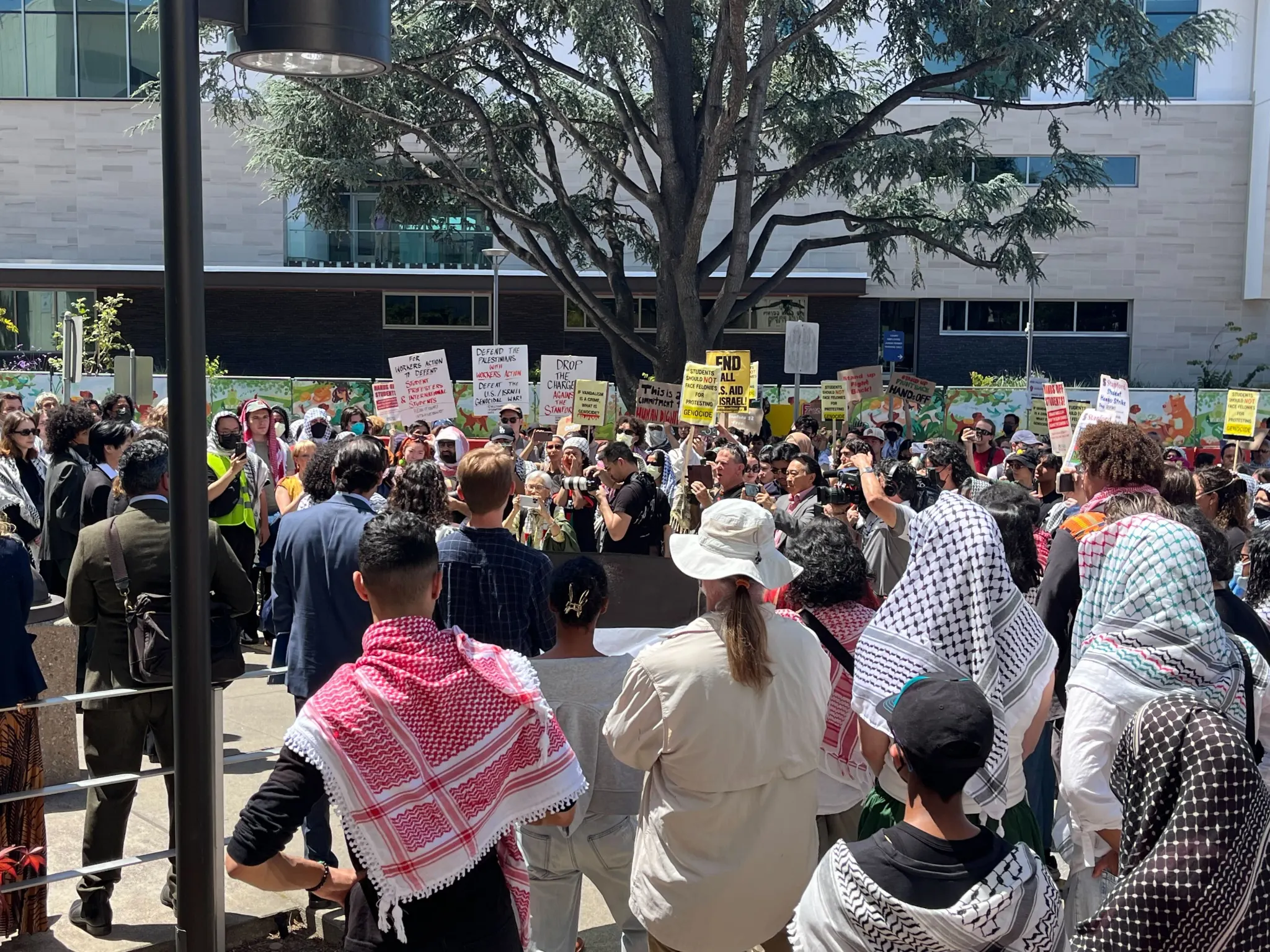
Pretrial motions for the case against five pro-Palestine protesters were heard by Judge Hanley Chew on Dec. 9 and 10 at the Hall of Justice in San Jose. The defendants, who barricaded themselves inside the Stanford president’s office as part of a June 2024 protest, could face up to three years in jail if they are found guilty.
The Stanford pro-Palestine protesters were indicted on felony vandalism and trespassing charges in November, and have chosen varying courses of action. While 12 protesters participated in the office break in, only eight currently face charges. Three protesters sought plea deals and three accepted alternative paths. Five decided to go to trial in January – Maya Burke ’18 MA ’19, Taylor McCann ’14, Hunter Taylor Black ’24, German Gonzalez ’27 and Amy Zhai ’25. The December hearings were to present pretrial motions for these five.
Arguments over the defense’s use of the term “genocide” dominated the hearing. Defense attorneys sought to describe their clients’ actions as a response to what they believe is a genocide in Gaza. The prosecution was concerned about the term’s relevance to the felony vandalism case and whether it could open the door to hearsay and speculation.
Judge Chew denied a motion from the District Attorney’s Office seeking to bar defense attorneys from referencing the term “genocide” in their case.
The judge also denied the prosecution’s motion to bar the defense from arguing political motivations, but asked the defense counsel to be judicious with the word “genocide.” Chew said he would exclude further use of the term if he felt that the parties were exploiting it.
The prosecution argued that alleged genocide in Palestine is irrelevant to the immediate vandalism and trespassing case at hand.
“[The defense strategy] is not to test the sufficiency of evidence to prove the charges of conspiracy to trespass and vandalism. The defense strategy is to use this jury trial as a forum to put Israel and Stanford on trial for the Gaza War,” the prosecution team wrote in their official response to the defense’s request to use the term “genocide.”
The prosecution added that any testimony or argument characterizing the war in Gaza as genocide would be based on inadmissible hearsay, given that allegations of genocide are currently the subject of pending litigation in the United Nations International Court of Justice (ICJ).
No international court has issued a final verdict determining if the current conflict in Gaza constitutes a genocide, although the International Criminal Court (ICC) is conducting an ongoing investigation into the situation.
The defense’s concerns about the harassment of those facing trial were also at the forefront of the pretrial hearing.
“Most concerning is the defense publicly accused Stanford police of ‘doxxing’ the defendants online. The claim was totally false and when provided with documentary evidence, they withdrew it,” prosecution attorney Rob Baker wrote in an email to The Daily.
The doxxing accusation stemmed from a story published in the Stanford Review, which identified the defendants by name and provided an image of what appears to be a redacted arrest log from Stanford police.
“If an individual doxxed the defendants at the direction of someone at Stanford University or in a supervisory role at the Stanford University Department of Public Safety (SUDPS), then the impeachment could properly be attributed to the entire investigation,” the defense wrote in its trial brief.
The prosecution accused the defense of spinning a “baseless conspiracy theory” that SUDPS and the Stanford Review intentionally released their names via the arrest log in order to facilitate harassment of the defendants.
Supporters of the pro-Palestinian activists gathered at the Santa Clara County Superior Court on Tuesday to show their support for those being prosecuted, an assembly that Stanford Students for Justice in Palestine (SJP) helped organize.
“We have received an outpouring of support from the community: people drove for hours from across the Bay, and students and faculty came to court in the middle of finals week. That kind of solidarity helped defeat an attempt not just to criminalize protest, but to criminalize even naming a human rights catastrophe,” said Amanda Campos ’26 on behalf of SJP.
“As the case moves toward jury selection and trial in January, we will continue to stand with the Stanford 11 and organize court support,” she added.