
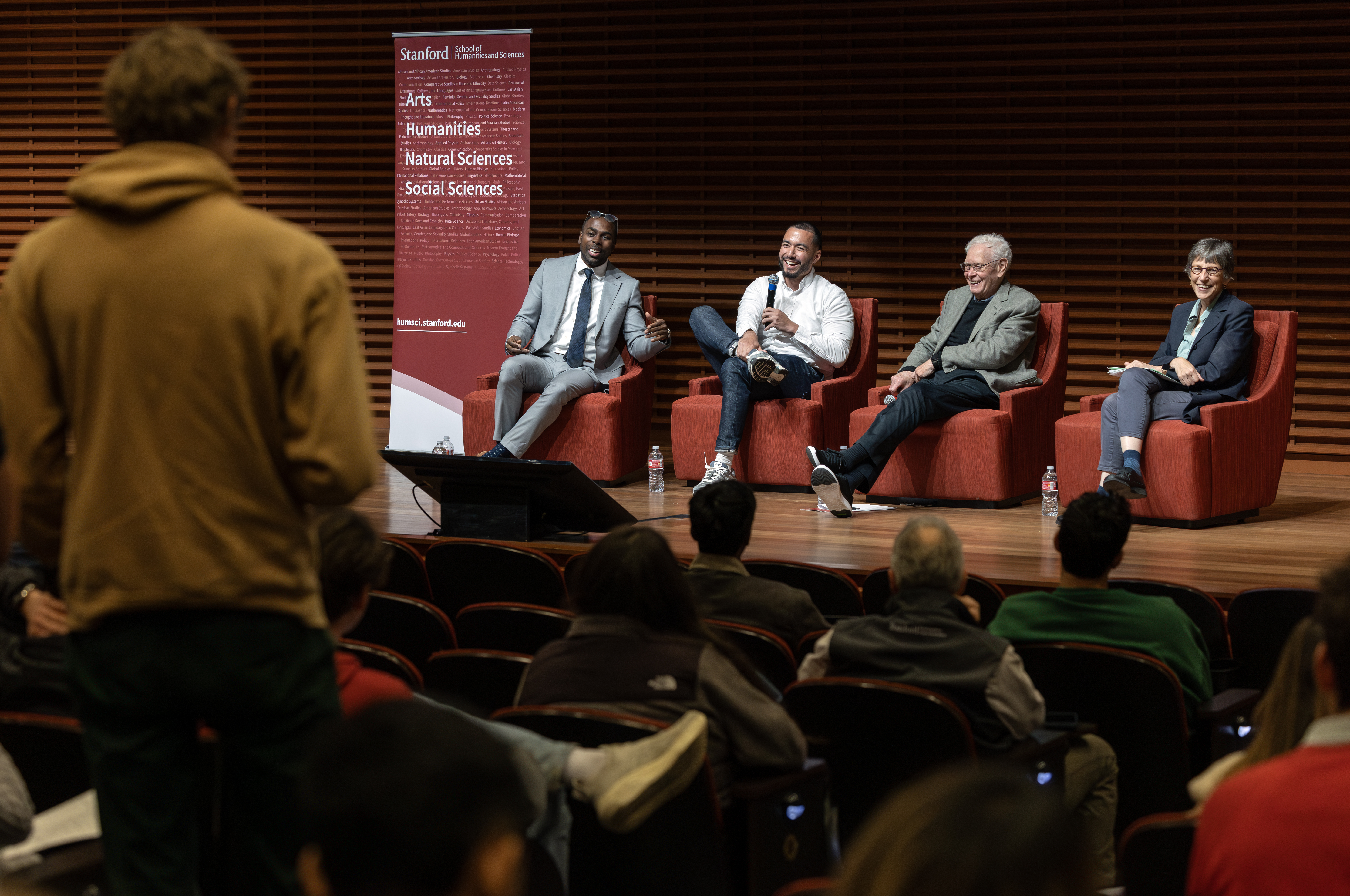
The class “Democracy and Disagreement” is back for its third iteration this winter quarter, featuring contentious topics such as “Israel-Palestine” and “Gender-Affirming Care.” The goal of the course is not to change the minds of speakers on stage or students in the audience or to create a “winnable” debate. Rather, the class aims to serve as an example of how students can look to deal with inevitable differences in opinion, ones that may have even been suppressed in the classroom.
Two experts with differing opinions will take the stage each Tuesday at 3 p.m. at CEMEX Auditorium. They will present their case to enrolled Stanford students and community members, demonstrating how to effectively disagree.
Paul Brest, former dean and professor emeritus at Stanford Law School and co-professor of the class, said he’s noticed that students aren’t currently speaking up in class in a way that reflects their actual opinions. According to Brest, programs like this class are trying to change that by encouraging respectful disagreements and vulnerability in classrooms and beyond.
The class is a part of a group of programs at Stanford aimed at facilitating discussions. This includes the freshman requirement “Civic, Liberal and Global Education” (COLLEGE) and the campus-wide initiative ePluribus Stanford.
“[COLLEGE] is also trying to get students to think about big debates in America and also world history and how to approach them and to be open minded,” said Debra Satz, dean of the School of Humanities and Sciences and co-professor of the class.
According to Satz, “Democracy and Disagreement” emerged from “a culture and a society where nobody seems to be able to have reasonable conversations.”
“I think a lot of students are afraid. They’re afraid of their peers. They’re sometimes afraid of what they think the professor wants to hear,” Brest said. Hence, he hopes that through this course, they could fundamentally change Stanford’s culture around difficult discussions.
Kaisa Goodman JD candidate ’26, a Teaching Assistant (TA) for the course last quarter and this quarter, said the structure of the class opposes the style of most traditional instruction. According to Goodman, it instead focuses on demonstrating an effective form of communication as an alternative to debates.
“We’re often taught to win arguments and to convince others of our point of view, to find the ‘right answer.’ And I think a lot of our interactions with others and the way we’re taught sort of reinforce those approaches, but that those are often not the most effective way to solve problems or interact with others,” Goodman said.
In the structure of the course, attendees are polled before and after the presentation on their opinions of the topic. Sometimes opinions of students are quite homogeneous going into the talk.
“[Speakers] who are coming are experts who have taken positions in writing, and they’re unlikely to change it on the stage, but indicating a genuine understanding of the other people’s positions, that’s the goal,” Brest said.
Selecting speakers and topics for the class is a complex calculus. Satz says she and Brest look to choose speakers who have the ability to engage students rather than getting bogged down in the complexities of their work. They also must be exemplary models of the skills of discussion that Satz and Brest are hoping to impart on students with topics that have room for “reasonable disagreement,” on impactful current events, Satz said.
“One of my biggest takeaways from the class was just how engaged the students were,” said JD candidate Gabe Malek, another TA for the class this year.
This quarter, Satz and Brest hope to see even more attendance at all of the talks from students as well as meaningful participation from them, both in sections and during the events, to help work towards these essential and potentially groundbreaking discussions.
The upcoming event on Jan. 13 will cover “Israel-Palestine: The Future of Palestine” with Dennis Ross, former U.S. Special Middle East Coordinator, William Davidson Distinguished Fellow, Washington Institute for Near East Policy and Shibley Telhami, Anwar Sadat professor for Peace and Development at the University of Maryland.
Other colleges have followed suit with similar programs to promote civic education. And in recent years, there has been an increase in student groups on campus that look to start effective conversations, like the Stanford Political Union (SPU).
“Approaching disagreement or even just different perspectives with just open-mindedness and humility and critical thinking can go such a long way,” said Goodman.