
On Dec. 9, the University announced several new theme house assignments. The changes came as a result of the 2025 theme house application and review process, a new system managed by the Committee on Residential Learning (CoRL).
Next year, Kappa Kappa Gamma will move to 710 Bowdoin, replacing ZAP, while Alpha Phi will move to 702 Bowdoin. Synergy, which faced University pressure in May to close down alongside Terra, will now share its current house at 550 San Juan with Terra.
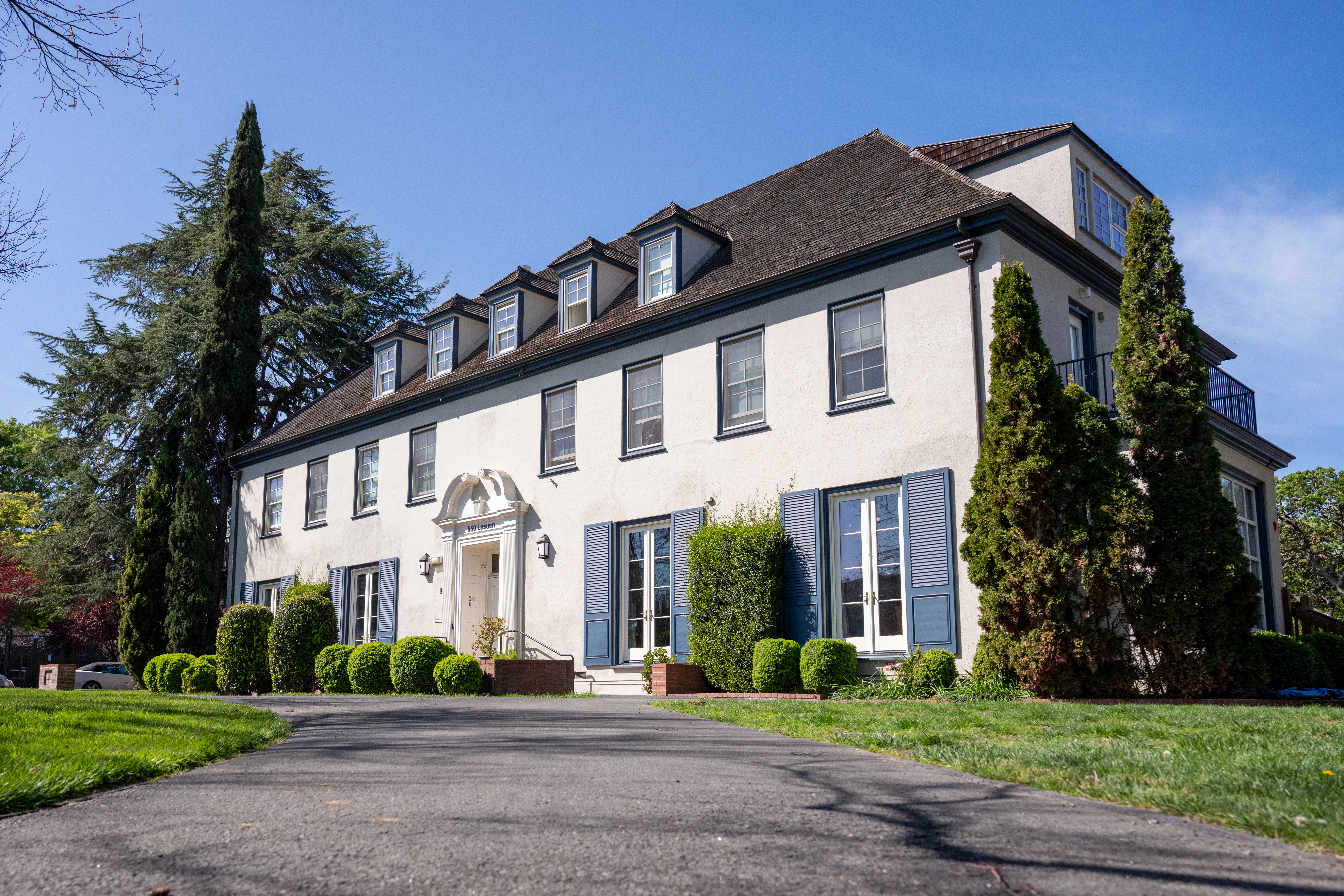
In another shift, Sigma Chi will be regaining on-campus housing status, moving back to 550 Lausen. Sigma Chi’s former ground lease for 550, which the fraternity held for 86 years, expired in 2023 after the University attempted to terminate it. Both 539 Cowell Lane (Terra) and 675 Lomita (shared by Alpha Phi and Kappa Kappa Gamma) will replace the lost self-op housing. The application period saw 30 total submissions for 24 available theme house spaces. Ethnic theme houses, which are governed by the Undergraduate Residence Governance Council, were not affected by the process.
“This was our first time, since I’ve become a member, [that we’ve] submitted the application, so we’re just very grateful,” said Sigma Chi president Mason Osborn ’26. “We’re obviously very appreciative about that.”
Michele Rasmussen, the vice provost for student affairs, emphasized the unique role faculty played in determining student housing.
“I think one of the distinctive things about Stanford’s undergraduate residential life system is that…there’d be a strong infusion of the educational part of the Stanford experience, even in the residential component of student lives,” said Rasmussen. “Faculty have long been very interested and engaged around what it’s like in the dorms, what it’s like in the residences.”
Anant Singhal ’26, a current resident at 550 Lausen, emphasized how beneficial living in the self-op has been to his Stanford experience.
“It’s been honestly such a great experience,” Singhal said. “Most people in the house are here because they want that social experience, so they also make that social experience… There’s no cliqueiness. Everybody’s friends with pretty much everybody. We socialize a lot over dinner. We hang out in the lounges. People go on trips together.”
According to the University, the application revealed a discrepancy between supply and demand in several aspects of Stanford housing. “There were more applications than we had spaces for, so there’s that shortfall right there,” said Rasmussen, who pointed to the Class of 2029 as Stanford’s largest-ever frosh and transfer class.
“The lack of quality two-room doubles or singles, I think that’s a real issue for a lot of people,” Singhal, who lives in a one-room double, said.
While Singhal chose a smaller dorm room for the social experience of 550 Lausen, he acknowledged the limitations of such a trade-off.
“The quality of existing stock is questionable… [I live in] a one-room double. It’s a small one-room double. I love it because I love my roommate. I love my community. But like, it’s definitely not [like] everybody’s going to be satisfied with that, right?” he said. Singhal emphasized the need to expand housing — both apartment style and theme housing — to give students more choice in their preferred style of living.
According to Rasmussen, constructing new housing poses a challenge due to county land ordinances.
“Stanford is somewhat constrained currently in putting up new buildings for a variety of reasons, including the GUP [General User Permit, a Santa Clara County Board restriction that limits Stanford’s transportation impact and population in exchange for freedom of property development],” she said. “But certainly looking at a longer time horizon, there’s also the possibility.”
Mason suggested the University provide increased clarity and feedback to applicants in the new system. “The one thing that would be beneficial would be possibly a rubric, or something like a specific set of guidelines,” he said. “Obviously, we were very grateful that we got [housing], but we didn’t receive any feedback. I’m not sure if the people who didn’t get houses got feedback, but it’d be nice if everyone could [get it].”
Rasmussen acknowledged the difficulties in assigning theme housing. “I do think we’re going to need to have agreement and open-mindedness about how we keep some stability and sense of tradition from year to year,” she said. Students may need to “make room [in discussions] for the potential of some houses being sunsetted and being replaced by new ones,” Rasmussen said.
At the same, Rasmussen emphasized the importance of the student perspective, which she believes will help improve the housing process. “I would say that anytime a student wants to share their input, they should just shoot me an email, or share it with vice provost of undergraduate education Jay Hamilton.” Rasmussen said. “The best source of how we can improve is coming from the students.”
This article has been corrected to accurately spell Mason Osborn’s last name.