
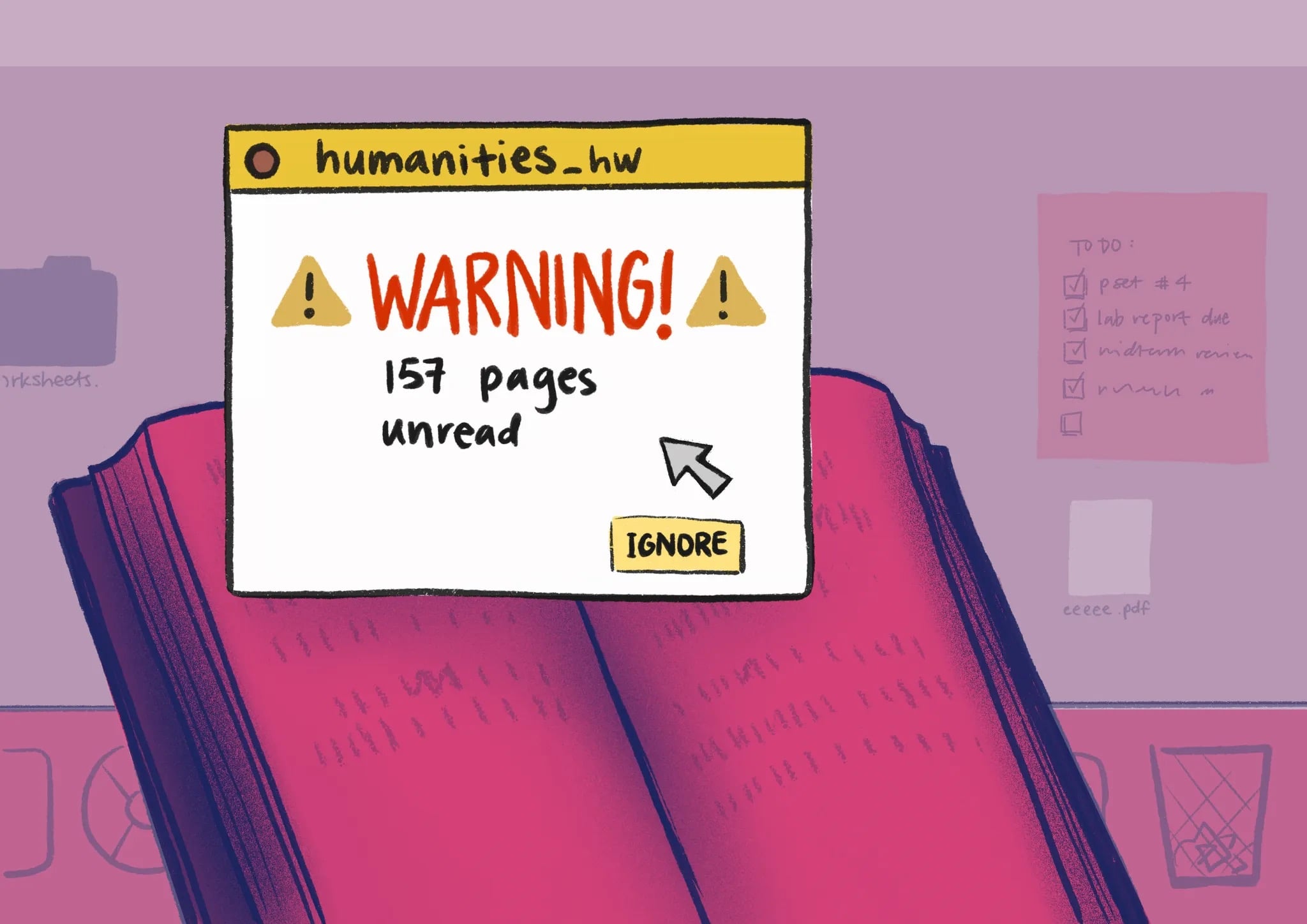
“Why is it more acceptable to walk into a class with your readings half done than it is to walk into a class with your p-set half done?”
When a friend majoring in comparative literature posed this question to me on a late Sunday evening, I thought — first to myself and then aloud — that if you hadn’t completed the latter, it wouldn’t just be evident; you would also be severely lost in class as a result of the discrete, sequential nature of quantitative subjects. In a humanities class, however, you can often stitch together a response by building on personal experience and on what your peers have said. Close reading lends itself to on-the-spot analysis, allowing one to deconstruct themes and semantics in a way that remains coherent even without a broader overview of the text.
Our conversation was rooted in a more overarching discourse about the dismissive “nonchalance” directed toward the humanities and those who study them — jibes framed either as “signing up for a life of poor pay” or “surviving on grant funds alone.” Some of the jokes are admittedly funny. But their sometimes caustic origins point toward a bitterness that stems not only from a (grossly exaggerated and often misguided) concern for our financial futures, but also from the ease with which many students seem to coast along in the humanities. In the case of COLLEGE especially, contract grading during the autumn and winter quarters produces a peculiar inversion of rigor: effort is formally decoupled from evaluation, such that completion itself becomes indistinguishable from excellence.
Don’t get me wrong: I am not advocating for a pedagogy of fear, but for a departure from the dismal attitude that has come to surround interpretive inquiry. Much has been written about how ChatGPT can substitute for critical thinking and embellish take-home essays; yet in the humanities, this anxiety is intensified by the field’s inherent subjectivity. The problem is not subjectivity itself, but the way it renders the humanities seemingly bypassable — classes one can waffle through while concentrating effort elsewhere, on coursework perceived as more consequential. Furthermore, interpretation is too often conflated with ‘anything goes,’ allowing the malleable boundaries of these disciplines to be mistaken for intellectual permissiveness: a space where inarticulate, textually unsubstantiated claims circulate freely, yet are affirmed in the name of open-minded discourse. As Susan Sontag cautions in Against Interpretation, interpretation that abandons close attention to language, form and structure no longer clarifies how a text works, but substitutes disciplined reading with paraphrase or personal projection.
It is under these conditions that the humanities begin to lose their force. This is not an argument against the humanities, but against the conditions under which they are too often encountered. When difficulty is designed out of a discipline, so too is the respect it commands. The result is a self-fulfilling loop: the humanities are dismissed as unserious because they are experienced as unserious, and they are experienced as unserious because we hesitate to demand from them the same intellectual precision, interpretive risk, and argumentative accountability we expect elsewhere. What suffers, ultimately, is not student well-being, but the very claim that humanistic inquiry cultivates judgment — that it teaches us how to read carefully, argue responsibly, and live with complexity rather than evade it.
How, then, does one tackle a sense of dismissiveness that is the cultural byproduct of years of anti-intellectualism, misinformation about the humanities’ economic prospects and disdain for critical thought? Factuality might be one answer. To reconfigure how students view the humanities, Stanford ought to consider a pedagogy that invokes a perception shift — one that reintroduces factual knowledge not at the expense of the subjective inquiry that defines the humanities and its beauty, but instead as a supplement to it.
In a landscape where subjectivity can be reproduced and masked by large language models — and where close reading can broaden interpretive scope to the point of becoming an abyss — quizzing students on their factual understanding might be a way to circumvent, if not overcome, the laziness with which some approach the humanities, especially when doing so merely to fulfill WAYS requirements. Think of a quick, pen-and-paper quiz in the first five minutes of class: if you have completed the reading, there is no extra effort required to score full marks. But if you haven’t, it becomes as self-evident as an incomplete p-set.
This model is far from perfect, with several limitations and loopholes. Administering daily tests on paper would be a logistical and time-management nightmare for faculty already operating with short lectures and seminars; conducting them online would invite obvious forms of cheating.
Furthermore, this would do little to resolve the problem of AI use. Students do not turn to ChatGPT merely because they lack information, but because they feel insecure about their writing itself. Shifting assessment toward factual recall does nothing to address that insecurity, leaving students’ voices in long-form, take-home assignments shaped by the very large language models this pedagogical turn claims to resist.
Finally, the most pressing concern is that such a model could alienate students from experimenting with disciplines that already struggle to command numbers. Many students pursuing alternative academic pathways see their humanities seminars as low-pressure spaces to decompress; by stripping these spaces of their inherent comfort, the proposal risks pushing them away, thereby further entrenching the perception that the humanities are merely boxes to tick.
But for all the costs of such short-term aversion, there is something to be said for how a pedagogy that integrates factuality could spark a long-term perception shift, allowing students to better appreciate the complexities of these disciplines. One might even argue that this momentary disinclination could foster a greater number of takers in the long run, who begin to view the humanities as viable due to an increased veneer of legitimacy.
The limitations and loopholes of any assessment model are endless, but so too are the possibilities for reinvigorating an academic domain increasingly challenged by institutional inertia and global inequity. If we want students to take the humanities seriously, we must be willing to make their rigor visible — to design forms of evaluation that demand preparation, interpretive accountability and intellectual risk without collapsing inquiry into rote measurement. This is not a call to turn the humanities into STEM, nor to trade curiosity for fear, but to restore stakes to a mode of thinking too often treated as ambient or optional. Because if the university is where we learn how to think, then reclaiming the humanities is not an academic luxury or a matter of interest alone; it is the precondition for thinking at all.