
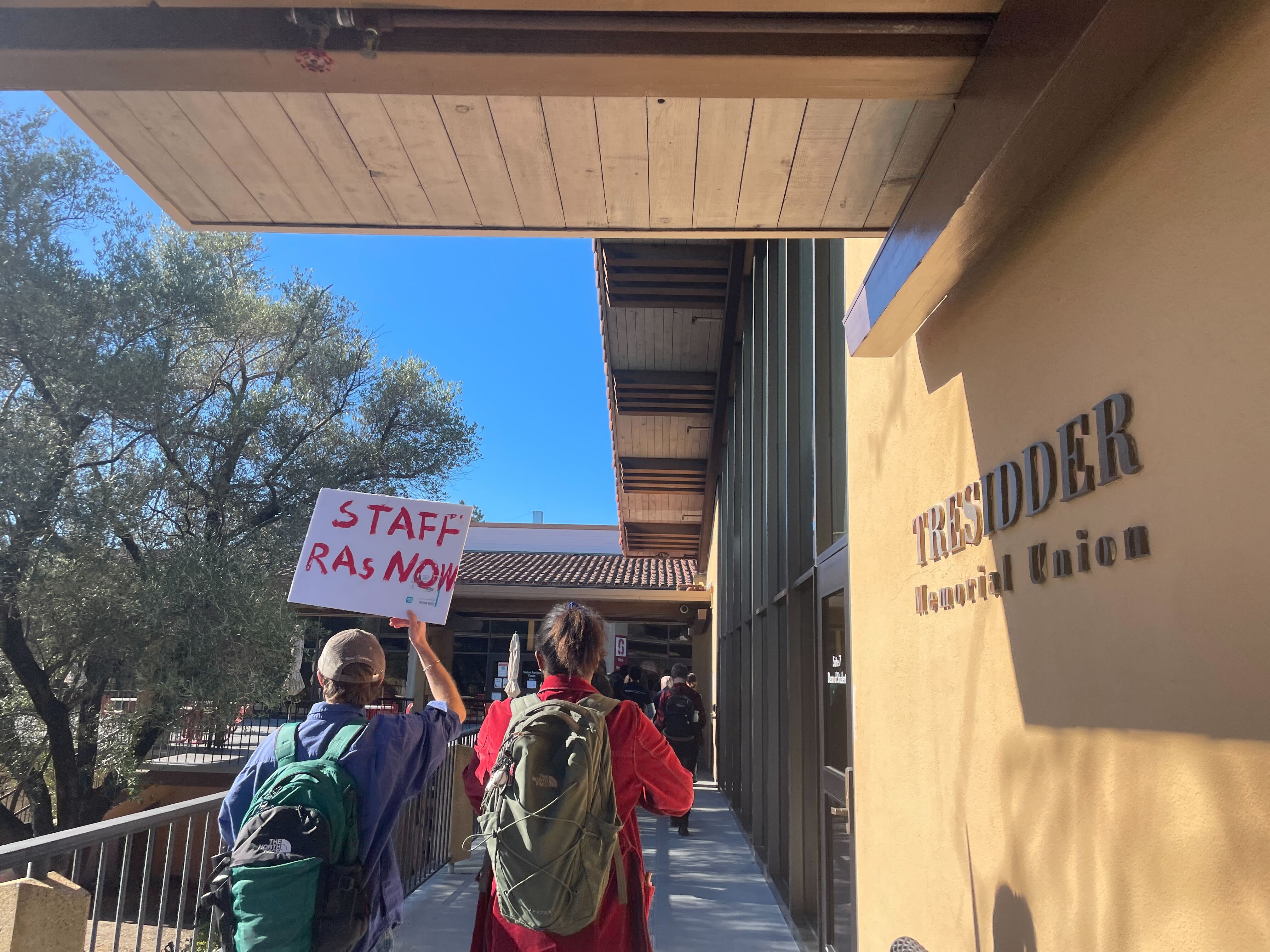
Around 30 Resident Assistants (RAs) gathered Monday at 12:30 p.m. to present their demands to Cheryl Brown, Assistant Vice Provost of Residential Education. They asked for the full reinstatement of Emmanuel Angel Corona-Moreno ’26, a previous RA at Zeta Alpha Phi (ZAP), and to fill vacancies at understaffed dorms. Officers from the Stanford University Department of Public Safety (SUDPS) arrived midway through the march and remained for the duration of the event.
The group said they were seeking “10 minutes of uninterrupted time” with Brown to address what they describe as the unjust firings of co-staff and widespread understaffing across multiple dorms. They requested a response from Residential Education (ResEd) by Friday, Jan. 16 at noon.
“We are trained to do all these life-saving measures. If there’s not enough of us, how effective can we really be?” said Dawn Royster ’26, an RA at the freshman dorm Branner, which lost two RAs before the start of the school year. Royster is a former reporter for The Daily.
The RAs’ grievances are outlined in their petition, which has been backed by Associated Students of Stanford University (ASSU), the Undergraduate Senate (UGS), the Graduate Student Council (GSC) and signed by nearly 300 individuals, including 100 RAs, according to the statement made by RAs.
Understaffing is “such a widely felt issue … There’s so many houses that are understaffed,” said Shuci Zhang ’27, an RA at Terra, a co-op currently missing one of two kitchen managers, and an organizer of the event. According to the RAs and confirmed by The Daily, the affected dorms include Branner, Robinson, Rinconada, Junipero, Terra, Kairos and Crothers Memorial.
Brown was not present when the RAs arrived at her office for the “march on the boss” at around 12:45 p.m. The group then asked to speak with Michelle Rasmussen, Vice Provost for Student Affairs and Brown’s supervisor, who was also unavailable. The Daily has requested comment from Brown and Rasmussen on the Monday gathering and RA concerns.
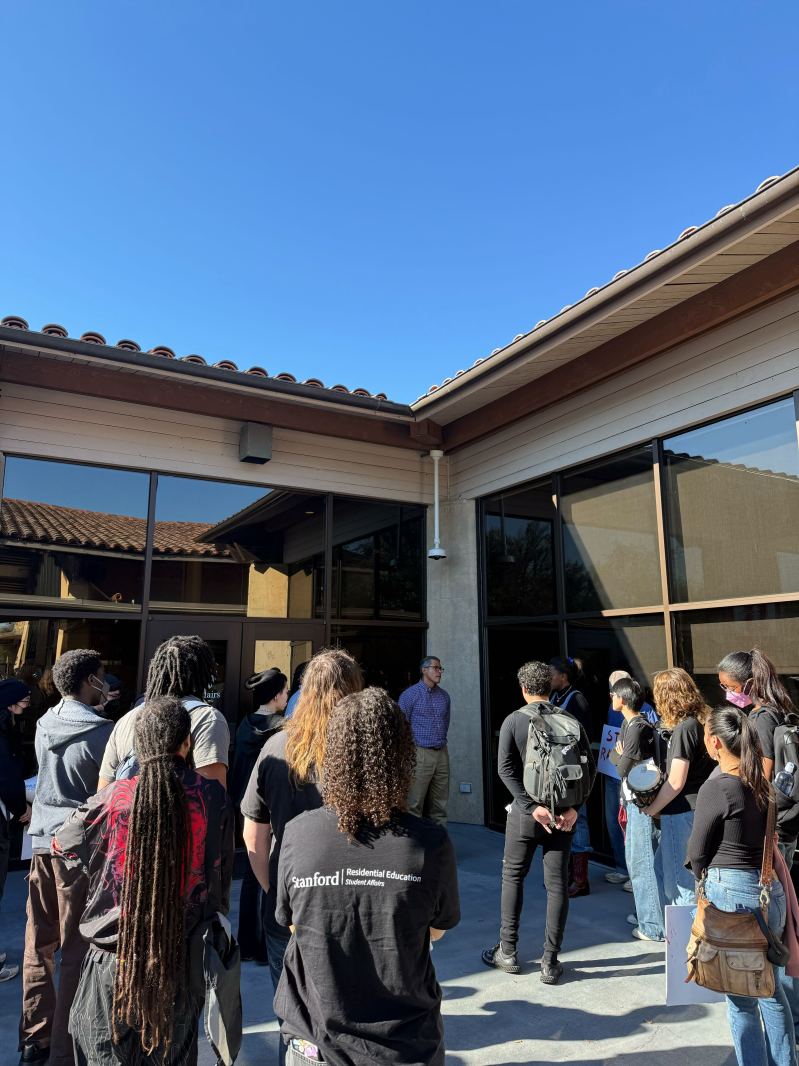
The group of RAs presented their demands in the form of a “march on the boss,” a tactic used by organized workers to congregate at the bosses office with demands. RAs said this was to subvert the power structure in an effort to challenge what they described as ResEd’s persistent unresponsiveness.
In a message to The Daily after the event, Zhang wrote that it was “incredibly frustrating how they shut us out when we only wanted 10 minutes to talk to them, and how inaccessible our bosses are, which [is] the reason why we have this action in the first place.”
During the protest, RAs carried signs and drums as they marched from White Plaza to the VPSA offices. The signs said “Restaff Our Costaff” and “An Injury to One is an Injury to All.” Attendees sported black attire, many in black ResEd T-shirts. Four RAs also spoke about how the understaffing has affected them as students, workers and points of support for peers.
“When I was vulnerable, isolating to protect the community, and asking for help, the University responded with a termination letter. That is not leadership; that is bureaucracy acting without a soul,” Corona-Moreno said in his speech.
Royster followed with her perspective from an understaffed freshman dorm, explaining how RAs often serve as freshmen’s first introduction to Stanford.
“The decision to not fill the vacancies in our dorm felt like a slap in the face after the two firings of Branner staff, days before NSO,” wrote Royster in her section of the speech.
Royster elaborated that freshmen are among the most vulnerable to issues like binge drinking or mental health crises on campus and thus their RAs serve an essential, potentially life-saving role.
Though RAs didn’t explicitly state the repercussions of the Friday deadline, they assert that it exists to force the university to take action, and not “drag things out,” said Zhang.
“When [ResEd doesn’t] adequately support us or staff us at the right levels, it’s harder to do our jobs and it’s harder to do them well,” said Royster.