
On Jan. 2, the U.S. launched a full-scale military strike on Venezuela, capturing President Nicolás Maduro. Vice President Delcy Rodríguez was then sworn in as acting president, while President Trump stated that the U.S. would “run” Venezuela.
Scholars and students have expressed cautious optimism in response to the operation, hopeful that it represents an opportunity to restore Venezuelan democracy, while fearful that this opportunity will be missed.
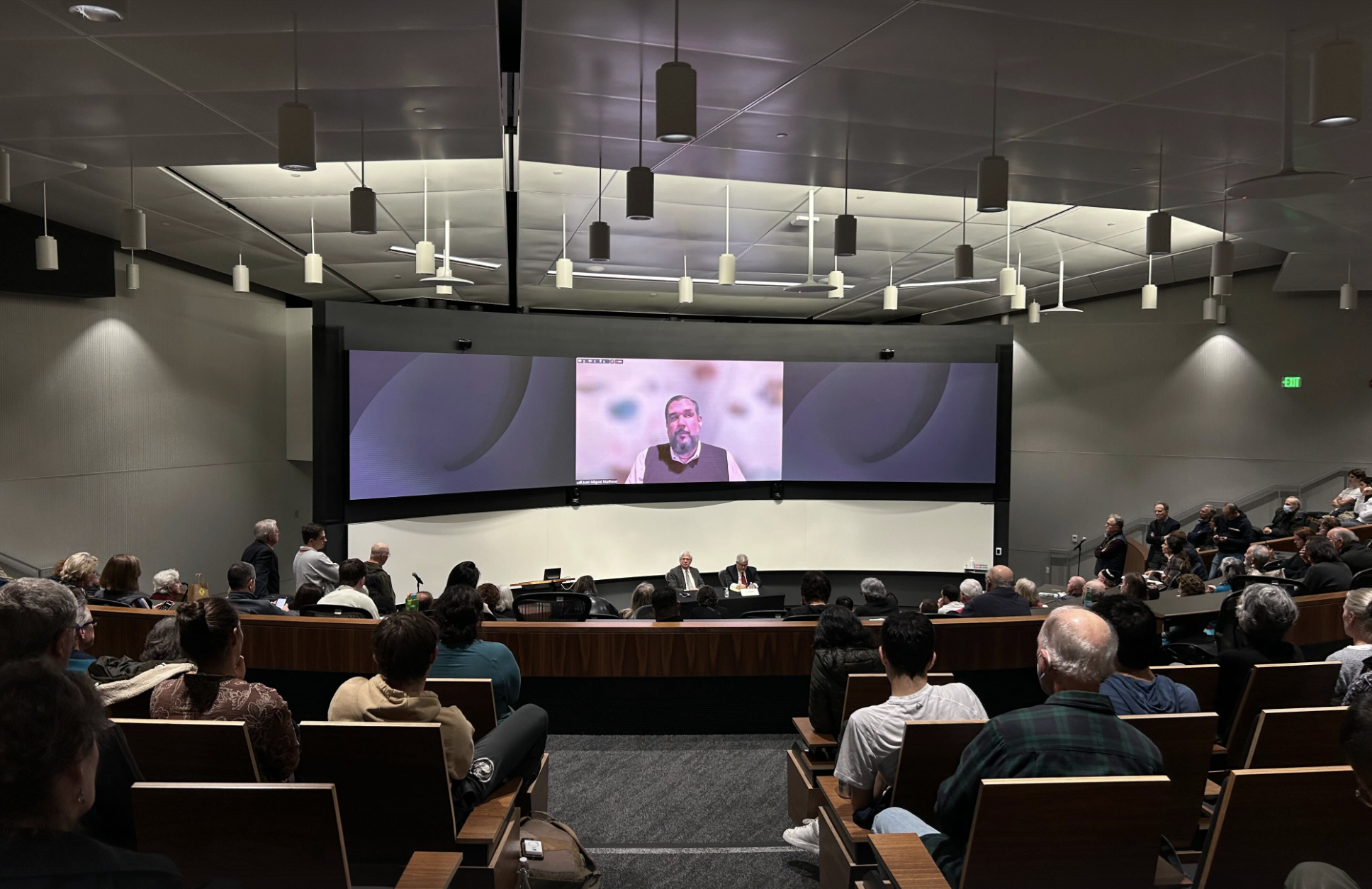
In response to the strike, the Stanford Constitutional Law Center hosted a talk titled “The Venezuela Attack: Legality and Consequences.” The event, which took place on Jan. 6 at the Stanford Law School, brought together Harvard Law School professor Jack Goldsmith and congressman Jan Miguel Matheus of the National Assembly of Venezuela for a discussion on the operation’s legality and Venezuela’s future.
Goldsmith argued that the U.S. clearly violated international law when it attacked Venezuela. He cited a core principle of the United Nations Charter that prohibits the “threat or use of force against the territorial integrity or political independence of any state.”
However, Goldsmith said there is no “effective remedy” to hold the U.S. accountable. While the UN Security Council can authorize the use of force to maintain or restore international peace, the U.S. holds veto power over the body.
He also assessed the operation under domestic law. According to Goldsmith, the government has justified the attack on Venezuela, which killed at least 80 people, as lawful because U.S. armed forces acted in defense of law enforcement officers. He described this rationale as “imaginative.”
As with international law, Goldsmith voiced skepticism that domestic law would hold the government accountable. “The best guarantee of responsible uses of force is to elect prudent presidents,” he said, drawing applause from the audience.
In response to Goldsmith, Matheus characterized the operation as a “partial democratic liberation” and expressed hope that this liberation would be fully realized. He called for Venezuela to embrace the constitution, implement free and fair elections, restore human rights, and establish diplomatic relations with the U.S. and other countries. Matheus added that the Venezuelan people want opposition leader Maria Corina Machado to lead this process.
Despite his optimism, Matheus raised concerns about U.S. intentions. “My concern is that… President Trump doesn’t want a democratic transition, but a transaction – an oil transaction,” he said. “We want the support of the United States, but we don’t want the United States to use, without control, our resources.”
A Stanford undergraduate who was born in Venezuela and requested anonymity for fear of retaliation echoed these anxieties that the operation was motivated more by resource extraction than democratic values. “When [U.S. officials] captured Maduro and they said that they were going to take control of the country, there was really no mention of promoting American values,” she said.
The student was at the airport on her way back to Stanford when she received news of Maduro’s capture, which she described as “shocking.” She did not expect the U.S. to intervene, expecting instead that democracy would break down in Venezuela like it has elsewhere in Latin America.
Despite her concerns about American goals, the student believes that recent events will benefit the country. Even if the U.S. is mainly motivated by oil interests, she said, economic growth could significantly improve the quality of life in Venezuela. “I remember … having to send boxes of basic supplies, like hygiene products, to my family [there],” she said. “I think we really forget how dire the situation has been in Venezuela.”
The student added that she hopes to return to her birth country one day. “My Venezuelan passport is expired and traveling as an American to Venezuela is very, very dangerous, so right now, it’s not something that I could do,” she explained. “But I hope that at one point, me and my family can go and visit.”
Unlike the student, Harold Trinkunas, Deputy Director at Stanford’s Center for International Security and Cooperation (CISAC), was not surprised when he learned about the operation in Venezuela because he thought that the size of the U.S. military deployment in the Caribbean was unusual.
Trinkunas, who was also born in Venezuela and studies foreign policy, governance, and security in Latin America, does not view Maduro’s removal as a democratic transition. Instead, he described it as an “authoritarian rebalancing” because the remaining authoritarian actors in Venezuela continue to hold power.
According to Trinkunas, the operation has created significant uncertainty about Venezuela’s political future. “There’s a lot of ways [the political situation] can change positively, but there’s also a lot of ways in which it can change negatively,” he said.
He outlined several possible scenarios: the U.S. continues to manage Venezuela from afar, while Venezuelan leaders “test the limits” of their freedom; the interests of U.S. leaders, Venezuelan leaders, and the Venezuelan public diverge, causing civil conflict; or the authoritarian regime in Venezuela survives by leveraging economic growth or waiting out the Trump administration.
Trinkunas hopes for a fourth scenario, in which a politically neutral transitional government implements elections at all levels and restores democracy, but considers it unlikely.
Despite Trinkunas’ low expectations, many Venezuelans, like the anonymous student, remain optimistic. “This is the first time in almost 20 years that there is some sort of hope for the country,” the student said.