
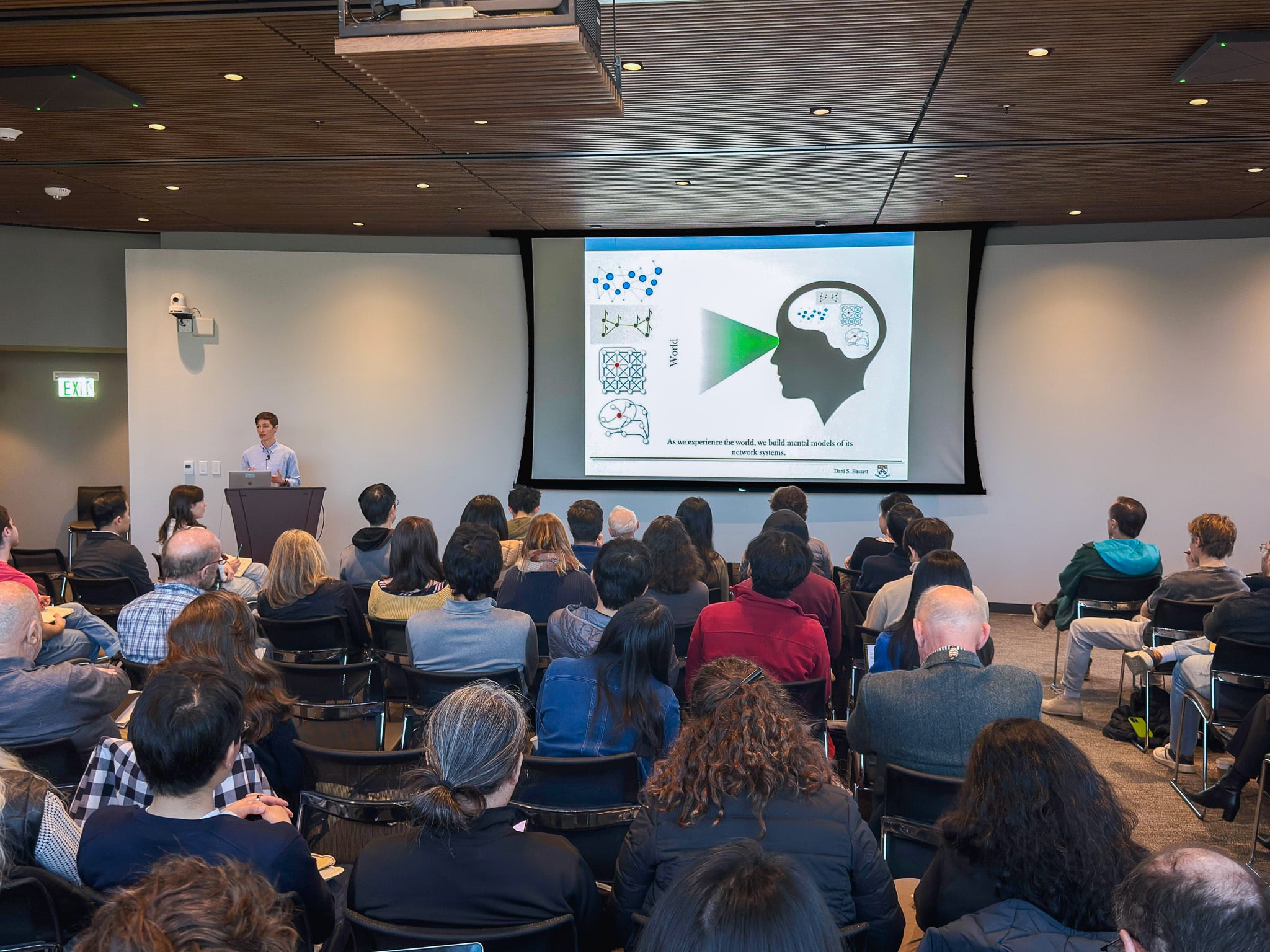
On Thursday, the Wu Tsai Neurosciences Institute welcomed Dani Bassett, a professor of Bioengineering at the University of Pennsylvania and an incoming professor of Biomedical Engineering at Yale University. As part of the Institute’s Neurosciences Seminar Series, Bassett’s talk centered around our evolving interdisciplinary understandings of human curiosity, learning and control. Bassett, who titled their talk “Network Cognition in a Curious World,” emphasized the intersectionality between these levels of experience.
“The traditional view of curiosity is that it is acquisitional [and] individual… I don’t [think that’s] comprehensive,” they said. “If you look back over history, there’s actually a hidden story of curiosity as much more relational rather than acquisitional.”
Rather than generalizing curiosity as a broad approach, Bassett defined three approaches to curiosity: busybodies (those who flip between knowledge networks), hunters (those who seek particular kinds of information) and dancers (who stitch together groups of concepts). In addition to shifting the fields of neuroscience and curiosity, they emphasized how these categories could change approaches to machine learning.
“Instead of placing the reward on the item that is being learned, which is the kind of typical thing that’s being done in reinforcement learning at the moment, we place rewards on the connection between two different pieces of information,” Bassett said. “We have these agents learn and choose an edge that connects pieces of information, such that the network changes in a particular way.”
Michelle Hedlund, the event’s host and a fifth-year Ph.D. in electrical engineering, was impressed by the interdisciplinary nature of Bassett’s work.
“I invited Dr. Bassett because their research spans many experimental methodologies, and has advanced the way we apply physical and mathematical models of graph theory to biological systems,” Hedlund said.
Graph theory was an area that Bassett emphasized in their approach to learning. Drawing on the idea that brains “are trying to build a model of the world [that is] relatively accurate… but trying to minimize the computational complexity of the model they’re building,” they were able to determine that participants respond more quickly to modular-based information — a structure where ideas are siloed into individual modules based on topic and theme. According to Bassett, these differences in efficiency have implications for technology.
“If we know that students are always going to get imperfect models of what we show in a classroom, is there a way for us to… emphasize different connections so that the student, in the end, really sees the organization we were hoping they would see?” they asked.
Despite coming from different research specialties, many members of the audience had encountered Bassett’s work in other contexts.
“I knew about [their] work on network neuroscience studies before the talk,” said Nathan Wang, a research scientist at the Institute. “[The talk] covered a lot of interesting things, beyond just a brain, that goes to human behavior in the community and learning as well. I think it’s a new paradigm for learning studies in the field.”
Bassett also touched on the actual neurological processes of learning, particularly as they relate to biological processes in the brain.
“In the process of world experience and model building, the brain has to move through a set of distinct and adaptive states and activity,” they said. “So what I want to know is how the activity flow is happening on top of fixed routes.”
Bassett further explained how the energy needed to move between brain states differs based on how familiar the agent is with the task itself. Tougher tasks, according to Bassett, are those that force the brain structure into diverging networks.
As to why they titled their talk “Network Cognition in a Curious World”?
“The way that I see the human experience, the world is a network of events and objects and bits of information that we experience,” Bassett said. “And then we build network models in our minds of those experiences. Because minds are imperfect, those models are a little bit imperfect as well.”