
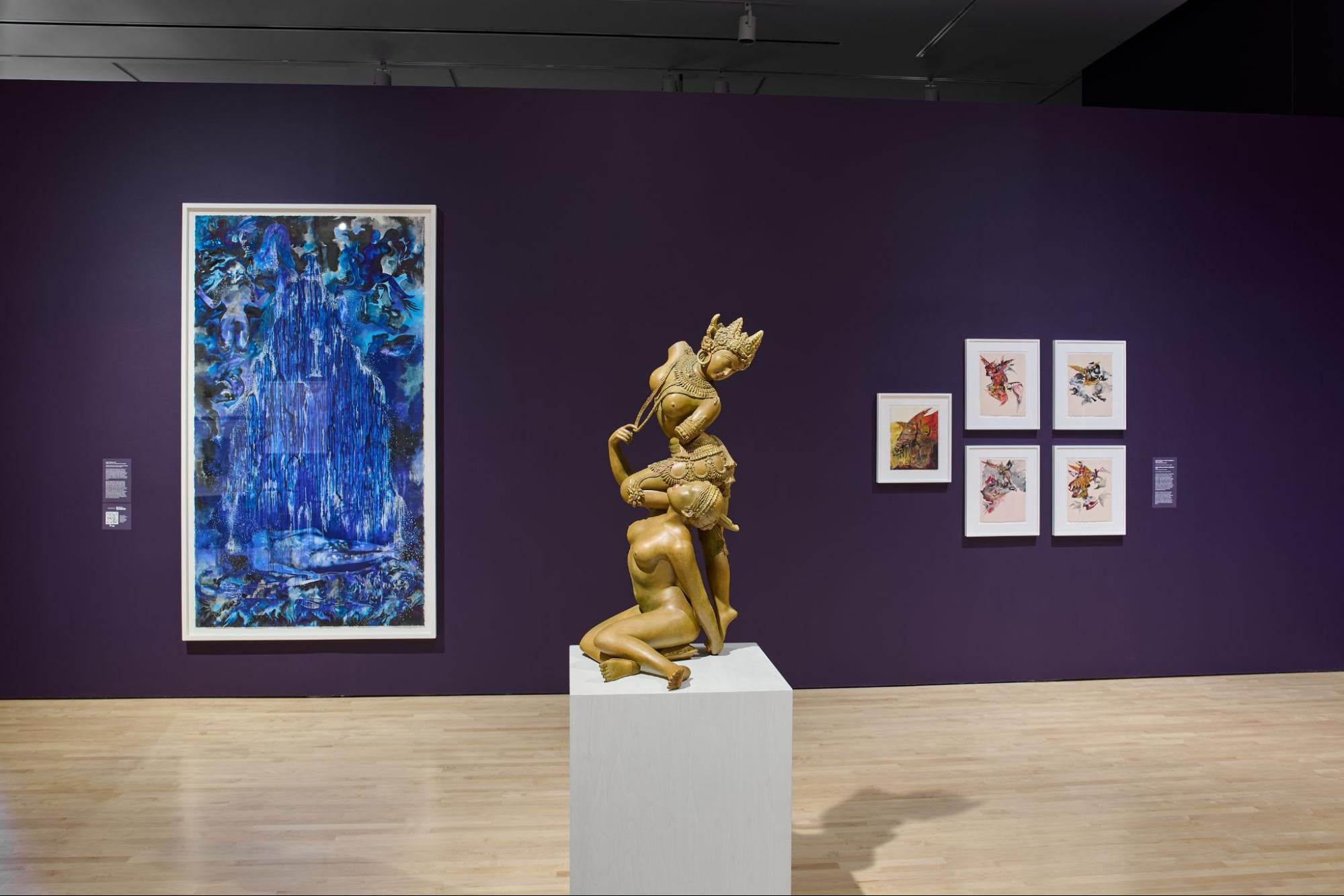
A hand-painted scroll depicts a lone figure across personal architectural spaces, tracing the path toward becoming an artist. A glittering animation shatters a historic love story into drifting, luminous fragments. A sculpture of a “self-rooted woman” displays stability while bearing the weight of women’s historical disenfranchisement on her shoulders.
These are all works presented at the Cantor Arts Center exhibition, “Shahzia Sikander: Collective Behavior,” the most extensive presentation of Sikander’s work to date, according to a press release sent to The Daily. The exhibition spans 35 years of a practice that moves across media while confronting power, migration and the collective power of women.
On display from Sept. 17, 2025 until Jan. 25, 2026, “Collective Behavior” is the largest solo show of an Asian American artist as a part of Cantor’s Asian American Art Initiative. The exhibition emphasizes the contributions made to contemporary art by Sikander, who was born in Lahore, Pakistan and is currently based in New York.
According to the associate curator of modern and contemporary art and co-director of the Asian American art initiative at the Cantor Arts Center, Aleesa Pitchamarn Alexander, the Cantor’s director saw Sikander’s collection at Venice’s Biennale Arte exhibition and was excited to take in the touring show from the Cincinnati Art Museum.
To increase visibility of this exhibition, Alexander led a guided tour on Jan. 8 for visitors, highlighting the backstories and artistic context of key works.
“First and foremost, I just want people who didn’t know about Shahzia’s work or who Shahzia was as a person to walk away with greater appreciation of this incredible woman artist, immigrant artist, Asian American artist, who’s finally getting her due,” Alexander said. “I want people to think about the ways that art can be made, which is why I talk about her working collaboratively, her interest in materials… [and] what it means to have a visual language as an artist.”
Parul Chandra, who works at the Bing Nursery School, came to visit the exhibition with her friend, Aarti Johri M.A. ’12, who said she knows the artist and was excited to come to see Sikander’s works displayed in this large exhibition.
Johri highlighted the aspects of the exhibition that resonated with them: “Both of us [Chandra and Johri] are immigrant women, and that was a big part that felt focused a lot on,” she said. “Her stories always go back to women.”
The exhibition is organized thematically by three sections. Firstly, point of departure: bringing female narratives into a historically male-dominated tradition. Secondly, the feminine space, focusing on Sikander’s exploration of body politics. Finally is negotiated landscapes and contested histories, a section that primarily engages in legacies of colonialism.
“So many of the works are really about challenging topics — about colonialism, about war, about resource power struggles, about the oppression of women — but the way that [Sikander] is doing it is making works that are so incredibly beautiful to look at,” Alexander said. “So the difficulty of the subject matter doesn’t become the central or most obvious focus… You’re initially drawn in because of the incredible materiality and technicality that was required to make the work.”
According to the Cantor’s press release, Sikander’s “vast multimedia practice engages pressing themes of both personal and collective history.” Multimedia works include video, animation and digital elements. Chandra emphasized how she was drawn to this diverse display of media.
“We were really also fascinated by the multimedia. Her mosaics and the fact that [Sikander] seems to be working with everything from digital to mosaic to watercolors to oil,” Chandra said. “She seems to be very, very versatile.”
Especially in an age where it is often thought that almost anything can be generated by computers or experienced virtually, this exhibition, with its diverse visual elements, serves as an incredibly potent example of the importance of experiencing art in person, according to Alexander.
“As someone who works in museums, I will always maintain that there is no replacement for seeing something in real life,” she said.
Beyond discussing “Collective Behavior,” Alexander spoke about how she hopes students will engage with the Cantor however most resonates with them, underscoring that there is still time left to see “Collective Behavior’ and promoting the museum’s website for current and upcoming events.
“We want people to have whatever kind of engagement with works of art that they want,” Alexander said. “Whether it is coming to a lunchtime curator tour and listening to me talk, or just popping in for five minutes because you just want to see [Sikander’s] beautiful mosaics again and you have some time in between classes, there is no right way to come and have a museum experience.”