
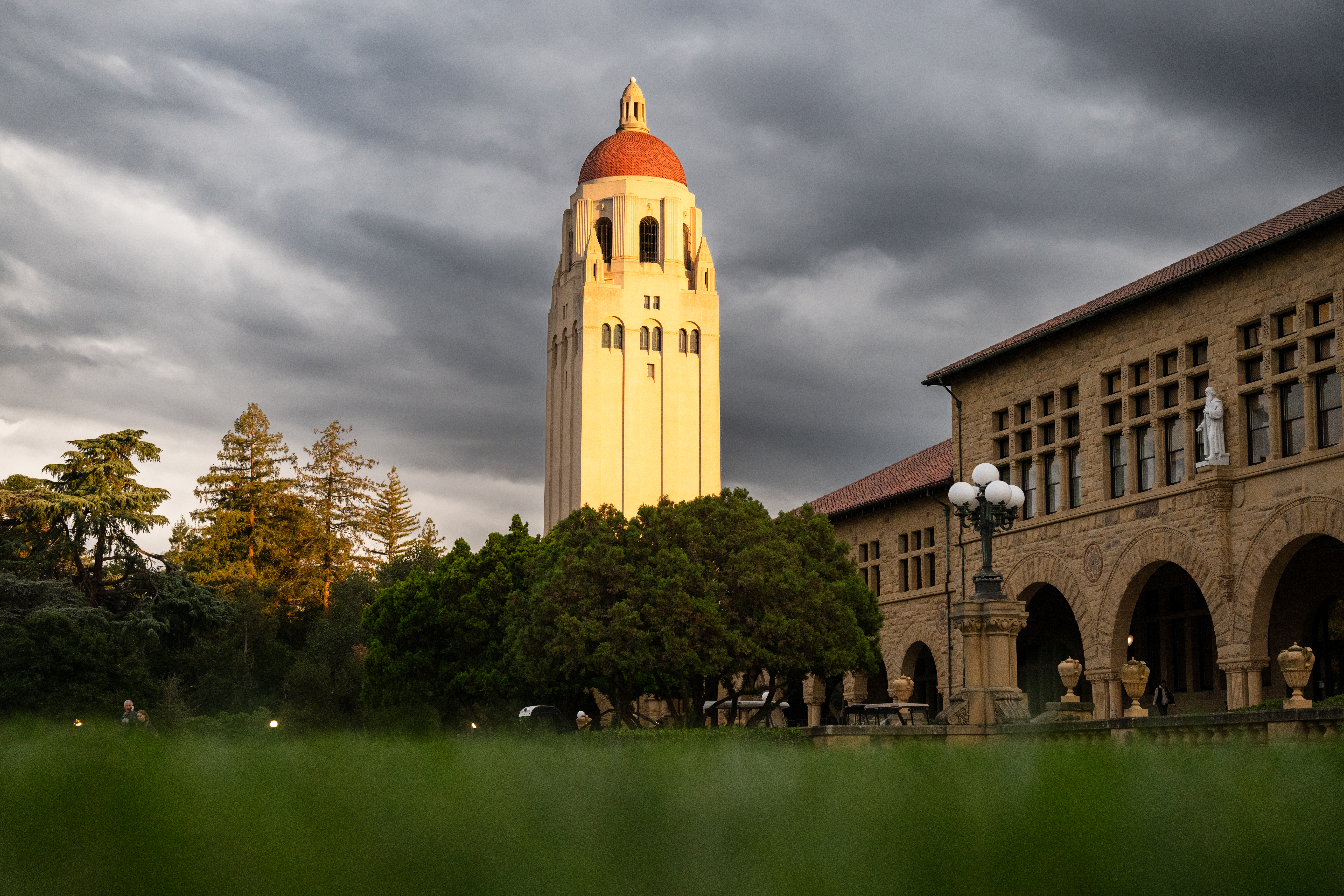
University president Jonathan Levin ’94 highlighted the University’s resilience and ongoing excellence despite political and financial pressures in the second annual “State of Stanford” address on Wednesday night in History Corner.
“It’s been an incredibly tumultuous year,” he said, referencing changes to federal policy affecting higher education. “When there’s a lot of disruption, it’s good to be at a place where people are problem solvers and figure out how to move forward.”
Hosted by the Stanford Political Union (SPU), the event began with a 30-minute conversation moderated by SPU president Nathan Kuczmarski ’26 followed by an audience Q&A. Over 50 students attended, around 20 of whom stayed after the event to speak to Levin one-on-one.
According to Kuczmarski, SPU introduced the “State of Stanford” address in the wake of significant political change at the beginning of President Donald Trump’s second term in office. He said the question that loomed large among Stanford students — and that motivated the club to host the event — was: “What is the state of Stanford?”
“It continues to be important for there to be a place where students can come and have an open discussion,” Kuczmarski said.
During the talk, Levin addressed the impact of the Trump administration, funding challenges, the removal of diversity, equity and inclusion (DEI) webpages, international student enrollment and other pressing issues.
He described the stable, bipartisan partnership that the federal government and universities enjoyed for the past 60 or 70 years. “That contract changed dramatically in the last year, and it now needs to be knitted back together,” he said, citing reductions in federal research support.
Levin added that he has worked with leaders of other institutions to make the case in Washington D.C. for universities’ essential role in advancing knowledge. Given that Congress is set to reject Trump’s proposed cuts to science funding, he called these efforts a success.
Alongside research funding cuts, Levin addressed the impact of Trump’s “One Big Beautiful Bill,” which raises taxes on university endowments, meaning Stanford will owe $200 to $300 million per year in additional taxes.
Stanford made a $140 million budget cut over the summer, leading to the layoffs of over 360 staff members. Levin said these changes were an attempt to put the University in a more resilient position if the endowment tax was passed.
“You never want to do that at a university because we have an incredible staff,” he said. “That was really an unhappy and incredibly difficult thing to do.”
Over the past 12 months, University programs including Stanford Digital Education and the Office for Inclusion, Belonging, and Intergroup Communication, were cut. Webpages relating to DEI across University departments were also removed.
In regards to Stanford Digital Education, Levin said that online courses for high schoolers were costing thousands of dollars per class — funding coming from undergraduate education.
“It’s hard to argue that we should be using undergraduate tuition for someone else to take classes,” he said, adding that the Trump administration’s funding cuts triggered the program’s dismantling. “It was a good experiment to run and it didn’t quite work out as hoped.”
The dissolution of the Office for Inclusion, Belonging, and Intergroup Communication and the removal of DEI webpages, Levin said, had more to do with the Supreme Court’s ruling on affirmative action than the Trump administration’s impact.
“The University as a whole… made a decision that [it] would not make institutional statements about social and political issues unless they directly bore on the mission of the University,” he said. In regards to the DEI webpages, he said that many featured unauthored statements from years ago.
Levin said that he was “very concerned” about the fact that the number of foreign students enrolling in U.S. universities has dropped for the first time in three years. While Stanford has not seen a decline in the number of international applicants and admitted students last year, he voiced concern that the Trump administration’s policies would chill interest from foreigners.
“My view is, and has always been, that [having international students] is a great thing for the research mission of universities, and it’s a great thing for this country,” Levin said.
Looking forward, Levin outlined his vision for Stanford’s future. He predicted that in the next five to 10 years, the University will work more with companies or philanthropic organizations if federal funding cuts are not reversed, and its research enterprise will evolve to further incorporate AI. He also said that Stanford plans to build a comprehensive cancer center.
Students in the audience asked about a variety of topics, including housing, civic education and football.
“I think it’s great that he comes out and actually talks to students,” said SPU member Jhonny Almeida ’28. “I think that definitely is good for an administration that many view as a black box.”
At the same time, Almeida said he wasn’t completely satisfied with Levin’s response to his question about whether student activism impacts administrative decisions.
“He gave me political answers. I think he kind of dodged around the heart of the question,” Almeida said. “He focused on how students should say their piece, not really on, ‘Is their piece even counted at all?’”
While the University president focused on challenges facing the school throughout his address, he also emphasized Stanford’s strengths.
“Every day I walk around and I’ll just see something going on around the University… and it just blows my mind,” he said. “Stanford continues, even relative to the other great universities in the world… to have unparalleled levels of excellence across different areas.”