
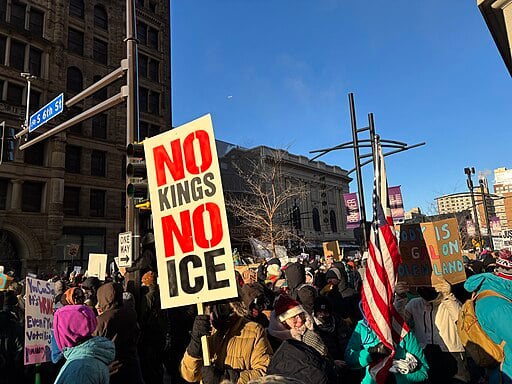
Alex Pretti’s last words were, “Are you okay?” Renee Good’s were, “I’m not mad at you.” Both were fatally shot by Immigration and Customs Enforcement (ICE) officers this month. Neither was holding weapons. They were observers, present to record, witness and alert their communities. We all saw what happened to them.
ICE brutality is not new. The agency has instituted inhumane conditions and separated families for decades. Thirty-two people died in ICE custody in 2025, but that was also true in 2004. What has changed is not the violence. The change is that we can no longer pretend we do not see it.
There was once a time when we could only read about deaths in the newspaper days after they happened. We could wait for investigations and the machinery of accountability to grind through its motions. But now, we hear the children in Dilley, Texas’ immigrant jail cry for their freedom. Now, we watch, in real time, as Renee Good is shot at point-blank range beside her wife. The distance that once protected our ignorance has disappeared.
That same ignorance disappeared when footage was released of refugee camps in Gaza being bombed, when children were starved and entire family bloodlines were killed with the financial and political support of the U.S. government and complicit corporate entities, including universities like Stanford. We could no longer pretend it wasn’t happening, not when we saw peers our age burning and heard children beg for an ambulance. The footage arrived on our phones unbidden, and it changed what once was possible to ignore.
We must ask ourselves: why does the sense of danger feel geographically confined when the threat is not? Minneapolis is under siege. Its residents are sheltering neighbors, documenting raids and facing down federal agents in their own streets. Why does their urgency not reach us here? The night raids look like Kabul. The detention regime echoes Guantánamo. All are perpetrated by the U.S. government and funded by our taxes to instill fear and line the pockets of weapons and tech companies. This is the “imperial boomerang,” the tendency of violence projected abroad returning home, carried by the same agencies, the same contractors and the same logic.
Last Thursday, amid the siege on Minneapolis and against the looming Senate vote on a funding package with renewed appropriations for ICE, the Black Student Union and Somali Student Association at the University of Minnesota called for a national general strike on Jan. 30, this Friday. The call is simple: no going to work, no shopping and no going to school.
A general strike is not a symbolic gesture. It is the withdrawal of labor, attention and commerce from a system that depends on our participation to function. It is the oldest answer to the question that haunts every moment of political despair: what power do ordinary people actually have? The answer is this: the power to stop.
There is also a particular significance for Stanford students and workers. The technologies that enable ICE surveillance, the capital that funds detention infrastructure and the engineers who build the technology of identification and tracking — many of them trace back to this campus. Silicon Valley is not a passive beneficiary of the border-industrial complex. It is an architect. Palantir data systems that make deportation efficient were not designed by strangers. We are implicated. But that implication is also a form of power.
When Stanford’s workers do not show up, when its students refuse to attend class, when its researchers and coders withdraw their labor, it registers. Not because we are uniquely powerful, but because a general strike makes visible what is usually invisible, the fact that business-as-usual can be a choice.
We ask you to take this risk because the alternative is worse. The alternative is doing nothing. The alternative is to scroll to the next video of tragedy, and the next, until the faces blur and the names become a list. The alternative is discovering, years from now, that we were present for an atrocity and that our presence made no difference — that we were bystanders, not witnesses.
What does it mean to witness?
Renee Good and Alex Pretti knew. They were observers, there to watch and document so that the law might hold. Pretti’s last words were a question — “Are you okay?” — directed outward, toward another person, in the final moments of his life. We have seen what they saw. We have heard what they heard. The footage is on our phones, and we must decide what it demands of us. To witness is to push us towards action in whatever way we can — even if it’s just stopping for a day.
They ask so little of us, the dead. They do not ask us to be heroes. They do not ask us to risk what they risked. They ask only that we do not abandon them in our silence. That if we have the power to do something against the entities complicit in their deaths, we do it. As Stanford students in the U.S., we have that power.
Here is what Minneapolis has taught us: that ordinary people, armed with nothing but their bodies and their refusal, can stop a raid. That neighbors can protect neighbors. That a city can rise, not because its residents are braver than the rest of us, but because they decided together that they would not look away.
Join us in White Plaza this Friday with a walkout and rally at noon. Insofar as we let this be the new normal, it will continue. Keith Porter, Renee Good and Alex Pretti will be killed again and again.
We are not asking you to save the world. We are asking you to refuse, for one day, to participate in its destruction. We are asking you to let your absence speak.
How will you answer?