
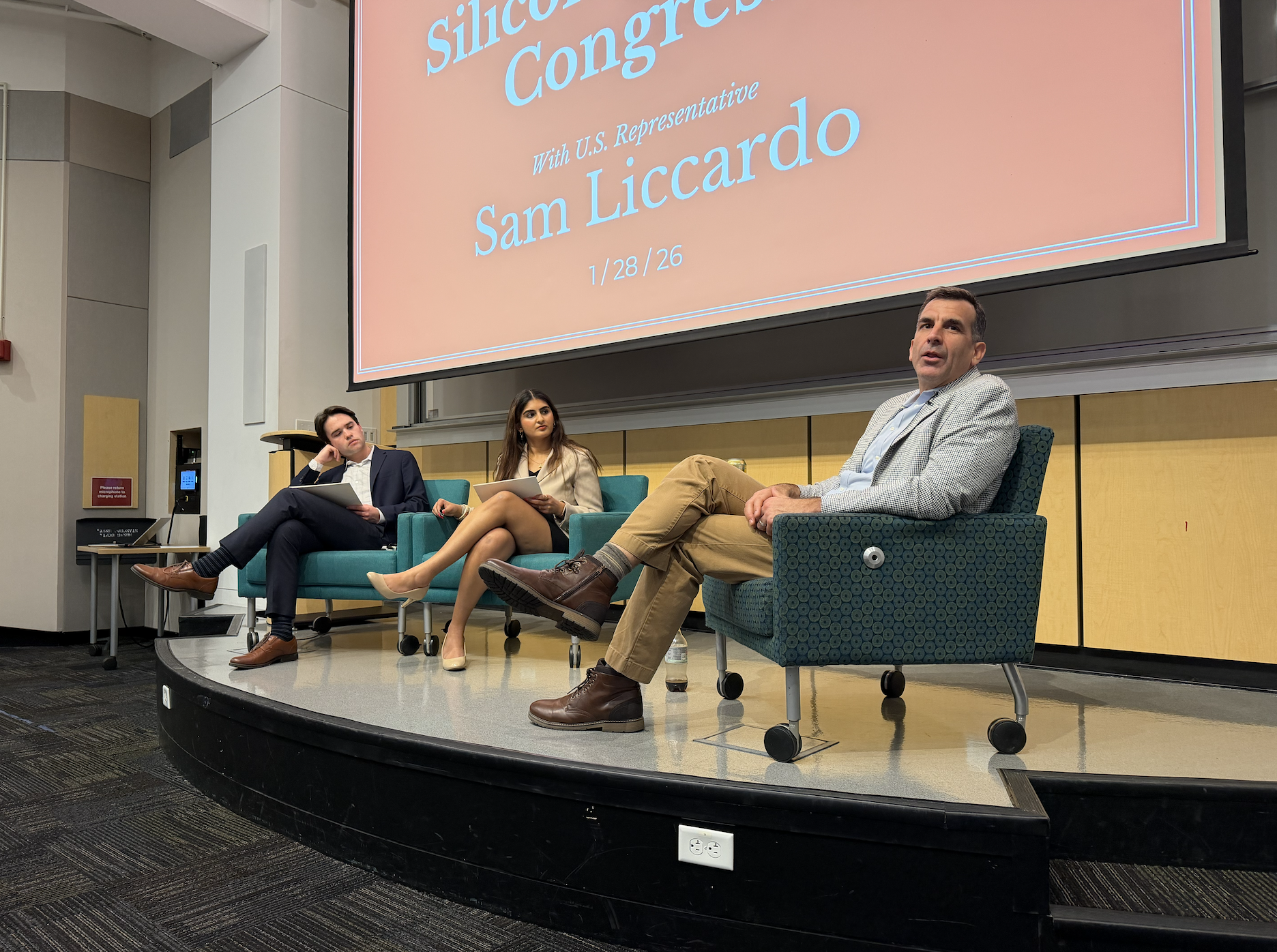
U.S. Representative Sam Liccardo (CA-16) expressed disillusionment with political inaction on AI and sustainable energy during a talk hosted by Stanford Political Union (SPU) and Stanford Abundance Wednesday night.
SPU events director Colin Weis ’28 and Stanford Abundance co-president Shreya Mehta ’26 began the event by asking Liccardo questions on technology, bipartisanship and affordability. A student Q&A followed, with questions ranging from AI and nuclear energy to political engagement.
Liccardo said that Americans “have every right to be cynical” about inaction on affordability. He expressed frustration regarding government gridlock on bills that failed to address the cost of living.
“I think both parties are at fault,” Liccardo said. “I got into office last year thinking, okay, there’s a lot of stuff we could probably reach across and try to do something about, particularly reducing the cost of living.” However, Liccardo said that the bills in consideration “had nothing to do with affordability. It was all culture wars.”
When Weis asked the congressman to reflect on San Jose’s consistent homeless rates during his tenure as the city’s mayor, Liccardo said, “Any mayor of a big city over the last decade would say, on homelessness, we failed.”
Liccardo said he regrets not pushing for more radical change while in local office. “If I could say there was one failure I had, it was probably not having the willingness to break more stuff to get things done,” he said.
Reflecting on his first year as a representative, Liccardo expressed a similar desire for more groundbreaking policies. “I can’t point to a single piece of legislation that I feel really confident about that you’re going to feel relief from as a result,” he said. “If we were to do something transformative, we’d quadruple the number of housing vouchers. We’re not doing anything close to that.”
Liccardo employs a similar mindset towards technology and AI regulation. In reference to Section 230, which Liccardo claims has been protecting social media companies, he said, “For about 30 years, folks have been saying we need to change it, and there’s been no substantial change.” Liccardo plans to introduce an AI regulation bill in two weeks. “I know I’m a frosh [freshman congressman], but nobody else will do it,” he said.
Liccardo recognized that data centers using fossil fuels create emissions, causing a negative environmental impact.
He commented that nuclear energy “is promising,” but he’s “not smart enough to know how legit it is.” He proposed AI as a “forcing mechanism,” saying now is the time to “leverage the urge of the most valuable companies on the planet to move quickly and invest in energy.”
To implement measures like clean energy mandates, cross-party support would be necessary. On bipartisanship, Liccardo said, “I think it’s always better if you start with your adversaries’ ideas, at least the sensible ones.”
He cited a two-hour conversation with representative Thomas Massie (KY-4), in which he aimed to gain his vote on a measure limiting a specific area of presidential oversight, as evidence of this bipartisan effort. Liccardo said that congressional polarization can complicate policymaking across the aisle.
“The criteria for what it takes to get elected is not necessarily the criteria to come up with sensible policy,” he said. “I spend 98% of my time fundraising for Democrats in other parts of the country. I wish I was not spending my time doing that.”
When asked about youth engagement and moral inconsistencies in the Democratic Party, specifically in regards to Gaza, Liccardo replied, “Two things can be true: Democrats are morally inconsistent, and things are currently not working out for the country, the planet, or for Gaza. I don’t use the term genocide, but there are war crimes and atrocities, and we should hold Israel accountable.”
Nason Li ’29, who plans to study political science, said he attended the event to engage directly with a member of Congress and better understand how elected officials approach governing. “I was expecting standard politician responses,” Li said, “but I don’t think he lied.”
SPU president Nathan Kuczmarski ’26 said that the organization’s goal in putting on events like the Liccardo talk is “to create a space and a forum for constructive dialogue and to catalyze discussion on campus.” Speaker events, he said, put ideas in the spotlight so students can “scrutinize it, see what they’d like to take, what they’d like not to take and move forward.”
Kuczmarski also emphasized that audience participation, particularly the extended Q&A, is “really central to [SPU’s] mission.”
Li said he was surprised that “there weren’t more people, honestly, because [Liccardo]’s our congressman and he represents a bunch of Californians.”
After briefly speaking with Liccardo following the event, Li said the congressman encouraged young people to stay engaged even when disillusioned, telling him that frustration “means you care.”