
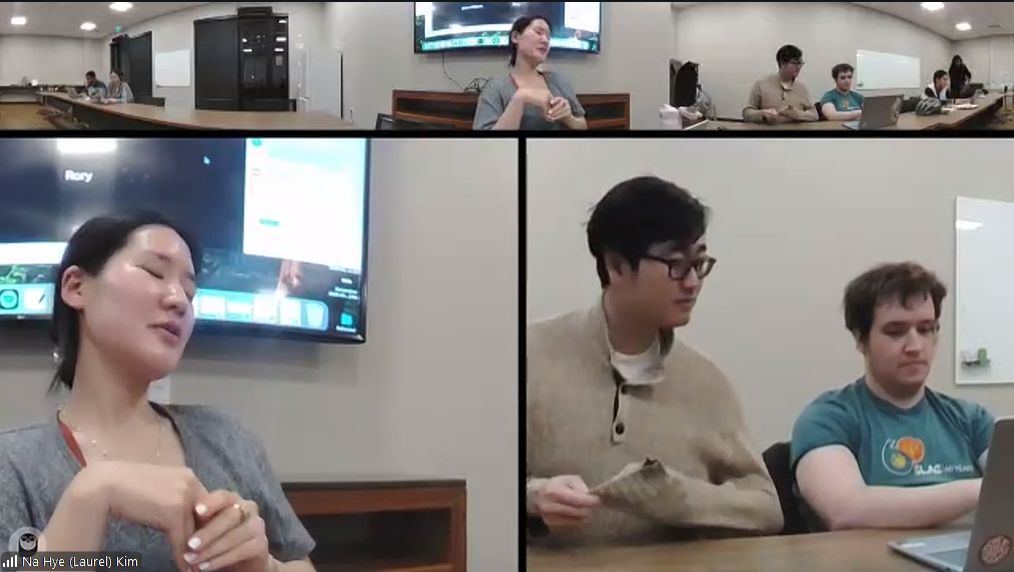
The Graduate Student Council (GSC) affirmed its solidarity with a nationwide strike protesting Immigration and Customs Enforcement (ICE) violence, proposed Office of Community Standards (OCS) reform, deliberated amending the Associated Students of Stanford University (ASSU) bylaws and questioned Residential and Dining Enterprises (R&DE) representatives in its Thursday meeting.
The GSC voted to approve the Joint Resolution in Solidarity with the Nationwide Student Strike and Opposition to Federal Immigration Enforcement Violence. The bill expressed admiration for Stanford community members’ participation in a nationwide walkout on Jan. 30 to protest violence perpetrated by ICE.
“We likely know folks who come from mixed status or immigrant households, or maybe undocumented themselves. This fear is real. It’s not abstract,” said Undergraduate Senate chair David Sengthay ’26, who presented the bill to the GSC. “If we don’t act, it’s a failure.”
The GSC also discussed introducing a measure calling on the Board of Conduct Affairs (BCA) to amend OCS procedures. The discussion occurred in light of the University’s recent settlement with the family of Katie Meyer ’22, a Stanford student and soccer player who died by suicide in March 2022
The settlement stated that the University will implement the conditions of Katie Meyer’s Law, which mandates mental health services for students facing disciplinary violations, according to GSC chair and sixth-year Ph.D. student Rory O’Dwyer.
“The Katie Meyer law is definitely something that has been brought up in BCA,” said BCA member Tom Liu, a sixth-year Ph.D. student. “I think the ultimate conclusion that we come to will probably benefit a lot from outside pressure.”
Sengthay presented the Joint Bill to Amend Article V, Section 8 and Section 9 of the Joint Bylaws of the Associated Students of Stanford University, which proposes amendments to two sections of the ASSU’s Joint Bylaws that govern reporting and invalidation of election results.
Sengthay referenced controversy surrounding last spring’s ASSU presidential election as the reason for the amendments. Last year, following accusations that presidential candidate Ivy Chen ’26 M.A. ’27 asked former elections commissioner Christian Figueroa ’27 to tamper with votes, the GSC voted not to certify the results of the election.
Following the decision, the GSC introduced an election certification bill, drawing concerns from council members about issues of continuity in decision-making regarding the ASSU election.
The amendments in question would automatically certify election results 14 days after polls close unless there is a motion to invalidate. The bylaws state four grounds for invalidating election results: voter fraud, voter disenfranchisement, partisan elections and elections not in accordance with the ASSU constitution.
The proposed amendment also enforces a seven-day deadline to adopt a motion to invalidate election results. If the motion is adopted, the Elections Commission (EC) must call for a new election within 10 days, and the re-election must be held within five weeks of the EC’s motion
GSC parliamentarian Aron Ricardo Perez-Lopez expressed concerns that certification under the amended bylaws does not happen with sufficient automaticity, suggesting that certification should happen before the window to invalidate expires.
The GSC has one week to either approve or reject the proposed amendments.
During the meeting, GSC councillors also questioned David Ward, the assistant vice provost for R&DE Housing Operations and Stanford Conferences; Rebecca Benederet, the senior associate director for Graduate Housing Operations; and Justin Akers, the senior director of Housing Assignments.
Councillors posed questions on planned power outages, guaranteed housing for graduate students and meal plan affordability.
R&DE is in the midst of implementing electrical upgrades through the Electrical Reliability Improvements (ERI) campus project, which will necessitate planned power outages of up to 15 hours. The shutdowns will begin the second week of February in Escondido Village’s low-rise apartments, according to Benederet.
Councilor Ruby Zhou M.S. ’27 briefed the representatives on a 2016 document stating that Master’s students are only guaranteed one year of on-campus housing. According to Zhou, Ph.D. student housing operated under a similar policy until advocacy by the GSC, the Graduate Housing Committee and the vice provost of graduate education passed a measure to allow renewal of housing contracts for up to six years.
Ward said that even without a policy guaranteeing renewal of Master’s students’ housing contracts, R&DE provided housing to over 90% of returning Master’s students who indicated a desire to live on campus. However, Ward expressed hesitancy to guarantee housing for Master’s students. “It’s tricky, because you don’t want to make promises you can’t keep,” he said.
Assistant Vice Provost of Stanford Dining, Hospitality and Auxiliaries Eric Montell and Senior Director of Stanford Dining Khalil Wells also announced a 25% discount on graduate students’ 25-block meal plans from Feb. 2-28 and a happy hour with reduced food and drink prices at the EVGR pub on Saturday nights from 5 to 8 p.m.
“We continue to look at ways to make our meal programs in the dining halls, in our cafes and in the pub right in EVGR affordable to grad students,” said Montell. “We continue to hear from grad students that that is a top priority for them.”
Finally, GSC treasurer Elena Vasilache, a fourth-year M.A. candidate, said that the current “70-30” VSO funding system violates the ASSU constitution. Under the system, a VSO composed of more than 70% graduate students is funded by the GSC, and a VSO composed of more than 70% undergraduate students is funded by the UGS.
Without the rule in place, the GSC will have to review over 200 annual grants to ensure proportional funding from the GSC and UGS, respectively. The GSC will vote on a bill to replace the “70-30” system with a proportional funding model at next week’s meeting.