
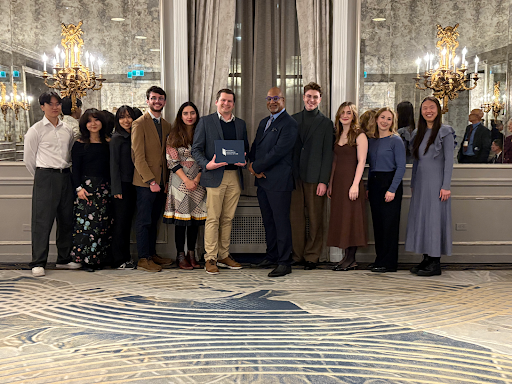
The biennial Modern Language Association (MLA) Prize for a Scholarly Edition was awarded to a publication by Stanford Online High School (OHS). The group of 16 students and their teacher won the accolade for their critical edition of William Combe’s 19th-century satirical poem “The Tour of Doctor Syntax in Search of the Picturesque.”
The OHS’s edition features a redesigned cover as well as side-by-side annotations parallel to the text, designed to help readers navigate the poem in its Regency era context. The MLA’s press release praised the book’s “public facing vision” and the decision to put the text in conversation with Jane Austen’s life and work.
“The [edition’s] descriptions of adulatory spinoffs, merchandise, an eponymous racehorse, board games and stage pantomimes resonate with twenty-first-century readers and scholars of fandom,” the press release read.
The prize, announced on Dec. 3, was presented to the group at the association’s 141st convention in Toronto on Jan. 9.
According to Dr. Ben Wiebracht, an English instructor at Stanford OHS, the class project grew out of a class on Jane Austen. Austen shared Combe’s interest in picturesque social satire and was one of many Regency-era fans of the character of Doctor Syntax, a hapless countryside clergyman who meets constant misadventure in the poem.
Wiebracht was at the project’s helm, organizing student contributions. He described the honor as an “all-time career highlight” and noted how momentous it was for a high school project to receive such recognition. According to Wiebracht, “for a teacher and a bunch of high-school students to win it, or to win any MLA award, is simply unheard of.”
According to Wiebracht, students took responsibility for individual portions of the lengthy poem — 26 sections in total — while Wiebracht drafted the introduction with substantial input from the class. Students also contributed to the cover design and annotations.
“Involving students in genuine scholarship makes the end product better,” Wiebracht said, contrasting the project‘s collaborative model with conventional humanities research opportunities such as honors theses or research assistantships. He described the project as a “happy medium, where everyone shares authority and responsibility.”
Three members of the editorial team are now Stanford undergraduates: Mayuko Karakawa ’29, Rathan Muruganantham ’29 and Sabine Mazzeo ’28. In an interview with The Daily, Mazzeo said she appreciated that the MLA “recognized us, a group of high school students, as having made a contribution” to scholarly work.
The experience helped her see what work in the humanities can look like beyond the classroom, said Mazzeo, adding that “Dr. Wiebracht as a teacher made such a meaningful impact on us.”
The edition, published by Pixelia Publishing, is available for purchase and for free as an online PDF. On campus, the edition is currently featured in an exhibit at Stanford’s Bowes Art & Architecture Library, running through March 12.
According to Weibracht, this recognition carries promising implications beyond the prize itself. To him, the success of “Doctor Syntax” represents the exciting potential of collaborative teaching in the humanities, where “teachers and students work together to create something, instead of the teacher simply assigning and grading student work.”