
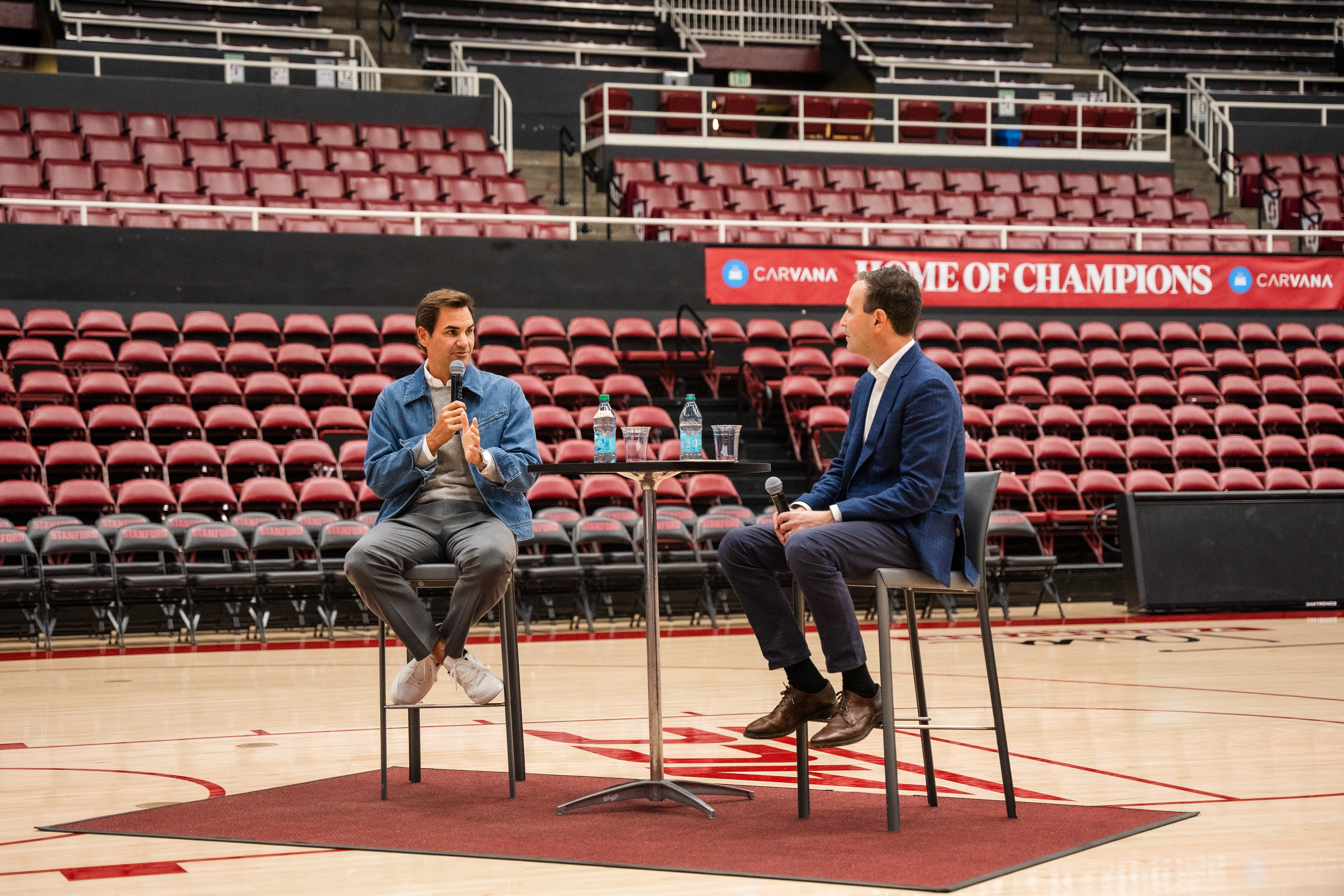
On Monday, 20-time Grand Slam champion and former world No. 1 men’s singles tennis player Roger Federer sat down with University president Jonathan Levin ’94, speaking about developing as a player, finding resilience in tough moments and navigating life after tennis.
The event, co-hosted by the Department of Athletics and the Office of Vice Provost for Undergraduate Education (VPUE), was moved from Bing Concert Hall to Maples Pavilion accommodate overwhelming interest. Organizers estimated an audience of roughly 1,600 people.
Federer — who has spent a record 237 consecutive weeks as World No. 1 — was introduced by men’s tennis team player Nico Godsick ’27, whose father, Tony Godsick, served as Federer’s agent since 2005.
“I want to give you guys a sneak peek to the Roger I know away from the spotlight: I’ve seen the way he treats people when no one’s watching. He spends as much time talking to young players, ball kids and tournament organizers as he does speaking with world leaders, CEOs and fellow champions,” Godsick said. “This impact will outlive, I believe, any of his stats or trophies he has to his name.”
The conversation centered around Federer’s development as a player, and the mental and physical challenges he faced throughout his career.
“When I used to play, I’d be very sad, crying, commentating [that I was] playing bad, everything’s bad, life is bad, forehand is bad, and then I lose,” Federer said, recalling his attitude during his early days on court. When he realized that his outbursts had to come to dominate his post-match highlights, however, he realized that something needed to change.
“I need to be my own boss,” Federer said, stressing the importance of “independence” during matches. “If I can’t do it, nobody else can tell me to do it, because then it’s just me doing somebody else a favor. But I have to do myself a favor.” Balancing his passion and collectedness, Federer described how he “tried to create…sort of like having the ice in the veins and the fire in the belly.”
Levin highlighted Federer’s message about focusing on aspects in your control as particularly applicable to students.
Nathan Barki ’27, a member of the men’s tennis team, said Federer’s advice extended beyond the sport.
“He shared a lot of wisdom, not only as a tennis player but also in life and business,” Barki said in an interview with The Daily.
At the same time, Federer acknowledged the mental health struggles faced by athletes at the highest level.
“The sport, the grind, the pressure can really get to you,” he said. “And I came through it, I didn’t [show it] on my face, but I did it, and I came out on the other side with knowledge, happiness…and very few regrets.”
In dealing with those pressures, Federer emphasized the importance of building a good team. “I tried to always spend time with people that I really felt inspired [by] and [who] motivate me,” he said. For instance, Federer outlined his choice to hire his idol Stefan Edberg amid a 2014 career slump. “When I was a kid in my living room on the couch [I would] cheer Stefan on, he said. “[To] spend time in the presence of my hero — that’s super inspiring.”
For Federer, building a sustainable mindset towards setbacks was crucial in building more responsibility over his team. Rather than keeping his team “constantly on edge” by being “unbearable to be around” after losses, Federer said he decided to shift his outlook.
“Only one guy leaves as a winner in the Grand Slam, all the other 20 plus players, they leave having lost [it],” he said. “So inevitably, you’re going to be in a horrible mood every week for two, three days. I was like, why do that? That is too stupid,” he said.
“[Federer] was like the first player I really watched, especially in 2017 and 2018 [when he was] coming back from his injury,” said Kovid Akshar Capildeo ’29. “Especially when he won his 20th Grand Slam Title, that was a really big moment in my life because it really taught me about perseverance.”
Several of Levin’s questions centered around Federer’s rivalries with fellow tennis players Novak Djokovic and Rafael Nadal
“You see how unfortunate I was: if they wouldn’t have been there, how much more I would have won?” Federer joked. But he also acknowledged the conscious effort that went into dealing with a new batch of competitors. “A lot of the sport actually goes into re-organizing your brain, of appreciating that they are actually here, in many ways, to make you a better person and a better person, because you have to accept their presence and the strength.”
Federer said he still keeps in contact with Djokovic, Nadal and other players he competed against on tour. “We are like brothers in many ways, because those brutal matches and those long careers that we had all together connect [us],” he said.
The event concluded with a Q&A session, which saw Levin pose questions submitted by audience members in advance. Federer, who retired from professional tennis in 2022 at age 41, spoke deeply about his post-professional career.
With his playing days in the rearview mirror, Federer said that his family has been able to travel extensively over the past year. Last year, he visited Stanford ahead of the 2025 Laver Cup, which was held in San Francisco.
“Right now, I’m in a great spot defending or protecting my schedule as much as possible, so I can also have time to work with creative thinking,” Federer said.
Levin described Federer’s mindset as a source of inspiration.
“There’s something for everyone to learn in being able to view and have such a relentlessly positive approach and turn setbacks into opportunities,” Levin said. “I was thrilled to have him spend time with students.”