
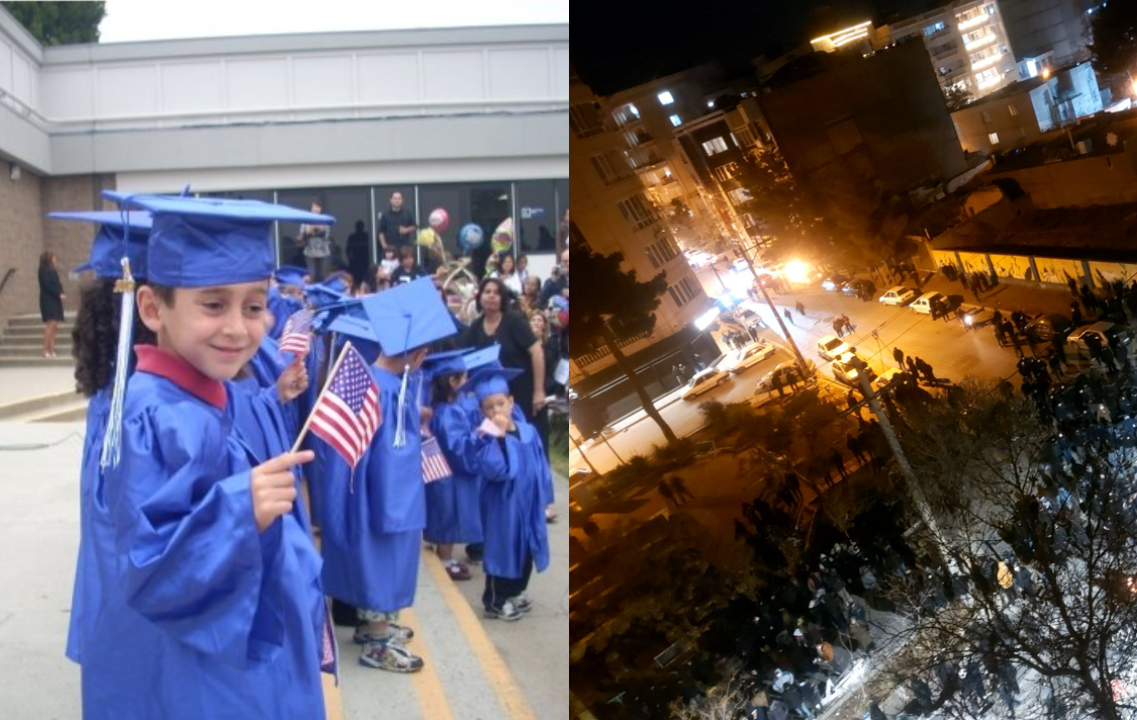
My father took his first breath on April 24, 1955. He entered a generation of hard work and conviction. His father, a machine shop owner, and his religious mother taught him the importance of prescribing purpose to one’s life — to decipher life’s absurdities with biblical resolve and hard labor. The pursuit of knowledge was his pillar of faith and his salvation. The more he pestered books and analyzed every nook and cranny of mathematical knowledge, life would reveal itself to him in all its lucidity — the world was his Riemann Sum, each small increment of studying elucidating a clearer whole.
There was something subversive, poetic and psychedelic to him about mathematics; as a poor young Iranian boy, it was his artistic revolution. Working as a carpenter at the age of seven, a great phantasia of mathematical shapes, geometric diagrams and waves of fascination would crash into each other, producing brilliant arrays of colors and beauty. Perhaps the God his mother spoke of did exist, harnessing His divinity within the beautiful simplicity of mathematical ideas.
However, living in a devout Muslim country, it was the conviction that inspired Abraham to sacrifice Isaac and spill his blood down Mt. Moriah that gave grounding, purpose and direction. Humans endured suffering, and the Abrahamic belief that a God was there to acknowledge suffering was intoxicating. Mohammed Reza Shah rested in power and material wealth, his tainted soul gilded with gold, his hands stained with blood and oil.
In a rich man’s house there is no place to spit but his face, and with a few broken skulls, raised fists and cast stones, the rule of a man who positioned himself as a God came crashing down. A good God, one who supported the people and acknowledged their pain, would be established in replacement.
By 1978, my father moved to Cambridge, but with the regime change and the Iran Hostage Crisis, the school cut his scholarship program, kicked him out of the dorms and left him to die in a foreign country. His education in an Ivy League town wilted in the freezing Boston cold, his indigenous displacement pronounced by his frozen beard and hairy legs. He would study in the attic of an old lady, praying she would cook at night so the heat from the stove would rise and melt away the frozen indifference of American xenophobia.
Back home, Saddam Hussein, armed with chemical weapons, had invaded the Iranian desert, and he had to watch as many of his friends died while he sat in a Boston attic, frozen in time. Shadows and halogenic hallucinations would dance on the walls as he helplessly tried to make sense of the absurd imagery of war. Sweet red syrup oozed through desert sands, mixed with oil and mustard gas. Trying to focus on work, he would blink, and a flash of “Guernica” would appear with blood on the wall.
My father lost his faith, his mathematical phantasia decomposing into esoteric numbers and jargon. How could one’s conviction remain firm when faced with the lack of humanity humans had for each other? Why was America providing weapons not only to Hussein, but both countries, supplying sadistic generals with the chemical weapons that were disfiguring his friends? Were the lives of Middle Eastern people no more than pawns to play on a political chessboard? This foreign country — America — prided itself on upholding the pillars of justice, yet Americans had defaced the meaning of fairness, representing their Lady Justice with a blindfold so that she would turn a blind eye towards the suffering of dirty, unworthy, blood and Sarin-covered immigrants.
By my junior year of high school, I felt as if my brain were overcooked and my work underdone. I was experiencing burnout, and I knew why: I had bought into a great American lie, sacrificing so much of my soul for personal gain and assimilation that there was none of me left. Why was I working so hard to take part in the same system responsible for much of the instability and death plaguing the Third World, just to gain infinity pools I’d never be able to baptize myself in, houses I’d never be able to truly live in, accolades I’d never have the pride to display? I was a slave to my own guilt. I reached for the back of my head and felt a gaping hole. Despite all the scholarships and support I received, I was merely another casualty of war, shot execution-style by Uncle Sam’s gun.
From that gaping hole, in a pool of red molasses, had crawled a creature called Fear. It was that amorphous figure that had rested in my head all these years after locking the door in my brain and throwing away the key. That dark foreboding voice told me to stay in line, whispering that if I had not followed the rules, climbed tax brackets and reached this goal of the idealized student, brother, leader, American, the sacrifices of my parents would’ve meant nothing. This saving grace, a kind of lobotomy, helped me realize that to assimilate was to give into fear.
The rise of the recent protests in Iran, estimated to have killed somewhere between 12,000 and 36,500, provides a foreboding reminder of the consequences of a corrupt theocracy that mutagenizes the words of an infallible creator to justify the murder of thousands of innocent people. Many Iranian Americans feel helpless seeing their relatives struggle with basic necessities such as food and water and risk death to protest their condition.
Iranian Americans, who now make up a significant portion of America’s entrepreneurs, doctors and engineers, carry a constant yearning to see their relatives again — a constant guilt that they could easily have been in their relatives’ plight. We understand the blessing of American opportunity despite the imperialist past that made it possible. Additionally, we grow weary of the all-too-familiar rise of religious nationalism in the United States, where politicians use the Bible to justify changes to government policy on abortion and education.
This issue poses the question: if faith provides grounding to the beautiful, confusing and terrifying illogicality of life, how can a society prevent a corrupt few from hijacking the word of God to oppress millions of people?
My answer for people is to be authentic about their faith, their citizenship and their purpose. Faith proves grounding, and people can discover it in many different ways: my father’s love of math, a baby’s laugh as she rolls past me in a stroller, the unparalleled beauty of millions of blades of grass caressed by a warm summer breeze. The concept of life is so terrifyingly ludicrous, and to try to fight against it alone, to feel personally responsible for fighting against every river of blood spilled by every emperor and general so that they could be momentary masters of Earth, is so highly illogical. Instead, displaced populations should live their lives in ways meaningful to them.
America — a place of beautiful diversity and change — is not something we should assimilate to, but what we make of it: the paradigms we want to shift, the archetypes we want to destroy. Immigrants should see American dollars not as a form of safety and success, but as an opportunity to distribute education, wealth and technology to countries that suffered at the hands of imperialist collusion by the Western World. Not in a sense of revolutionary resentment, but rather as an act of unconditional love, a promise to put into action the spiritual faith we ran away from for so long.
Free Iran.