
Two years ago, Arun Majumdar, dean of the Doerr School of Sustainability, was moderating a panel of university presidents from around the world when a question was raised: “What can we do together that we cannot do alone?”
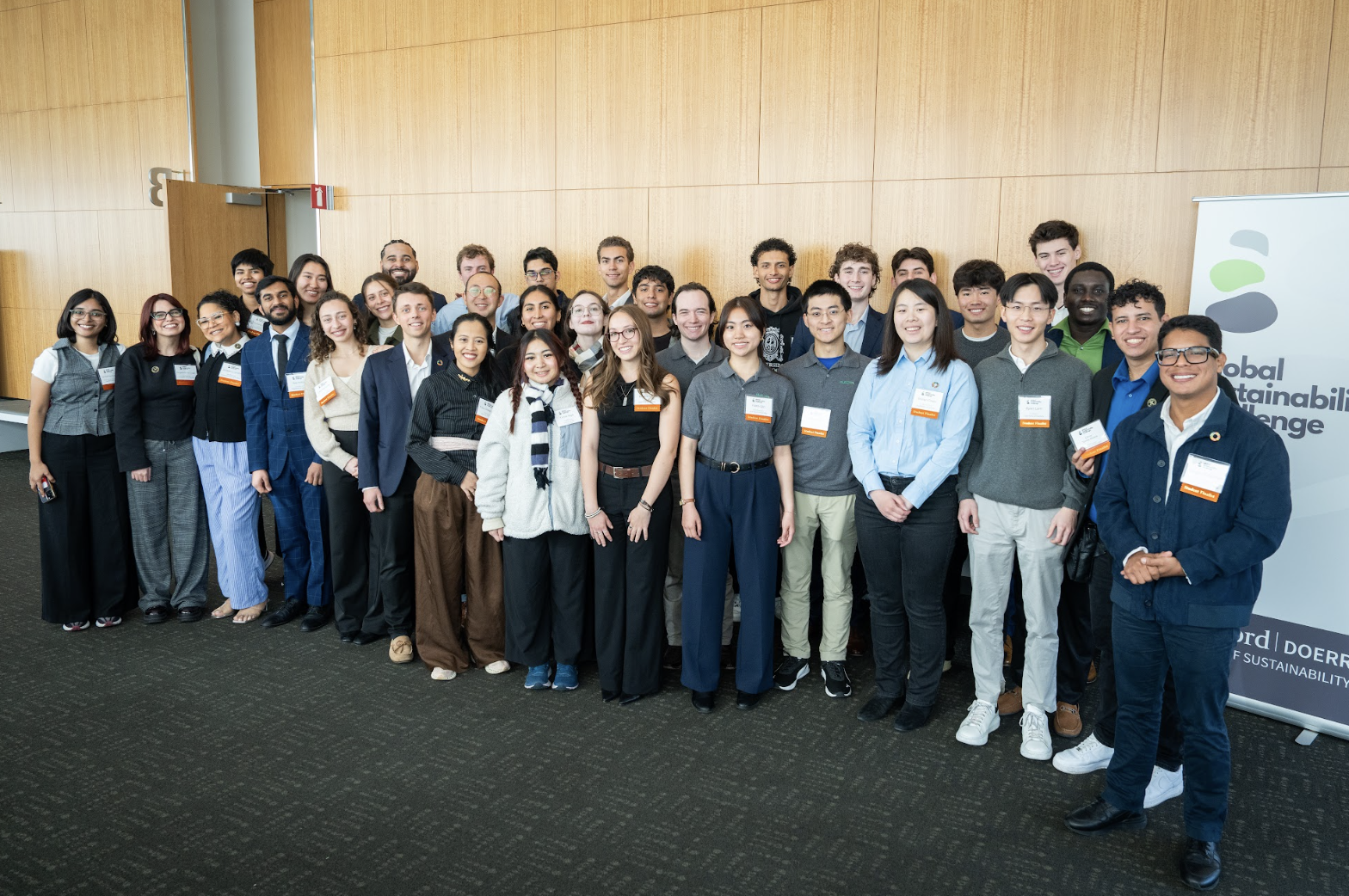
In pursuit of an answer, Majumdar began to conceptualize what would become the Global Sustainability Challenge (GSC) — an “Olympics” of real-world sustainable solutions. Friday marked the Americas final for the inaugural GSC. 23 finalist teams from across North and South America competed, with six advancing to the Global Finale in April at Technical University Munich. Three teams of all-Stanford students advanced, as well as a multi-university team that included a Stanford student.
While students use their campus as a “living laboratory” to test sustainable solutions, such as reducing food waste and emissions or designing energy-efficient buildings, prior to the GSC there was little communication between universities, Majumdar said. For example, Stanford students might not know about the innovation happening on campuses in Munich, Germany or Mumbai, India. With this in mind, the concept of the GSC was conceived.
“The idea of competition is that people get people really excited, and people want to compete and do better than others, which is a good thing,” Majumdar said. “But at the end of the day, the purpose is not the winning and losing, but to create a network.”
Majumdar recruited the Doerr School’s managing director for mobilization and former edtech entrepreneur, Parul Gupta MSx ’24, to take the lead on building the GSC. However, the specifics of the challenge reflect a collaboration between all of its founding partners, including the Hong Kong University of Science and Technology, Indian Institute of Technology Bombay and Technical University of Munich, among others.
“The fundamental nature of [sustainability issues] is such that you have to work with others,” Gupta said. “It cannot be a centralized model where one institution or one place seeks solutions.”
Gupta said the first year of the GSC “has been incredible.” When the competition began in September 2025, over 3,000 students across 91 countries assembled teams and competed with ready-to-implement solutions.
“Change doesn’t happen if it remains in the classroom or in the lab,” Gupta said. “That bridge of crossing research into real-world impact is a hard one to cross, and is often not taught in universities. A [solutions-oriented competition] was a very intentional choice.”
Just as intentional were the two themes of the year, which doubled as categories in the competition: “Sustainable Energy” and “Adaptation & Resilience.” At the finals on Friday, posters describing projects’ research, development and implementation processes lined the walls of the Li Ka Shing Center for Learning and Knowledge, while remote teams participated online. Judges pulled groups aside throughout the morning for tailored presentations on their project.
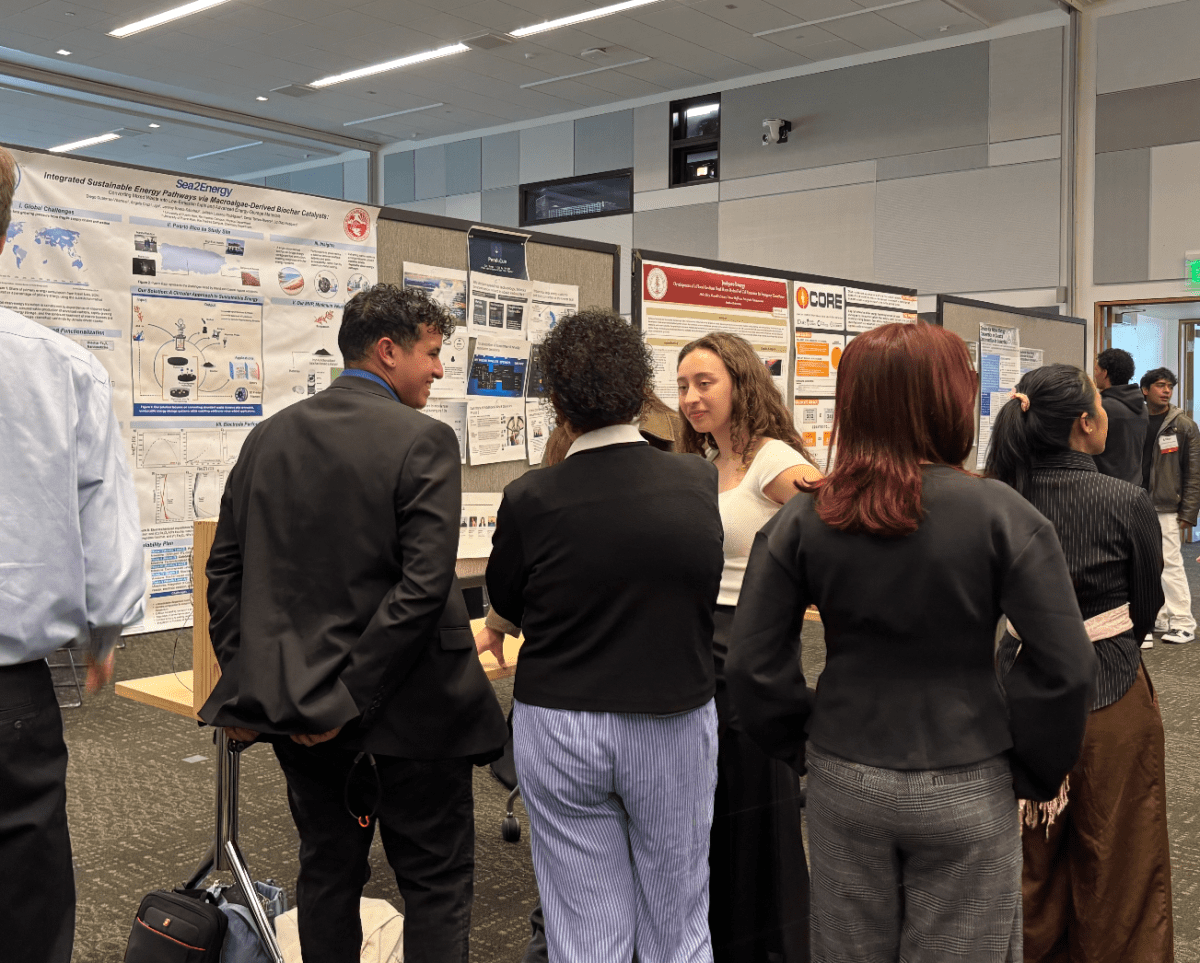
“It was a bit daunting [to present], because you have to bridge the gap between knowing 100% about your product as a team and having judges who are domain experts in their specific field,” Rudraksh Mohapatra ’27 said.
Competing in the “Adaptation & Resilience” category, Mohapatra was part of the all-Stanford team FloodMAP. By successfully innovating a low-power, self-sustaining sensor system that collects data to monitor and detect floods, FloodMAP will move on to the Global Finale. They are joined by team Electrocean, a three-person team including Faith Qin ’29, and all-Stanford team ResiliNet, comprised of Bhav Jain M.D. ’27, Srinidhi Polkampally M.D. ’28 and Anushka Bhaskar M.D. ’29.
ResiliNet created an AI-assisted platform that can allocate resources during climate disasters for hospitals in demand. Electrocean presented a solution to decimated oyster fisheries — a mechanically-engineered device that uses electrolysis to reverse ecosystem-damaging acidification. Or, as team member and Purdue University student Gabriel Boyd called it, “Tums for the ocean.”
“The GSC has given us good pressure and incentive to rapidly iterate our own device,” Boyd said. Central to Electrocean’s project was the need to combine the concerns of oyster farmers, affordability and practicality, with the simultaneous goal of revitalizing coastal habitats where food chains have begun to collapse.
In the “Sustainable Energy” category, teams Sea2Energy from the University of Puerto Rico, Junipero from Stanford and AmpliFi Energy from Columbia University advanced to the Global Finale. Sea2Energy’s project promotes converting mixed waste from the ocean into sustainable fuels or advanced forms of batteries, while AmpliFi Energy’s platform assembles portfolios of promising clean-energy startups and presents them to investors.
Team Junipero, composed of Daniella Fenster ’27, Miles Bliey ’27, Connor Hoffman ’27 and Panagiotis Papanastasiou ’27, met in the Explore Energy dorm during their freshman year. As engineering majors, they reunited to build two forms of power generation that can be deployed after an extreme flooding event. Their “microhydro” generator can be strategically set up by civilians or emergency personnel to harness the mechanical energy of moving water, while their saltwater fuel cell can generate electricity in still seawater.
It’s important, Fenster said, to innovate solutions that help people affected by climate change now, rather than solely developing commercial technology for the future. “Your technology does not have an impact unless you scale it and deploy it,” Fenster said. “We’re really excited about those next steps.”
Reflecting on the event, Majumdar focused on the legacy he hopes the GSC will build.
“I’m hoping more people will be interested in learning about [sustainable solutions] and in using what I call the biggest renewable resource, their mind, to innovate out of [challenges] and help their communities.”
Gupta said she hopes sustainability considerations extend beyond STEM majors or future GSC participants to the entire student body.
“Even if it’s not something you’re interested in professionally, do engage with it,” Gupta said. “Spend some time working with other students, talking to users and understanding the problems. That knowledge and awareness will serve you well in life.”
Correction: An earlier version of this piece misidentified the educational history of Parul Gupta and misnamed Gabriel Boyd. The Daily regrets this error.