
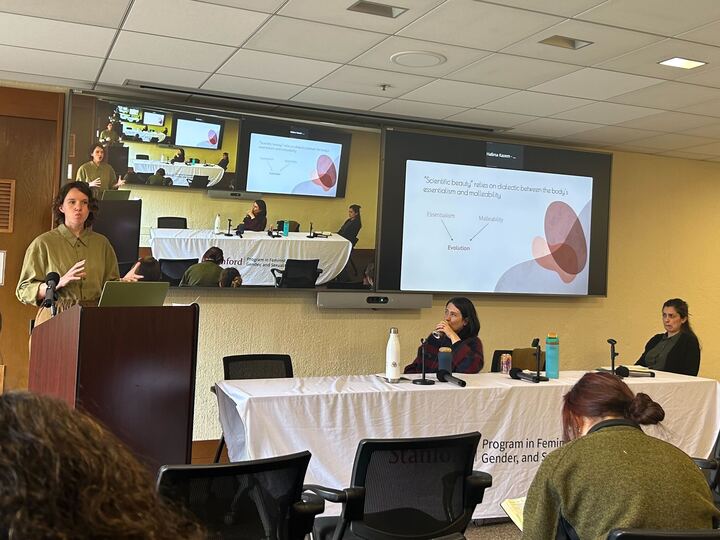
Alternative media spaces are reshaping ideas about gender, politics and beauty, scholars argued in an event sponsored by the Feminist, Gender and Sexuality Studies department Thursday afternoon.
“Manospheres, Femospheres, and Momfluencers: Gender and Content Creators in the Age of Social Media” brought together communication professor Angèle Christin, Stanford visiting scholar and University College London sociologist Katie Gaddini and third-year communication Ph.D student Elizabeth Fetterolf for a conversation about how niche online communities are changing societal norms.
For Gaddini, these communities are growing less niche, however. “This isn’t just a dark corner of the web that some people are tuning into,” she said. “This is very much a mainstream platform.”
Christin examined the lived experiences of men who engage in the “manosphere,” which she defined as “a network of websites, of forums, of social media groups that are broadly promoting masculinity, misogyny and opposition to feminism.”
According to Chrsitin, one example is r/TheRedPill, a Reddit forum that offers a set of principles about the different sexual behaviors of men and women. These principles include that women are biologically programmed to seek high-value men, feminism is a sexual strategy disguised as politics and men must transform themselves into “alphas” to succeed in competitive sexual marketplaces.
Through her interview-based research with fourth-year Ph.D. candidate Tomás Guarna on TheRedPill, Christin found that participation in TheRedPill is a way for men to connect their personal troubles to a larger societal crisis. “Usually in the interviews, [participants] started by talking about their individual romantic failures… and they connected that to a broader sense of a decline of the West,” she said.
Christin also observed that TheRedPill community members see themselves as having superior knowledge, based on personal experience and what they characterize as scientific evidence. Additionally, she said that these members frame their lives as hero’s journeys in which they transform from “beta” to “alpha” through fitness, career advancement and stoicism.
The manosphere is not the only segment of the alternative media ecosystem reshaping cultural norms. Another is the world of so-called “momfluencers” — female content creators who share parenting-focused content, often intertwined with Christian faith and conservative politics, according to Gaddini.
In her talk, Gaddini highlighted social media personality Allie Beth Stuckey. “She represents a broad group of Christian mom influencers who blend motherhood and Christianity to claim political authority for a massive female audience,” Gaddini said of Stuckey.
Drawing on a decade of ethnographic research, Gaddini highlighted several strategies that momfluencers use to gain political power, such as moralizing motherhood to gain legitimacy and communicating political ideas indirectly. Gaddini argued that the second strategy is especially influential because it allows momfluencers to reach a group of women who wouldn’t engage with politics otherwise, perhaps believing it is men’s domain.
Although the manosphere has attracted much public attention, Gaddini emphasized that the so-called femosphere also carries significant societal implications. “The manosphere is not the whole story,” she said. “While these [mom] influencers may not look like political actors, they are central to how MAGA is lived and sustained in the U.S. today.”
Fetterolf closed the event by analyzing “looksmaxxing,” or what she described as “the long process of promoting time, energy and money to looking hot.” Those engaged in looksmaxxing “see the very real financial and social rewards of feminized beauty, and they want that,” she said.
Fetterolf distinguished between two types of looksmaxxing: softmaxxing, which refers to minimally invasive measures like diet, makeup and fashion, and hardmaxxing, which primarily refers to surgical interventions.
Although the Reddit community dedicated to women’s looksmaxxing is relatively small, its ideas have disseminated into society, according to Fetterolf, who highlighted recent articles and TikTok trends that promote sometimes extreme beauty treatments.
For Fetterolf, the looksmaxxing community shows that alternative media is not exclusively conservative. “Reactionary ideas — about gender, about race, about the body — are being embodied by communities that do not explicitly identify as right-wing,” she said.
Event organizer Rachel Jean-Baptiste, faculty director of the Program in Feminist, Gender and Sexuality Studies told The Daily that the panel was partly inspired by the feminist, gender and sexuality department’s new subplan in technology, science and medicine.
She said that the event provided insight into the ways gender, technology and society interact. “[Social media] is a site of formation about alternative ideas of gender,” Jean-Baptiste said. “What’s happening online… is impacting real life and vice versa.”