
Editor’s Note: This article is a review and includes subjective thoughts, opinions and critiques.
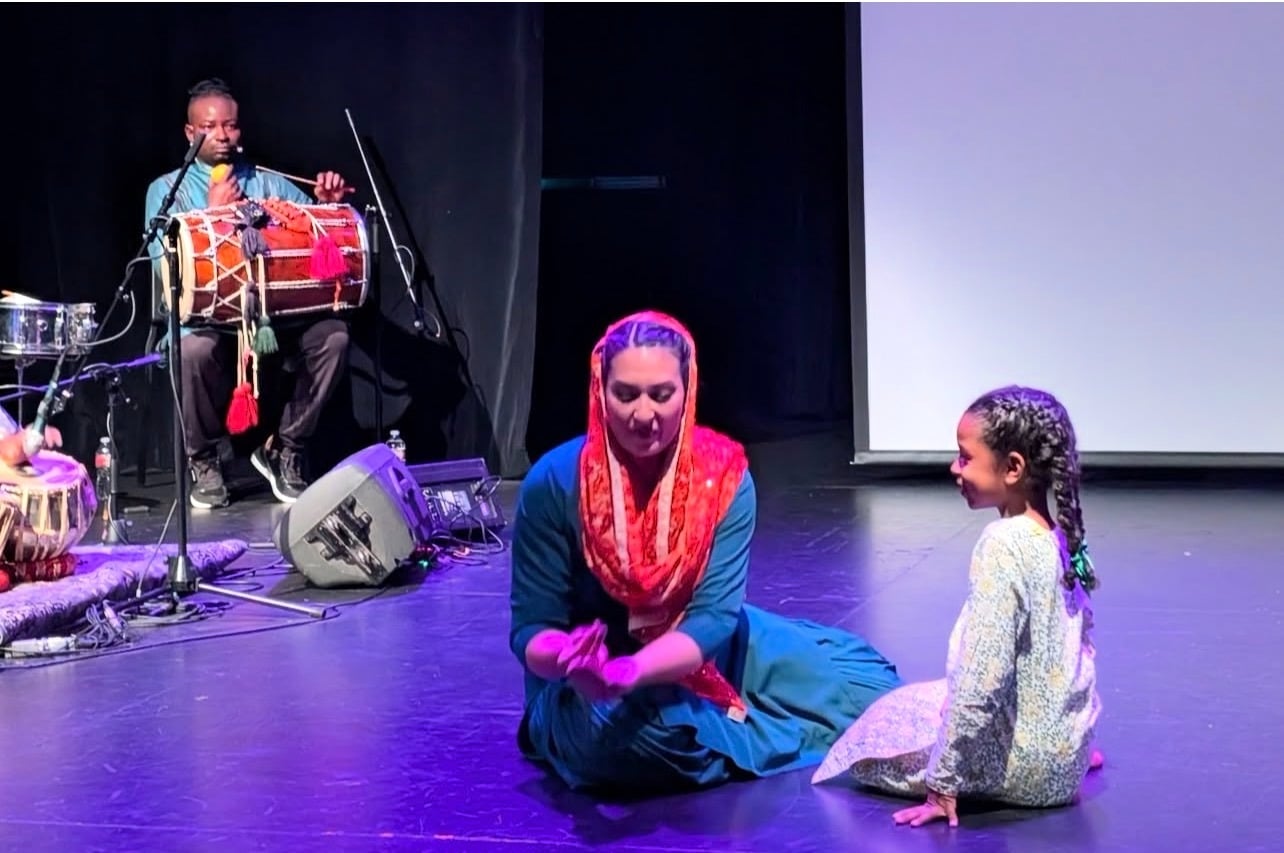
How does one decolonize when the colony’s lingering residue outlasts its literal existence? Dance creator Joti Singh’s “Ghadar Geet: Blood and Ink,” performed by the Duniya Dance and Drum Company and organized by the Center for South Asia on Saturday, suggested the answer to this question might lie in song and dance, a medium that activates a decolonial sensorium and raises questions of what decolonization sounds like and how the resistant, anti-colonial body moves.
With two full-house performances interspersed with a mehfil (poetry recital) — “Sunnō Panjab Bolda” — organized by curator Sonia Dhami and the Art and Tolerance group, the event symbolized resistance to a violent archive while also shaping futures of dissent.
The Ghadar Party, the subject of Singh’s performance, was founded in the Bay Area in 1913 by Punjabi revolutionaries committed to overthrowing British rule — a radical history that unfolded not far from Stanford’s own campus.
“It’s been a dream come true to have the radical histories of South Asia in the Bay Area come to Stanford,” said Usha Iyer, an associate professor of film and media studies and faculty director for the Center for South Asia.
While I couldn’t get tickets to the initial 3 p.m. performance of “Ghadar Geet,” I did manage to attend the mehfil followed by the 7 p.m. dance performance — a chronology that stitched together a distinctly layered experience. The mehfil unfolded through recitals of dissident poets such as Amrita Pritam and Faiz Ahmad Faiz, interwoven with original poetry by Bay Area artists Jessi Kaur and Lakhvinder Kaur, and accompanied by visual works from Kanwal Dhaliwal and Sarabjit Singh. Rooted in the history of Punjab, these artistic interventions oscillated between portraits of the late freedom fighter Bhagat Singh and poetic invocations of the role Panjabi soldiers played in India’s resistance to British rule.
Yet preceding her rendition of Baba Bulleh Shah’s poetry, Priya Satia, Raymond A. Spruance Professor of International History and a member of the Panjabi Poetica, unsettled this widely accepted colonial timeline.
“There’s a common assumption, still, I think, that South Asian revolutionary thought dates to the colonial era,” she said. This belief indicates that South Asian dissent is often misconceived as something that emerged only in resistance to the Empire, thereby overlooking revolutionary expressions that preceded the first half of the 20th century.
At the moment Satia commented on the “revolutionary quality and influence of… earlier traditions,” the mehfil’s anti-colonial charge was productively altered. Her intervention gestured toward a deeper provocation: even the language of decolonization can remain tethered to the empire when it assumes colonialism as the origin point of political consciousness. By foregrounding lyric traditions that predate formal anti-colonial movements — including those of Bulleh Shah, the 18th-century Punjabi revolutionary philosopher — the mehfil unsettled the temporal centrality of empire itself, reframing dissent not as a mere reaction but as an already existing mode of being.
However, if “Sunnō Panjab Bolda” historicized Punjabi dissent, “Ghadar Geet” pointed toward the futurity of anti-colonial sentiment, mobilizing resistance in India as a parable for contemporary forms of oppression that demand comparable overhaul.
Show producer Karishma Bhagani described the performance as “an extremely timely piece for our community to be experiencing,” one in which Singh “weaves stories of resistance and revolution across time.” Here, temporal layering functions less as biography than as method. By drawing parallels between colonialism and transnational migration, the performance reframed migration’s limits as neo-colonial mechanisms through which the empire continues to exert informal power.
What emerged was a call to action: a choreography that looked backward to compel its viewers to look forward, gesturing toward an anti-colonial futurity for an audience — including academics — willing to accompany scholarship with praxis.
Two instances of embodied messaging were particularly indicative of this sentiment. In the first half of the performance, a British soldier stripped a Sikh dissident of his pagri — though the garment is, in fact, a pagri-adjacent cap. While this substitution aided staging, its hybridity also allowed for the scene to be universalised, ensuring it resonated beyond a single historical moment and features toward minorities worldwide whose sacred symbols are distorted, surveilled or removed under the guise of policing.
The other instance emerged through a visual tableau of anti-colonial fighters being punished in the aftermath of World War I, betrayed by “internal traitors” who reported them to the British. At a time when India’s far-right Hindutva regime appropriates histories of dissent — despite having played no role in many of them — reclaiming those narratives through performance is a powerful act of resistance.
Toward the end of the performance, I was struck less by its spectacle than by its structure. In an era when the future of area studies remains politically precarious — scrutinized and flattened into culture wars — the convergence of lecture, mehfil and choreography did more than commemorate dissent. It modeled a broader creative approach — one that treats performance not as an add-on to scholarship, but as a way of producing knowledge in its own right, with embodiment serving as a powerful form of expression.
The kinaesthetic and sonic force of the evening opened discourse on Punjab outward, into the Bay Area community that filled the room — dissolving the boundary between university and public, archive and audience. By moving between historiography and rhythm, citation and choreography, the event suggested that regional knowledge need not remain sequestered within institutional walls; it can circulate, resonate and take root in shared civic space.
In the pursuit of these imagined solidarities that we ought to work toward, the Center for South Asia shows both the way and the hope.
Correction: A previous version of this article presented a paraphrased version of Professor Satia’s quote as a direct quote. The Daily regrets this error.