
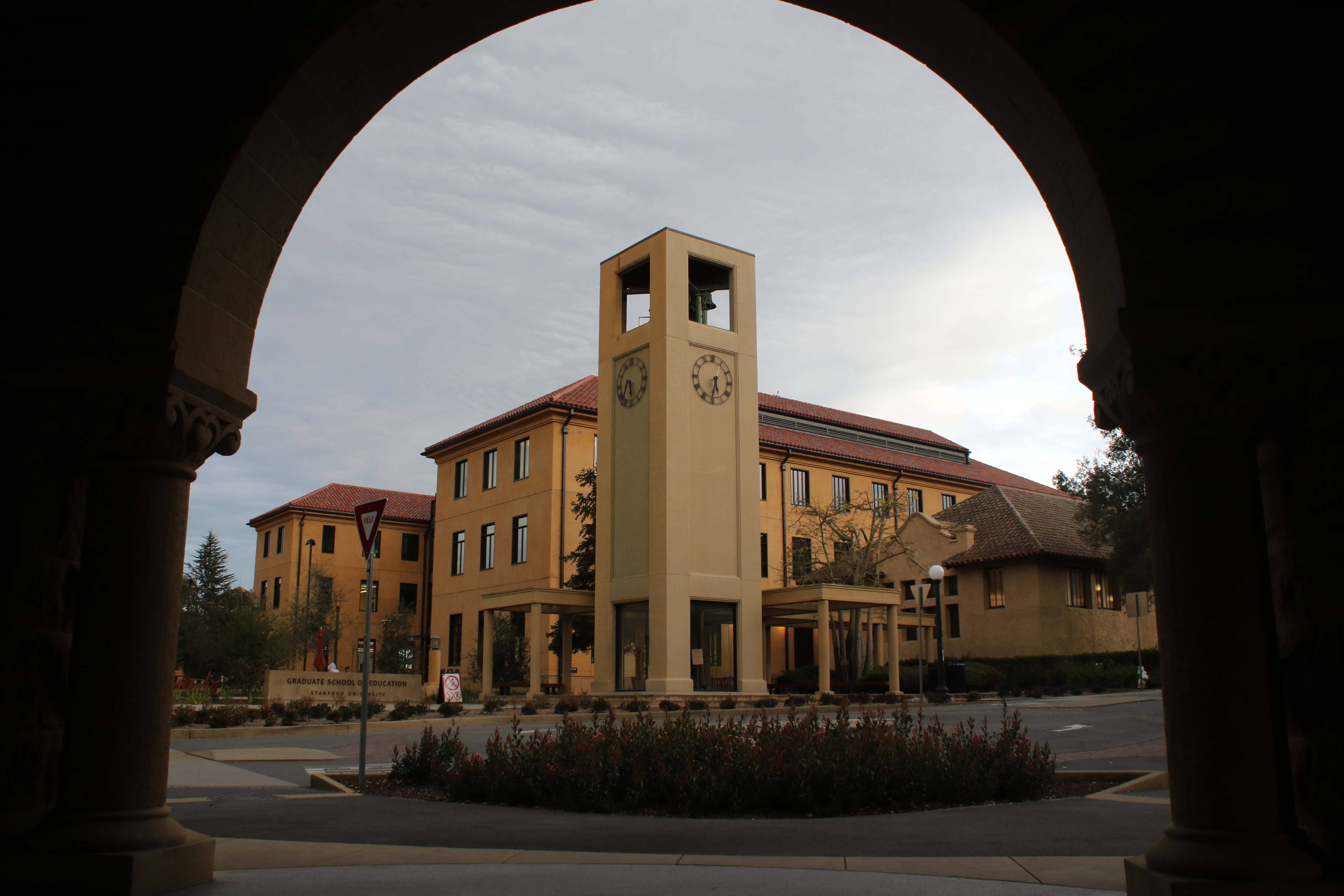
What’s your favorite part of campus? There’s many great choices. Maybe the Oval? Maybe it’s MemChu? What about Hoover Tower? Or, the Dish? (That’s a favorite of one of my closest friends.)
Well, I have another location to add into the mix: the clock tower.
No, not Hoover Tower. The clock tower. No, the Dish does not have a clock on top of it. It’s an actual tower. Right in the middle of campus — better said: the middle of the Graduate School of Education.
Some might think it’s a rather unassuming tower. I would, in fact, agree. It’s just there. Students bike past, dogs pee on the steps and construction comes and goes. Through it all is the clock tower. It isn’t flashy. It isn’t the next MemChu, but I love it nonetheless.
Now, while reading this, you might be thinking to yourself, “Next time I see this crazy kid, I need to ask him: why in the world does he like the clock tower?!” Indeed, I had a friend that when we were answered the inverse of this question — what is one thing on campus you would remove? — he said the clock tower.
Let me answer this question with another story. I was reading a book over winter break by our Vice Provost of Undergraduate Education, Jay Hamilton, called “You Got In! Now What?” It’s a book going over all the ins and outs of college for the newbies. Despite being a sophomore, I still must be fairly green because I learned and took away a lot.
Hamilton gave out various pieces of advice that stood out to me. For example, “going to your extremes” is not necessarily a cool, neat, or even admirable thing if it involves all-nighters, bad eating habits and the alike. However, I would like to wax poetic on one pointer in specific: “Think globally, act locally” — words straight out of Hamilton’s book.
I have someone very near and dear to my heart who embodied this spirit. She wasn’t someone who ran the world — who solved cancer or founded the next $100 million start-up. In fact, she did the exact opposite.
She lived an ordinary life. Had kids, divorced, worked, retired, babysat and eventually passed away. But, her impact was anything but ordinary. She ran one of the few preschools in my hometown for twenty years. She delivered donations every Monday of the month to the local food pantry. She traveled with my church’s youth group to rehouse roofs and build ADA accessible housing for less fortunate people in our area.
When she passed away, my pastor started getting stopped in the streets. Everybody everywhere — even people he had walked by for years without a conversation — wanted to personally give their sympathies and express how big of an impact she had on them.
Remember: she didn’t do anything that changed the world. If you asked for her name in Silicon Valley, no one would have known it. Even if you asked for her name in the next county over from my home, no one would have known it. In many ways, our modern world would define her as a “nobody.” But, she was anything but a nobody. She was a cornerstone upon which my hometown rested.
So, I have been thinking: what does this mean for me? Do I really need to change the world?
The problem, as I see it, is the same one that I often have when writing papers: breadth versus depth. Quantity versus quality. Maybe these people that we have all heard of — and who we all often aspire to be — have really changed the world. But, how much can people feel it? How often can you look into the eyes of someone that you poured your care and love into and see the effects? How often can you get stopped in the streets, not for the autograph, but for a thank you? How often can you have someone hug you, not just to say that they touched someone famous, but to say that they love you?
Don’t get me wrong: depth is not big. It will not allow you to help the 8+ billion people on this planet. However, depth does, in fact, have depth to it. You can serve personally and wholeheartedly the 10,000, 1,000, or 100 people in your small town. You get stopped in the street for it. People who aren’t even your kids or grandkids or even related to you will give testimony to your amazing impact. You will be missed.
I have a friend who I often talk existentially with. One day, we were talking about being remembered and fame and glory. He said to me, “Will, trying to be remembered is stupid. In fact, I want to be forgotten — as soon as I die.”
Being remembered might be stupid, but having an impact is not. Imagine if every town had a hometown hero — an enthralling teacher, awesome soccer coach or inspirational small business owner.
Remember that clock tower? (Yeah, I almost forgot about it myself!) And, in fact, that’s almost the importance: to forget about it. If some visitor asks what they must see on campus, the clock tower probably would even make the top ten list — most people forget about it. Yet, like a hometown hero, I think the impact of the clock tower is anything but forgettable. For me, it’s a cornerstone of campus that I can’t miss. And, it’s a cornerstone that I hope to be for my own community some day in the future.