
Editor’s Note: This article is a review and includes subjective thoughts, opinions and critiques.
Dance is the art of speaking without words. As a fiction writer, such an art has always fascinated me for its restriction of words, the very thing that grants existence to my own form of art. Though dance is perhaps the polar opposite of prose, I find that understanding it can only work to make me a better writer, as both are fated to communicate through movement, though the dancer’s is seen and the character’s imagined. I wonder: is there something the dancer can learn from prose? This question I leave to the dancers, providing the best I can for now, what I consider a love letter to the third annual Young Choreographers Festival.
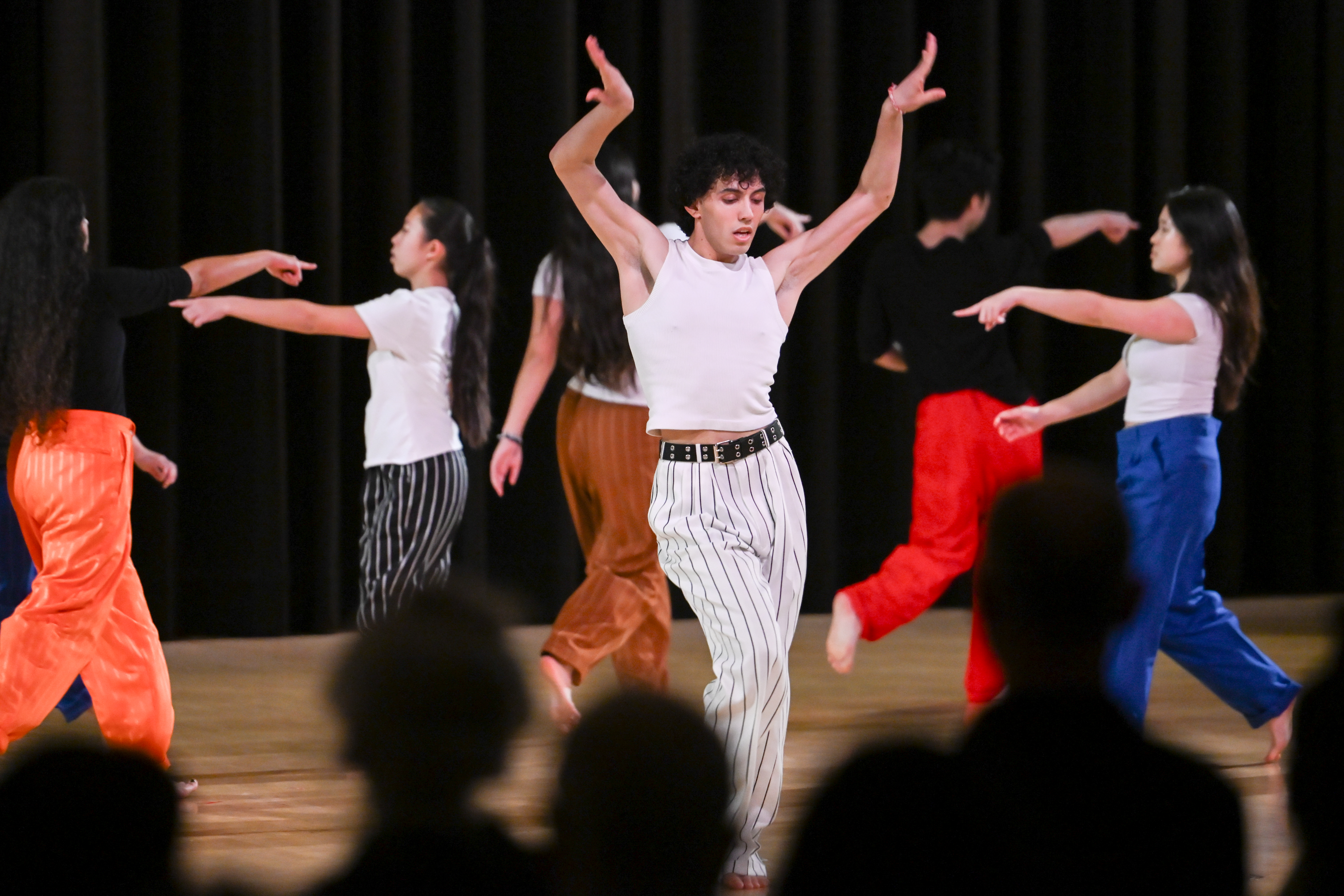
The festival, held in Roble Studio on Feb. 27, featured performances by Stanford student choreographers and student dancers. Organized by dance peer advisor and production manager Denise Robinson ’27 alongside assistant production manager Michael Ohayon ’27, the festival highlighted works from 19 students spanning waacking and contemporary genres. For me, as a writer, every new piece gave rise to a new story, yet for today, I restrict myself to attempting to recount and review the beautiful nature of this event.
The show opened with a slow, soulful piece that transitioned into a groovy and playful hip-hop performance by Eddie Chen ’28 and Mia Clark ’27. Through their performance, titled “When Life Gives You Dance,” the duo hoped to dispel the perception that hip-hop dance lacks meaning.
“We can still tell a story. We can still give an emotion,” Chen said. “[It] doesn’t have to be just contemporary modern ballet that can be able to do that, right?”
In addition to challenging these stereotypes, Chen — who has been dancing since seven years old — and Clark also wanted to communicate the impact of dance on their lives as a whole.
The piece “talks about the way [dance] makes us feel,” Clark said. “It’s this electric feeling, and it makes you feel alive and connected with the people you’re dancing with.”
Many pieces during the festival also included an element of interaction that consumed me throughout their performances. One was the interaction between dance partners Anusha Dwarkanath ’26 and Shreya Komar’s ’26, whose haunting and domineering stares shaped the tone of their performance, “Dvaita.”
Others brought the interaction to the audience. Elle McCue M.S. ’26 performed an emotional piece on the danger of humanity existing too closely with technology. Wearing a contraption strapped onto her chest, she later ran into the audience and asked members to pet it.
Similarly, Ethan Vo ’30 and Ohayon prompted the audience to become a source of their piece’s music, finishing their performance to the beat of the spectators’ clapping.
Others brought about interaction through the use of props: boxes on which dancers leapt and sat alongside each other, mirrors that communicated the complexity and persecution of existence, a piano through which the performers created their own music and flag poles that glided through the air.
Even for those who danced alone, there was interaction. For some, it was the strain and shake of their muscles as they leaped and landed — in a constant battle between gravity and their own strength. Others interacted through the booming nature of every step on the stage, communicating a ferocious presence. Even for those where there appeared to be no interaction, there was the conjunctive work of lips, eyes and eyebrows to convey emotions.
These performances’ passion and devotion to craft left me stunned, as it did other audience members, particularly those who came to see their family members during Family Weekend.
Charlene Connolly, who came in support of her granddaughter Dakota Gelman ’26, said, “I really enjoyed and was surprised at the talent.”
“I’m always amazed at the diversity of the student body and all the creativity that comes out of all of it,” added Michelle Gelman, Gelman’s mom.
Personally, I feel as though the nature of communication has become stilted in recent years, especially on a campus like Stanford, where hustle culture seems ever-present. For students feeling restricted by such a culture, dance is definitely an art worth looking into — whether it be to dance and express their own freedom, or to watch and be inspired by the expression of others.
In organizing the Young Choreographers Festival, “I’m trying to provide opportunities for students interested in taking dance seriously,” Robinson said. “It may be a little scary to say that out loud because you feel like you’re by yourself a little bit, but there are actually a lot of other people who feel that way.”
Dance brings about a freedom you don’t experience in everyday life, even for me as just a spectator. Robinson described: “Let [music] be the wind in the background and be the tree that sways.”
In a technology-driven society, allowing yourself to take a breather and enjoy the intensity and earnestness of art created by your peers can inspire you in insurmountable ways.