
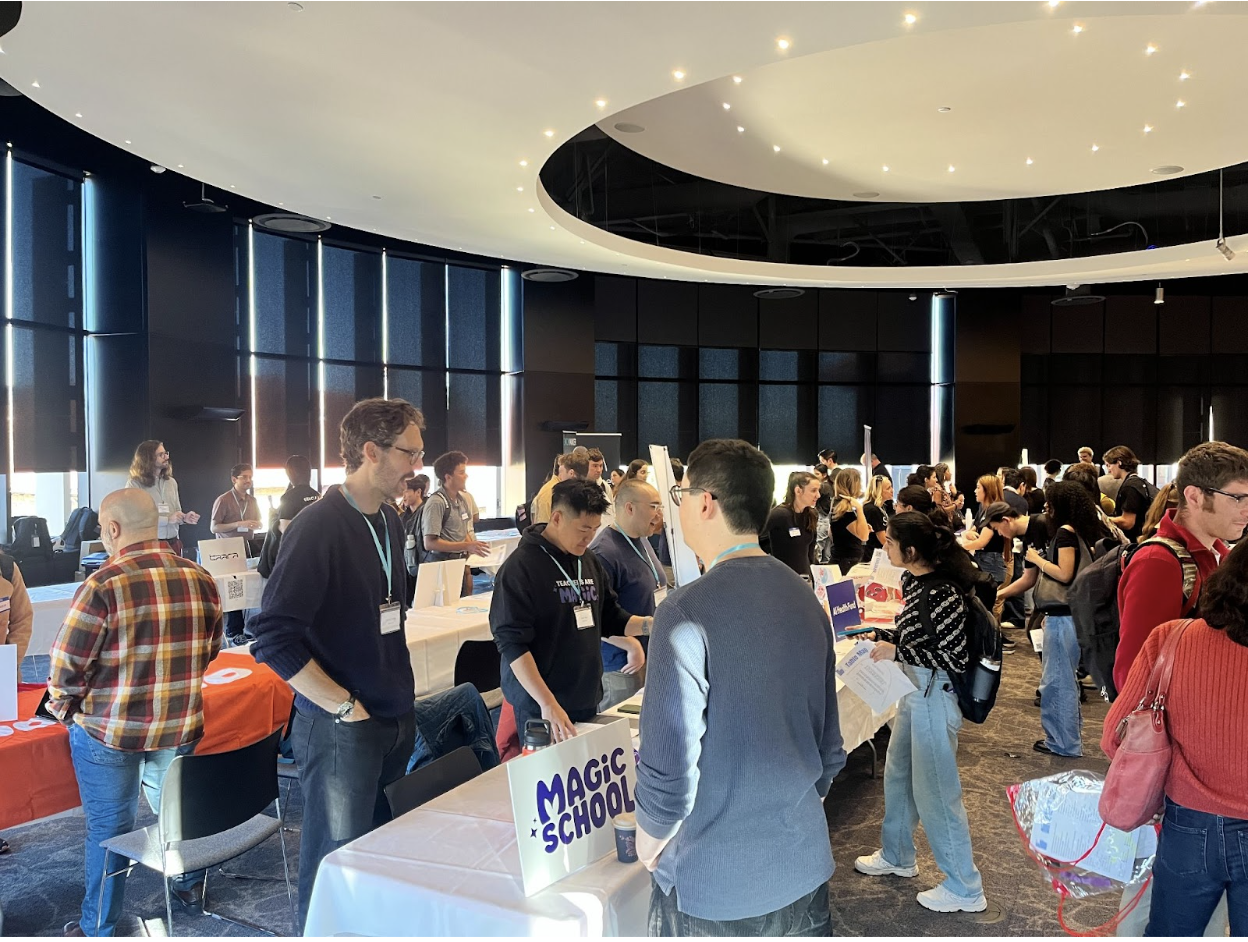
279 students seeking internships, jobs and career path insights attended the inaugural Do Good Now career fair in CoDa on Wednesday.
More than 45 organizations tabled, eager to advertise job openings and hear about students’ interests. Organizations such as GenMD, Teach for America and Coalition of Concerned Legal Professionals represented a broad range of fields from healthcare to education to law.
Organizers Lucy Zimmerman ’25 MS ’26, Georgia Walker-Keleher ’26 and Josh Delgadillo ’26 decided last summer that they wanted to host a career fair focused on social impact.
Zimmerman, who is involved with Stanford Tech for Liberation, is passionate about helping students consider the consequences of their labor. She found that once students understand the potentially harmful impacts of working for tech and defense corporations, they struggle to find alternative career pathways. For Zimmerman, a career fair seemed like an actionable solution to inform students of their options, whether in nonprofits, startups or something else.
On a road trip to Big Sur, Zimmerman asked Walker-Keleher if she wanted to lead a career fair. Walker-Keleher lived in the Otero public service themed dorm her frosh and sophomore years, where service opportunities were readily available. Then, in her junior year, Walker-Keleher and her friends started thinking about careers after graduation. “A lot of my headspace was about what not to do,” she said. “A lot of people come into Stanford and they want to go into banking or work at a nonprofit, but most people are somewhere in between.” Walker-Keleher aimed to reach that group and platform other jobs.
Inspired by the CS+ Social Good career fair last year, Zimmerman and Walker-Keleher reached out to Delgadillo for help.
As CS+ Social Good President, Delgadillo found that many frosh were enthusiastic about the program but lost interest as they got older. “That’s how I got into thinking about how we can make career pipelines more obvious for students,” he said.
Zimmerman, Walker-Keleher and Delgadillo felt the fair could add to the career landscape at Stanford. “We are aiming to show students that they can do things that are good for the world and have it be mainstream,” said Walker-Keleher.
The trio started organizing the event in fall quarter. They received administrative support from the Haas Center for Public Service and CareerEd and mentorship from the Center for Human Rights. “[Deputy Director of the Haas Center] Luke Terra really believed in us from the beginning,” said Walker-Keleher.
Zimmerman, Walker-Keleher and Delgadillo also worked with a coalition of Voluntary Student Organizations (VSOs), including Stanford Tech for Liberation, CS+ Social Good, Stanford Public Interest Technology (PIT) lab and Stanford Students for Educational Equity. “Something unique about this fair having involved a much broader coalition of organizations and people from different spaces on campus is that everybody has some kind of vertical, and that’s definitely broadened the array of companies that we’ve been able to have,” said Delgadillo.
“People’s willingness to help and jump in has been awesome,” Walker-Keleher said. “Shout out to the person in my dorm who connected me with an organization that they worked at last summer. My residents made our logo, and another girl from my dorm just decided today to help chip in on the charcuterie board to make salami flowers.”
Such collaboration was integral to pulling the fair together, so that when the day finally arrived, turnout and students’ enthusiasm were high.
“It was a super success. I never doubted it for a second because from a lot of conversations I’ve had with people, regardless of how much you know about social impact, everyone was interested in a venue to essentially find jobs that were meaningful,” said Zimmerman.
Vaishnavi Kumbala ’29 attended the fair to learn about potential career paths. “One thing that surprised me was the diversity of different options at the career fair. It’s easy to think about a narrow subset when you’re thinking about a career, but it’s cool to explore a lot of different things, and I feel like I was really able to do that today,” Kumbala said.
For Rachel Owens ’26 MS ’27, the fair offered a similar opportunity. As a Mayfield Fellow, Owens is expected to work at an early stage startup over the summer. “I really wish that there was something like this in past years because I got to see a lot of different types of organizations that I may not have been able to see otherwise on campus,” she said.
Priyanka Patel ’29 attended both the Do Good Now career fair and an earlier career fair focused on sustainability. “The one I went to for sustainability was much more Stanford-oriented. So this was definitely different because there were actual companies,” Patel said. “This felt more focused on full-time work as opposed to internships.”
Now, Zimmerman, Walker-Keleher and Delgadillo are thinking ahead to the future of the Do Good Now initiative after they graduate, planning ways to institutionalize the event and its message.
“The spring project is to think about how we can keep [Do Good Now initiative] this awesome grassroots scrappiness and those collaborations between VSOs, while also getting a level of support that makes it lasting,” Walker-Keleher said.
Correction: A previous version of this article overstated the number of students who attended, suggested that the venture capital industry was represented at the fair and suggested that public service careers were its primary focus. The Daily regrets these errors.
Update: This article has been updated to include perspective from Rachel Owens, a senior.