
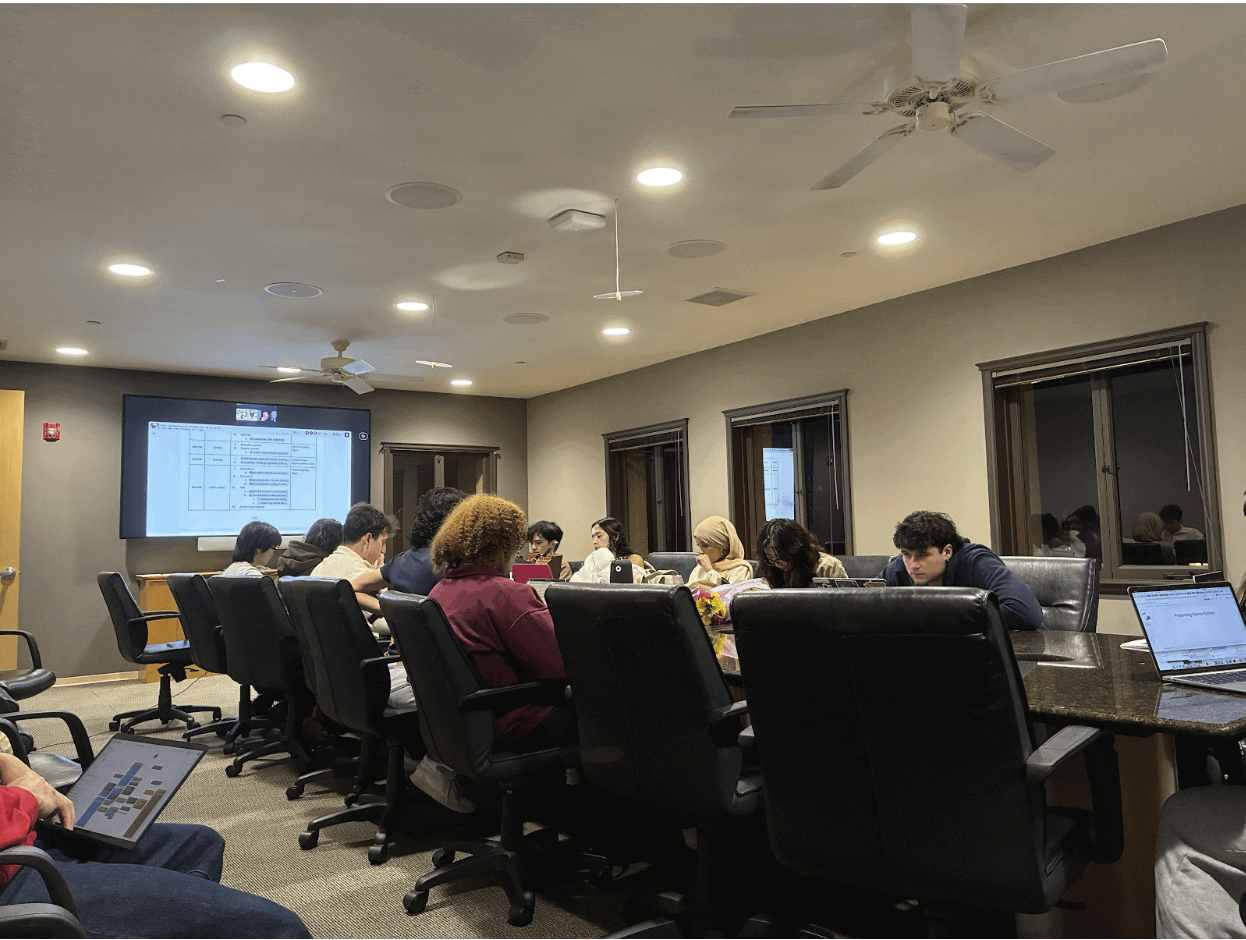
The Undergraduate Senate (UGS) heard presentations from current members of 1115 Campus Drive (formerly Enchanted Broccoli Forest, or EBF) and 586 Mayfield (formerly Kairos) advocating to preserve the co-op community on campus at its Wednesday meeting.
Jules Jackson ’26, a current resident assistant (RA) at 1115 Campus Drive, and Xitlali Ferrel-Alvarez ’27, current house manager, detailed the current situation in regards to the house’s co-op status and called for the protection of its co-op culture.
EBF was suspended in July 2025 following a Title VI investigation into the house. Ferrel-Alvarez said that the house’s co-op status remains in threat for the 2026-2027 academic year, with the Undergraduate Residences Governance Council (URGC) rejecting the house’s Committee on Residential Learning (CoRL) application to be reinstated as a co-op for the following year. The URGC stated that there hadn’t been enough time to establish whether or not the house was capable of self-governing.
Jackson noted the positive impact EBF has had on Stanford’s campus, especially in providing a space for creative expression through hosting outside artists and providing a hub for many creative and ethnic-themed student groups. Ferrel-Alvarez also discussed the harms that not reinstating 1115 Campus Drive as a co-op will have on the house.
“Co-ops run on intergenerational knowledge,” Ferrel-Alvarez said, adding that a one or two year gap in co-op status can have significant effects on the success of the house in the future.
“Momentum is key; a well-run EBF inspires the next set of pre-assignees,” said Ferrel-Alvarez. The presenters from EBF asked the UGS to support their efforts to be reinstated as a co-op in the 2026-27 academic year and be a part of the spring 2026 pre-assignment pool.
Following this, the UGS also heard a presentation from current 586 Mayfield members. Gisele Knaebel ’27, the current financial manager of 586 Mayfield, described the history and purpose of Kairos. She characterized the house as a place which focuses on art and uplifting marginalized communities at Stanford, with its kitchen and food being the center of much of the culture.
“It’s been a really valuable and life-changing community for a lot of people on campus, and a place where students can feel uniquely connected to one another, because their work is caring for each other and being accountable for each other,” said Knaebel.
Ethan Alfonso ’27, current resident of 586 Mayfield, summarized the timeline of the house’s status, starting with the suspension of its co-op status in July 2025. Alfonso said that the house’s CoRL application decision was deferred by URGC, adding that Cheryl Brown, Assistant Vice Provost for Residential Education (ResEd), confirmed that 586 would operate as a self-op without a communal kitchen in the 2026-27 academic year. Alfonso also expressed concern at a lack of student-led hiring next year.
“The main thing again, is that there is going to be this discontinuity between the RAs who are coming in, hired externally, who might not know anything about having a kitchen… [who] also don’t receive additional training,” said Hawthorn Bolger-Witherspoon ’26, the current community manager of 586 Mayfield.
Bolger-Witherspoon said the loss of a communal kitchen impacts not only the co-op members, but also the farmers and producers the co-ops have relationships with. She said one of the farms 586 works with, for example, receives around 80% of their income from co-ops.
“It’s important to note that, like with EBF, this transition would be more costly to the university than it would be beneficial… it would be a huge amount of investment and change in the house for something that’s not even meant to last that long,” said Knaebel.
The presenters asked the UGS to support their efforts in maintaining their communal kitchen, and to have greater transparency around the process of reinstating their co-op status.
Following these presentations, the UGS unanimously voted to pass the Joint Resolution to Reinstate Cooperative Status at 1115 Campus Drive and 586 Mayfield for the 2026–2027 Academic Year. This bill asks ResEd to review the houses’ CoRL applications in spring to reinstate their co-op status for the 2026-27 academic year. The bill now moves to the Graduate Student Council (GSC) for a vote.
The UGS also voted to pass the Joint Bill to Submit a Constitutional Amendment Restructuring ASSU Fee Disbursement and Reserve Deposits. This bill proposes two constitutional amendments to be voted on during the Spring 2026 General Election ballot. The proposed amendments will remove outdated language on funding from the ASSU constitution and make it so that student organizations’ future unspent fees return to a general pool that can be redistributed in future years. The bill will next be voted on by the GSC.
“Whether or not you agree or are going to vote yes or no on the constitutional amendment, the power of direct democracy can be bestowed upon our constituents very soon,” said UGS chair David Sengthay ’26.