
In “Culture of Craft,” Quinn Cook ’29 documents the culture of craft, those who practice it and what we might learn from them.
Mark Shunney is a Ranger, but he doesn’t work for the National Park Service. Rather, he is the Public Arts Ranger here at Stanford, educating the community about the diverse array of outdoor art on offer through walking tours and outreach programs. An artist working in various media, Shunney reached out to me reflecting on the first installment of this column, “How to be a craftsman.” In no time, we began a conversation about crafts and the arts here on campus.
Though his Stanford Arts profile will tell you he began his career in New York City, Shunney’s experience with craft began long before in Rhode Island, where he grew up with Heidelberg presses and lead type in the household. “Printing,” he told me, was what “really started my appreciation for craft.”
Though these various printing tools belonged to his father, they were also his to experiment with. When he was no more than 12, Shunney and his brother set up a private investigator business, creating and mailing letterpress business cards to addresses from local police logs. When two detectives came by, brandishing the stationery and a stern attitude, they were directed to the two tween detectives.
Shunney said he told this story, partly, to show how printing was “engaged and imbricated with all aspects of [his] life.” Shunney maintained his relationship with printed matter and the written word throughout his artistic journey. During his undergraduate days, he created installation art with truckloads of discarded library books, and, more recently, his work focuses on four-letter words.
As I was led through the emplotted arc of his art thus far, I couldn’t help but picture a winding labyrinth with printing at the center: sometimes drawing quite close to words, sometimes straying farther away, but consistently in correspondence with them. I began to wonder: “What motif will I find in my own craft?”
As a mere college undergraduate, I have little perspective on my journey thus far, nor any real clue of what’s ahead. Nonetheless, it was fun to roll the idea around in my mind: What will be important to me later on? Which experiences will I keep returning to? Who might I look to for inspiration?
We often think of college as adding purely professional skills to our repertoire that will later help us in the working world, but an equally important facet of education is engaging with art, craft and creation. Physical craftsmanship rounds our perspectives, giving us experiential material and teaching the soft but durable skills that seep even into professional life. To my knowledge, no employer has ever complained of too thorough an accountant, too patient a doctor or too adaptable a lawyer.
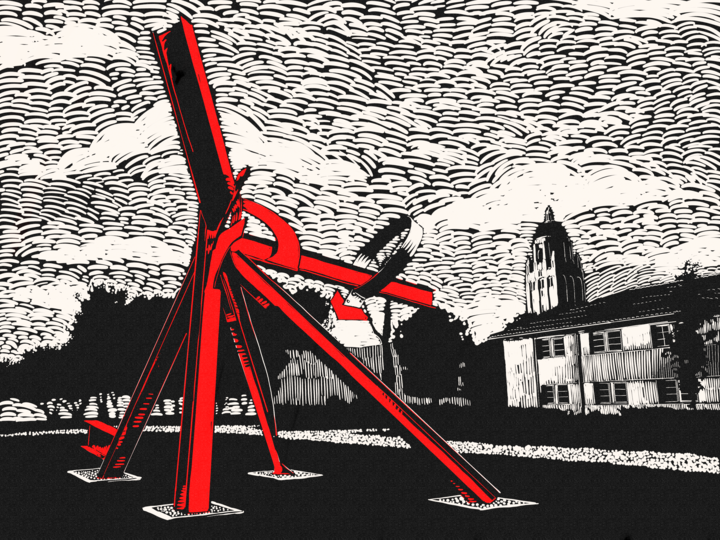
I argue, then, that our attunement to creation and the arts deserves at least as much intentionality as our course enrollment or newest job application. We have an abundance of opportunities for that here: there are over 85 pieces of outdoor art on campus, each with their own histories, that are walked, biked and scooter-ed past without a second thought — including by me. When Mark began detailing the intricacies of a particular di Suvero piece, I realized it was the giant, bright red sculpture that lives no more than 20 paces from my door at Crothers, but which I had known nothing about until then.
If we students are to make the most of our experience here, we must utilize everything campus has to offer — academic, social and creative alike. My conversation with Shunney showed me this balance isn’t a zero-sum game. In choosing what our college years will include, we must remember craft doesn’t take away from our scholastic preparedness or professional success, but enriches us in all areas of our lives.
Shunney’s own family is a prime example of this harmony. His dad, who has been setting lead type since adolescence, was educated as a chemist. His brother, who helped him build wooden cabins in abandoned gravel quarries, worked in commercial finance for much of his career. In this vein, craft isn’t something to be “earned” after a grueling and miserable career; it is co-present and in dialogue with our work.
As students, our coursework is only one of our responsibilities. Our larger project is to choose, with intentionality, to craft our Stanford experience. To ignore the vibrant arts scene, to forgo classes in the d.school or to skip past the abundant maker spaces on campus is to leave half our education on the table. Don’t misunderstand me: craft at Stanford is not a lost heritage, but it is one in need of careful reemphasis. The very Ranger Station that Mark and I sat in as we spoke was built by Stanford students from a felled tree — evidence of the craft tradition here on campus, just waiting to be tapped into.